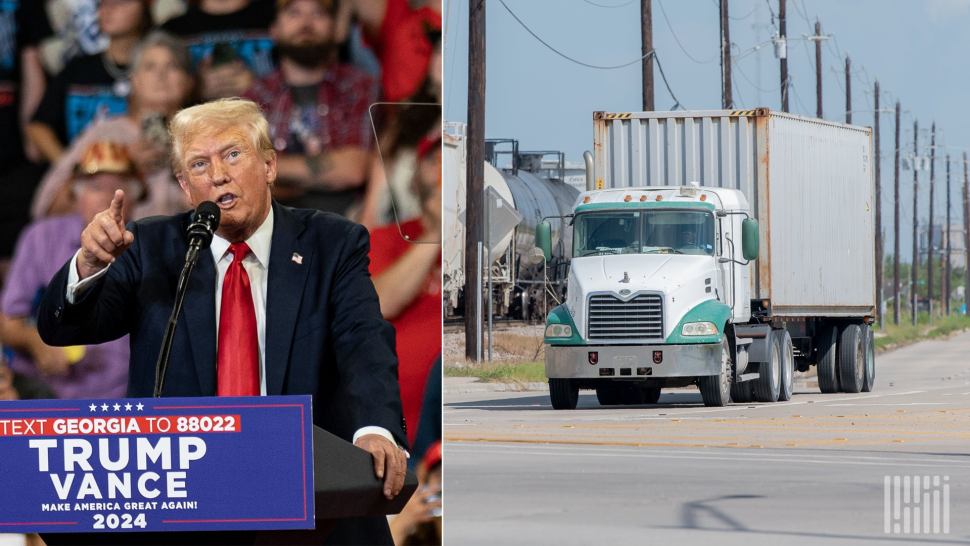
President Donald Trump announced Friday he will impose a new 10% global tariff under a different trade statute, hours after the Supreme Court struck down many of his prior tariffs as unconstitutional.
The high court ruled 6-3 that Trump exceeded his authority under the International Emergency Economic Powers Act (IEEPA) by imposing broad “reciprocal” and country-specific tariffs tied to trade deficits and fentanyl enforcement
The decision marked a significant setback for Trump’s emergency-based tariff framework. Chief Justice John Roberts wrote that IEEPA “contains no reference to tariffs or duties” and could not be interpreted to give the president unilateral power to impose sweeping import taxes
Within hours of the ruling, Trump unveiled what aides had described as a “Plan B,” signaling that tariffs would remain central to his trade agenda.
At a press conference, Trump said he would sign an executive order applying a 10% tariff on imports from all nations under Section 122 of the Trade Act of 1974
“Today, I will sign an order to impose a 10% global tariff under Section 122, over and above our normal tariffs already being charged,” Trump said, adding that existing Section 232 and Section 301 tariffs would remain “fully in place.”
Related: Supreme Court curbs Trump’s tariff powers, reshaping 2026 trade outlook
Unlike IEEPA, Section 122 explicitly limits both the duration and scope of tariff actions. The provision allows temporary import surcharges of up to 15% for a maximum of 150 days unless Congress approves an extension
The statute, originally enacted during the 1970s amid concerns over trade deficits and balance-of-payments pressures, was designed as a short-term emergency tool — not a long-term trade policy mechanism.
Section 122 has never previously been invoked, making this the first time a president has used it to impose across-the-board global tariffs.
While the Supreme Court ruled against Trump’s use of IEEPA to impose tariffs, the court declined to address whether importers must be refunded for tariffs already paid. One dissenting justice warned refunds could total billions of dollars.
The invalidated tariffs had generated roughly $130 billion in revenue as of mid-December, according to U.S. Customs and Border Protection data cited in court reporting.
Trump also announced plans to initiate additional Section 301 investigations targeting alleged unfair trade practices, a move that could pave the way for more durable, country-specific tariffs.
Section 232 national security tariffs — including those on steel and aluminum — remain unaffected by the Supreme Court ruling.
Brokerage Compliance Symposium
The day before F3. Every compliance issue you face - fraud exposure, carrier liability, FMCSA rules, cargo theft, insurance gaps - navigated by attorneys and operators defining best practices in a changing industry.
F3 Awards Dinner
The night before F3. FreightTech100 companies honored. FreightTech 25 and Shipper of Choice winners revealed live. Cocktail reception into dinner and live music - 300 industry leaders in one purpose-built room.
F3: Future of Freight Festival
Industry-defining keynotes, rapid-fire technology demos, and industry leaders networking in experiences across Chattanooga - plus the inaugural F3 Awards Dinner featuring the FreightTech and Shipper of Choice reveals.
The day before F3. Every compliance issue you face - fraud exposure, carrier liability, FMCSA rules, cargo theft, insurance gaps - navigated by attorneys and operators defining best practices in a changing industry.
The Signal at Chattanooga Choo Choo • Chattanooga, TN Register NowThe night before F3. FreightTech100 companies honored. FreightTech 25 and Shipper of Choice winners revealed live. Cocktail reception into dinner and live music - 300 industry leaders in one purpose-built room.
The Signal at Chattanooga Choo Choo • Chattanooga, TN Register NowIndustry-defining keynotes, rapid-fire technology demos, and industry leaders networking in experiences across Chattanooga - plus the inaugural F3 Awards Dinner featuring the FreightTech and Shipper of Choice reveals.
The Signal at Chattanooga Choo Choo • Chattanooga, TN Register Now