When Trucking Freight Futures kicks off on the Nodal Exchange on March 29, there are a few features it won’t have that can be found in long-standing futures contracts in other commodities. But that doesn’t mean they won’t get there eventually.
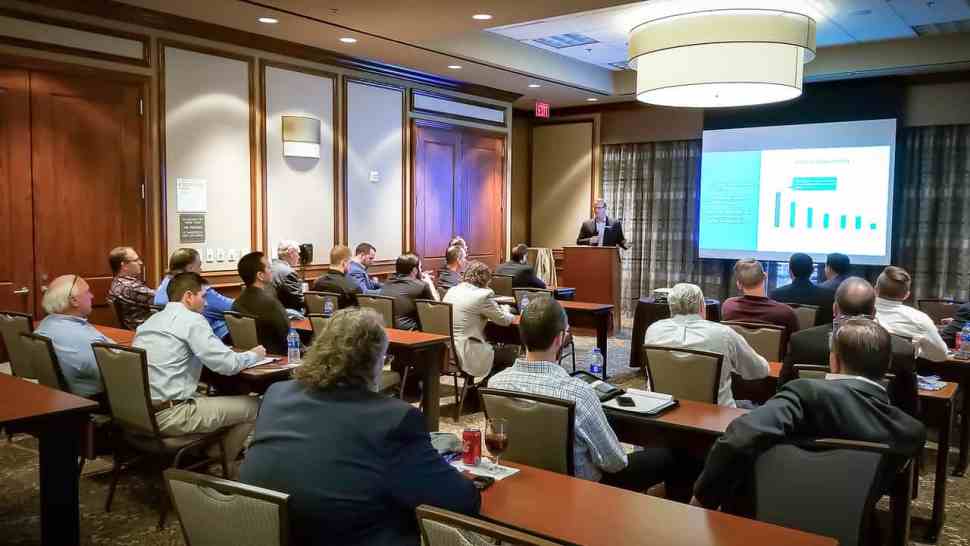
On the third stop of the current road show for potential investors in freight futures, questions from the audience in Houston – where energy futures trading is at the core of the city’s oil and natural gas commercial sector – focused on what the contracts will have beyond the ability to trade on the price of freight in key lanes.
As with earlier road shows in Chicago and New York, the ins and outs of the contract were presented by representatives from the three partners on the project: FreightWaves, which created the idea for Trucking Freight Futures and is leading the marketing effort; DAT, whose numbers on the price of moving truckload freight on key lanes will provide the settlement mechanism for the cash-settled contract; and the Nodal Exchange, whose platform will be the home of the contract.
For example, an audience member questioned whether options on the futures contract will be launched at the beginning of its life. A call option provides the owner the right, but not the requirement, to buy the commodity in question – oil, gold or a freight futures contract – at a designated price at a designated time in the future. A put option does the opposite, allowing the owner of the put the right but not the obligation to sell a contract at a designated price at a designated time.
Options are a key hedging tool, because they can require a far smaller initial outlay for a company to protect itself. For example, if an oil company wants to protect itself from a collapse in prices to less than $50/barrel, it can sell a put allowing it to sell oil to the owner of the the put at $50 if the price is less than that. (If the price is more than $50, there obviously is no reason to exercise the put.)
The downside is that if a company pays a certain amount for an option and then never exercises it, that money is 100 percent gone. But the money did provide the protection the company was seeking. It’s like buying auto insurance and never needing it; a service was still provided.
But the price of options on all commodity markets is very much a function of volatility. Without a history of how freight futures trade on Day 1, there is no volatility to measure, making the pricing of options problematic if not impossible. Tom Mallon, a vice president at FreightWaves directing the freight futures initiative, said the contract on Nodal will just be only futures at the beginning of the contract. Options could be listed “down the road,” he said, depending upon customer input.
To help create that volatility and volume, commodity exchanges often employ market makers who at all times are required to post a bid/ask spread. With that in place, there is never a time at which a company desiring to buy or sell a contract would be unable to get it done.
Mallon said the contract’s sponsors are “in discussion” with companies that would serve as market makers for Trucking Freight Futures contracts. He added that the contract backers “do intend to have liquidity providers making two-way markets on the screen.” However, there needs to be further discussions about the potential role of a market maker for block trading, where an off-exchange deal is brought to Nodal for clearing and what role is required for market makers there.
In other discussions during the presentation, Demetri Karousos, the chief risk officer and managing director of Nodal Exchange, reviewed the two numbers that will be produced on a daily basis for the contract. Nodal itself will produce a settlement price twice a day, based on the prices traded on the exchange. Such a settlement is used for such things as a company requirement to mark to market its price exposure – required by rules of accounting – and also as a benchmark for whether a company’s position requires additional funding, known as margin. Commodity contracts have minimum required margins to reduce excessive speculation. (The most extreme recent case of margin requirements saw exchanges in 2017 require margins for trading bitcoin many multiples of normal margin requirements for their other contracts.)
The second number is the DAT daily settlement. That is produced every day on a five-day lag from prior trading. Although the contract has not launched, DAT has been producing the number.
As Tony Salazar, DAT’s CFO said, the five-day lag is because “we want to make sure we have sufficient records to make a statistically significant number.” Additionally, adjustments are made in the number to ensure that no one company’s activities are over-weighted in the settlement, he said.
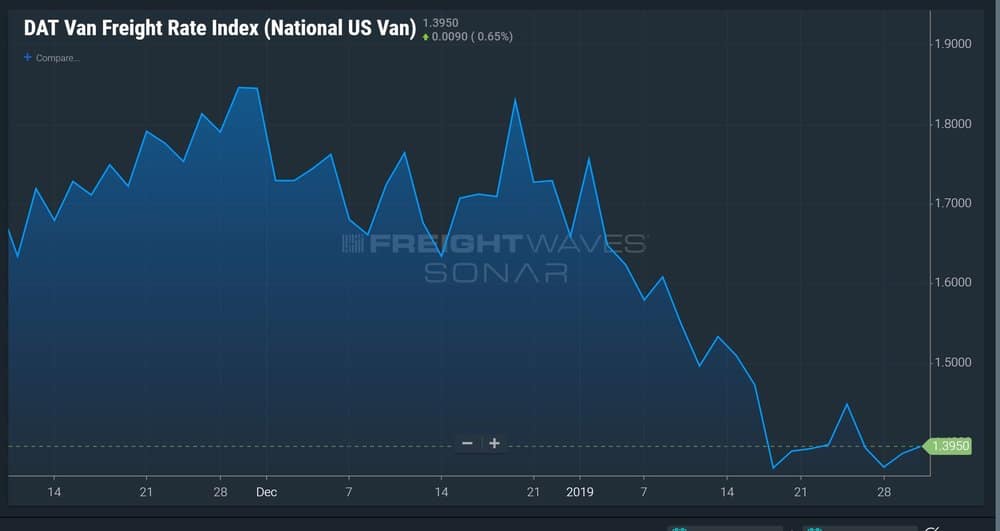
Salazar also said the number is for transportation only; DAT scrubs it of things such as hazmat charges or accessorials. The number is not trade-weighted. It is a straight price average, he said.
It is the average of that number that will settle open positions after a month’s contract is completed. For example, five days after the close of May, the DAT average for the month will be posted based on a straight average of the DAT daily settlements for May. Open positions will be settled at that number. But since it is an average of a series of daily assessments, the final number won’t be a surprise. The individual pieces will be produced every day and the last day of the month is just the final unit to go into the average. Nobody should be shocked by it.
That’s what a cash-settled contract does; as Michael Vincent of FreightWaves noted, since it is a cash-settled contract, no truck will ever be delivered to the holder of a long Trucking Freight Futures position and no seller of a Trucking Freight Futures contract will be required to deliver a truck to its counterparty. (By contrast, a physically delivered contract such as crude oil on CME can and does result in actual oil being delivered, albeit a small percentage of total volume.)
The DAT end-of-month settlement, while being absolutely vital as the closing number when a monthly contract expires, might mean nothing to some participants. For example, if the buyer of a contract on the 5th of a month then sees the market rise and decides to sell that contract a week later, the end-of-month number of DAT becomes irrelevant to that seller because it won’t have an open position on the final day of the month.
Brokerage Compliance Symposium
The day before F3. Every compliance issue you face - fraud exposure, carrier liability, FMCSA rules, cargo theft, insurance gaps - navigated by attorneys and operators defining best practices in a changing industry.
F3 Awards Dinner
The night before F3. FreightTech100 companies honored. FreightTech 25 and Shipper of Choice winners revealed live. Cocktail reception into dinner and live music - 300 industry leaders in one purpose-built room.
F3: Future of Freight Festival
Industry-defining keynotes, rapid-fire technology demos, and industry leaders networking in experiences across Chattanooga - plus the inaugural F3 Awards Dinner featuring the FreightTech and Shipper of Choice reveals.
The day before F3. Every compliance issue you face - fraud exposure, carrier liability, FMCSA rules, cargo theft, insurance gaps - navigated by attorneys and operators defining best practices in a changing industry.
The Signal at Chattanooga Choo Choo • Chattanooga, TN Register NowThe night before F3. FreightTech100 companies honored. FreightTech 25 and Shipper of Choice winners revealed live. Cocktail reception into dinner and live music - 300 industry leaders in one purpose-built room.
The Signal at Chattanooga Choo Choo • Chattanooga, TN Register NowIndustry-defining keynotes, rapid-fire technology demos, and industry leaders networking in experiences across Chattanooga - plus the inaugural F3 Awards Dinner featuring the FreightTech and Shipper of Choice reveals.
The Signal at Chattanooga Choo Choo • Chattanooga, TN Register Now