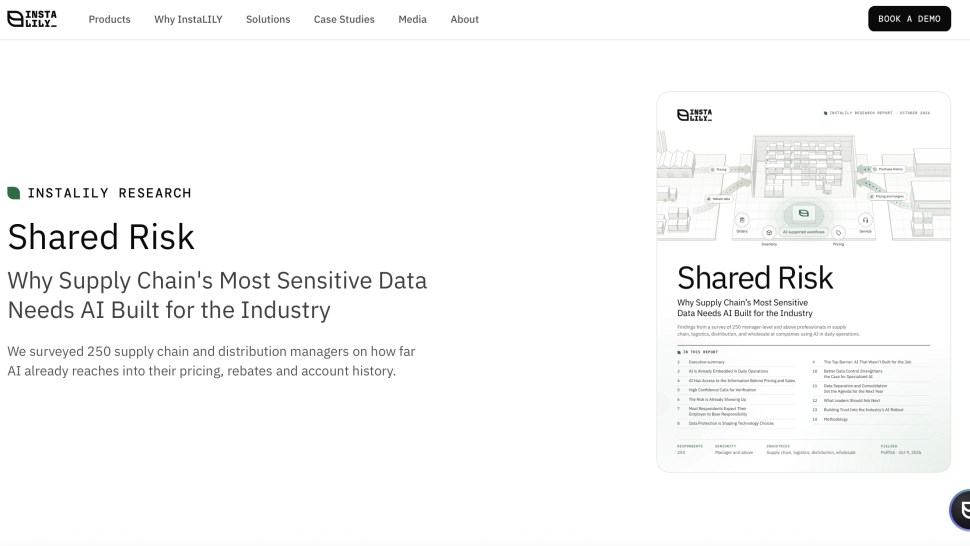
One in six supply chain, logistics, distribution and wholesale professionals said their company experienced an incident in the past year in which supplier or customer information was exposed through an artificial intelligence tool, according to a new industry survey.
The findings come as businesses increasingly give AI systems access to sensitive commercial information, raising questions about how the technology handles confidential data belonging to customers and suppliers.
The survey was conducted by InstaLILY, which develops AI agents for distribution, and was fielded through Pollfish. Launched Oct. 9, 2026, it collected 250 responses from managers and executives at companies using AI in their daily operations. It found that 78% of respondents said their company’s AI tools could access customer pricing and margins, while 67% said the tools had access to supplier pricing and rebate information.
InstaLILY defined an incident as a situation in which supplier or customer data was exposed, shared or accessed incorrectly through an AI tool. The results reflect respondents’ reported knowledge and experiences, rather than independently verified data exposures. Also, the report did not assess the severity of the incidents, meaning the findings do not distinguish between minor internal mistakes and more serious incidents.
The survey also found that 63% of respondents said their company had been asked by a supplier or customer how it protects their information. For 30%, those inquiries had influenced a decision involving a software provider, vendor or AI tool.
“Speed means very little if a faster answer costs you a relationship that took years to build,” said Adam Isenberg, head of distribution at InstaLILY. “AI working in distribution should know that one customer’s contract price never belongs on another customer’s quote. Buyers should make vendors prove that before they sign.”
Despite the reported incidents, confidence in existing AI safeguards remains high. Eighty-seven percent of respondents said they were very or somewhat confident their AI tools kept supplier and customer information appropriately separated. However, 63% acknowledged some overlap between supplier and customer data across their company’s platforms, including AI tools.
The survey reflects broader concerns about AI security, going beyond just the logistics industry. IBM’s 2025 Cost of a Data Breach report found that 13% of surveyed organizations had experienced a breach involving AI models or applications. Among those organizations, 97% reported lacking proper AI access controls. The report also found that breaches involving unauthorized AI tools, commonly called shadow AI, added an average of $670,000 to breach costs.
InstaLILY found that the most commonly cited obstacle to separating supplier and customer information was that existing AI tools were not designed with that requirement in mind, which was cited by 22% of respondents. Cost and a lack of technical expertise followed at 21% and 20%, respectively.
Nine in 10 respondents said their employers would be more likely to select an AI tool specifically designed for distribution and supply chain operations if it offered stronger controls over supplier and customer data. Meanwhile, 92% said data separation was a high or moderate priority for their company over the next year.
The report recommends testing AI systems against routine business scenarios, including whether a tool can prepare a customer quote without exposing confidential supplier pricing or contract terms. It also recommends establishing when human approval is necessary before AI systems act on information.
Why this matters
AI tools are gaining access to sensitive commercial information, including customer pricing, supplier contracts and rebate data. For logistics providers, distributors and wholesalers, a data exposure could damage relationships with trading partners and influence which technology vendors companies choose.