





For much of the past three years, freight was cheap enough to ignore. Shippers could lean on the spot market, push problems downstream, and skip the hard conversations about how their networks were built. That window has closed. As shippers finalize 2027 budgets, climbing transportation costs, tariff uncertainty, and a new Congress taking shape are forcing questions many had put off.
Chuck Papa, president of transportation management at NFI, has watched the shift happen in real time. With roughly 30 years in the industry, he says the current moment stands out. Geopolitics, Papa said, has been “the biggest roller coaster of impact we’ve probably seen since the 30 years I’ve been doing this.”
Rate volatility returns to the boardroom
The most common question NFI hears from customers planning for next year is what the market will do. The era of not worrying about rates, Papa said, is behind shippers. Because tariffs and policy remain unpredictable, NFI is steering customers toward flexibility. “Let’s be resilient and flexible, so we can deal with these as they occur,” he said.
Rising costs are also changing who is paying attention. “When transportation rates are low, nobody thinks about the overall cost,” Papa said. But “over the last six months, rates have gone up dramatically,” and that has put transportation spending in front of board-level executives who had not been asking about it. The result, according to Papa, is a broader conversation about the cost of the entire supply chain, not just the freight bill.
The spot market hangover
One of the clearest consequences of the freight recession is what happened to carrier relationships. Papa said shippers who have leaned heavily on the spot market have felt the most pain. “A lot of the shippers that have played the spot market didn’t really maintain relationships with carriers, and they’re now paying the price,” he said.
The fix is neither complicated nor new. “We can’t move freight without carriers,” Papa said, so NFI has encouraged shippers to rebuild strategic relationships that slipped during the downturn. That also means avoiding the opposite extreme. “You don’t want to have too many carriers either,” he said, since spreading volume too thin weakens the leverage a shipper has with any one of them.
Papa said the performance gap shows up in the data. As an example, he pointed to payment: “We’ll never go beyond 30-day payment terms.” Many shippers, he added, still treat carrier selection as a procurement event rather than a strategic one. Newer logistics professionals face a learning curve too. “They have never dealt with a tight capacity market,” Papa said of those who entered the industry in the last three years.
Transportation doesn’t start at the dock
If rebuilding carrier relationships is the first priority, the second is looking upstream. Papa described a customer shipping LTL from a Greater Philadelphia facility to Southern California. The customer’s focus was getting freight out the door the moment it was available, and its teams, in Papa’s words, “focus on shipping, not delivery date.” NFI had long argued that holding and consolidating freight, using multi-stop truckload or a cross-dock, could improve both service and cost. With rates low, there was little appetite to hear it. Now, Papa said, the customer is willing to take the conversation across its organization.
That means revisiting basics such as minimum order quantities and correcting the transit times in customers’ ERP systems. “It is better planning and optimization,” Papa said, describing “that shift back to much more of a supply chain conversation versus just transportation.”
The lesson, as Papa framed it: “Transportation doesn’t start when the product becomes available on the dock. It starts much sooner.”
What separates strong partners from the rest
Asked what makes a carrier or partner worth keeping, Papa kept the answer simple. It is “those that will listen and collaborate,” and who stay flexible as carrier networks change. Some carriers simply can no longer serve a lane the way they once did, and the productive response is to find alternatives rather than insist the carrier fix it.
For shippers evaluating a managed transportation provider, Papa said the green flag is providers who expand the conversation beyond just transportation. Providers that raise supply chain issues beyond the dock door are the ones who can challenge a shipper’s thinking. The red flag is a provider more focused on its own assets or internal services than on the customer’s outcome. “If you have to constantly bring ideas to them, that to me is a red flag versus them bringing ideas to you,” he said.
The best providers, Papa added, act as “an extension of their customers,” often joining annual operating plan discussions. NFI also looks across its own book of business for matches that benefit both parties. “How can we network our customers together where there are synergies for them,” he said, citing backhaul opportunities as one example.
AI moves network design from annual to continuous
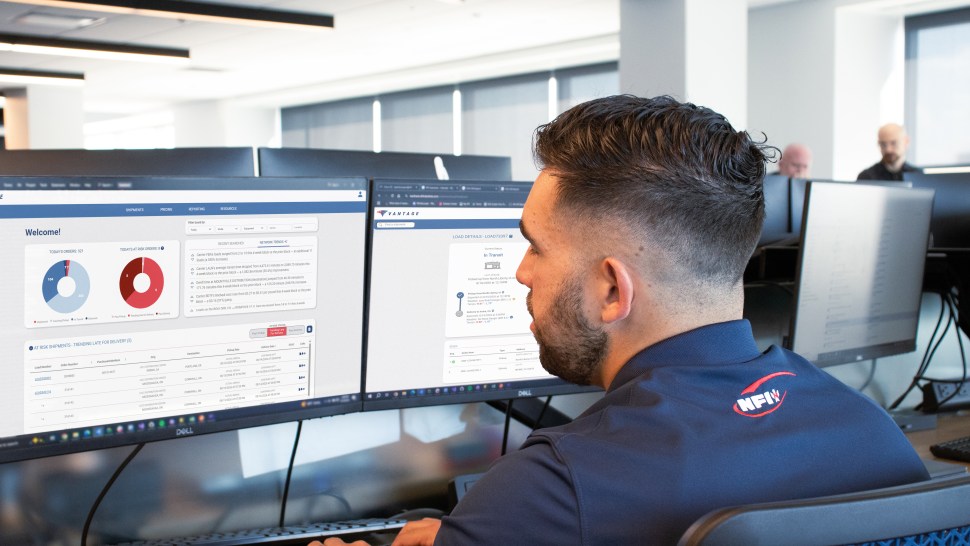
When it comes to data analysis, Papa pointed to AI. Traditionally, network design is a periodic project, often done about once a year. NFI has embedded AI into Vantage, its control tower, so the analysis runs continuously and flags changes to NFI’s operators, such as how the past four to six weeks compare with the same period a year earlier. Papa calls the approach “a dynamic freight network design versus static.”
Another example is the detection of a new lane that lacks a contracted rate. The system recognizes when volume on the lane is high enough to justify a mini bid and prompts a user to run one. That is the generative stage, Papa explained. The next stage is agentic: putting the bid out, procuring the carrier rate and updating the transportation management system automatically.
Papa doesn’t see this as displacing the people involved, calling it “an evolution.” The goal is to let operators act on changes as they happen, because by the time a quarterly review catches an issue, “it’s too late.” He expects “the days of doing annual or biannual network studies are going to be gone and replaced with a real-time network assessment.”
Why shippers outsource transportation management
Papa was also asked why a shipper should partner with a transportation management provider at all. For most companies, he said, logistics is a back-office function, while for NFI “it’s front office. It’s what we do and breathe every day.” He contrasted that with customers who adopt a TMS as software alone: after year one or two of good results, “it drops off because they don’t have the ability to retain, train, and continue to advance their capabilities.”
Scale also helps with seasonality. Papa said some NFI customers see huge spikes at certain times of year and then slow down. Rather than staffing to peak, “We’ve made that a design variable,” he said, adjusting technology and resources as demand changes.
The 2027 takeaway
Asked for one recommendation for shippers planning 2027, Papa gave two: build carrier relationships and “look beyond the dock.” Shippers that do both, he said, will be better positioned for whatever the market does next.
