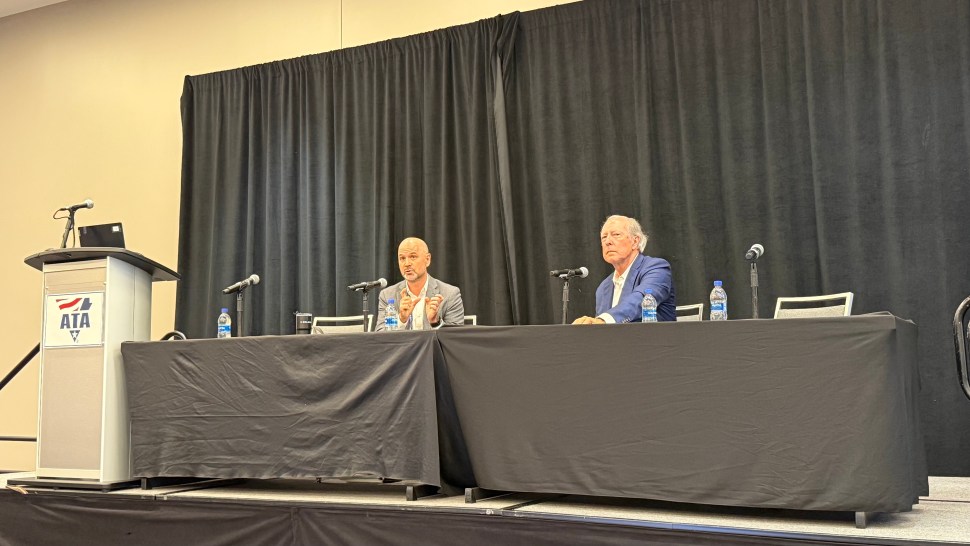
CHARLOTTE, N.C. — Nuclear verdicts against trucking companies rarely grow out of the facts of the crash itself, according to trucking defense attorney Doug Marcello. Plaintiff attorneys look for evidence of systemic failure, and Marcello said AI-only dash cams are giving them a new place to find it: risky driving the camera recorded but the AI never flagged.
That leaves fleets answering for footage their safety teams never coached. Marcello, a shareholder at Saxton & Stump, made the case at the American Trucking Associations’ Management Conference & Exhibition in Charlotte, North Carolina, on a panel with Sean Ritchie, a vice president at Solera Fleet Solutions. Solera, which sells video safety systems with a human review layer.
The panel came days after a Dallas County judge upheld a $604 million jury verdict against C.H. Robinson. The case stems from a 2021 crash in Jackson, Mississippi, that killed three people and the truck’s driver. Motor carriers ranked lawsuit abuse reform as their top concern in the American Transportation Research Institute’s 2026 Top Industry Issues report, released Oct. 18 at the conference. Lawsuit abuse reform also ranked second overall.
Marcello, who received the Trucking Associations Executive Council’s J.R. “Bob” Halladay Award in July, said fleets should treat any footage they hold as discoverable.
“If you have the activity of the driver captured by the video, you’re going to be responsible for it,” Marcello said. “And the defense or being able to say, wait, well, AI didn’t pick it up is not going to be the response. It’s not going to be an excuse.”
How AI changed camera review
Early video-based safety systems recorded an event when an accelerometer sensed G-forces past a set threshold, Ritchie said, and reviewers went through each event frame by frame. As recently as five or six years ago, he said, almost every video passed through that human layer before it reached the fleet.
Today’s cameras use computer vision trained to label risky behavior, and many send those videos straight into the fleet’s coaching workflow with no human review. Federal rules address where the camera sits: the Federal Motor Carrier Safety Administration’s windshield rule allows safety technology mounted no more than 8.5 inches below the top of the area swept by the wipers. Nothing in it covers how the video is reviewed.
With no government standard for AI review, Marcello said, juries will set one. “It will be an economic governance by what you do or fail to do with that AI,” he said.
The false negatives fleets don’t see
Ritchie opened the session with a show of hands. He asked who in the room used dash cams, and every hand went up. He asked them to keep their hands up if they knew their false-positive rate, and a few dropped. Then he asked who knew their false-negative rate. Every hand went down.
A false positive flags risk that isn’t on the video. A false negative is risky behavior on the video that the AI didn’t label. Not one fleet in the room knew how often its cameras were missing it.
Solera analyzed AI-triggered videos and found up to 30% held other risk the AI didn’t flag, Ritchie said. The company hasn’t published the sample size or method behind the figure, a version of which it has cited since at least August 2025. Ritchie said rates vary by vendor and by type of risk, and drowsy driving was the most common miss.
He tied the misses to vendors’ efforts to cut down on false alerts.
“Because these AI-only systems were getting feedback from the industry that their false positives were too high, they started to dial down the sensitivity of it,” Ritchie said. “And when they do that, you create more opportunity to have something that’s actually risky but not getting labeled as risky.”
Juries set the standard of care
A mock trial Marcello ran with a Philadelphia focus group showed how jurors judge a fleet’s follow-through. Jurors heard a hypothetical about a 35-truck carrier whose driver came over a hill, hit a line of traffic and killed two people. The driver had several overspeeds and hard brakes the week before, and the company’s lone safety director hadn’t caught up on them.
“That mock jury was totally unsympathetic,” Marcello said. “And the gist of it was, if you’re on the road, you better be paying attention.” He said the same holds for documented unsafe driving on a fleet’s video, “whether they’re picked up by AI or not.”
Marcello said cases like C.H. Robinson’s will define the standard of care one verdict at a time.
The jury in that case assigned 23% of fault to the broker and 45% to the driver, Gorgonio Gonzalez, and found Gonzalez was “subject to control by C.H. Robinson as to the details of the mission.” Marcello, who said he pulled the filings from the docket, said plaintiffs argue that finding makes Gonzalez a borrowed employee of the broker, which would combine the two shares above 50% and leave C.H. Robinson owing the full verdict.
Why unflagged video matters in court
The systemic-failure argument comes out of the reptile theory, Marcello said. He described it as “primarily a strategy for maximizing verdicts based upon engendering fear in the jury.”
“If we have a situation where there is risky behavior not caught or not flagged on the video by AI that goes uncorrected, even if that doesn’t relate to what caused the accident or what happened, it will be skewed in terms of being indicative of the lack of a safety culture and thus a systemic failure,” Marcello said.
Ritchie said fleet safety staff rarely have time to dig deeper. “Most people are wearing multiple hats,” he said. “These are very lean organizations, and they’re getting leaner by the day.” Under those conditions, he said, many safety teams are trained to coach the risk the provider labels, document it and move on to the next event. “You’re not necessarily guided to look for other things on that video that are risky,” he said. “And therein lies the problem.”
Retention policies keep that footage on hand. Ritchie said providers typically hold video with no identified risk for 30 days at most and video with any flagged risk for six months or longer, so a clip flagged for a seat belt violation can sit in the system with unflagged drowsy driving on it.
Some companies avoid analyzing their data for fear it will be discovered, a habit Marcello calls the discovery fallacy. “The fallacy is we can prevent discovery by not looking at it,” he said. “It’ll be discovered, the data itself.”
Not looking only means the plaintiff finds it first.
Three ways vendors handle review
Ritchie split vendors into three groups. Some send video from the camera straight into the fleet’s workflow, and he said those fleets need to check the footage themselves for unflagged risk. Some use human reviewers only to remove false positives. Others review for both false positives and false negatives before the video reaches the fleet.
But the argument comes from a vendor that sells human review, and neither panelist cited a court ruling that turned on an event an AI failed to flag. Marcello’s evidence was a mock jury. Ritchie also said dropping the AI wouldn’t help. Human review alone, “the old way of doing it,” is no better, he said, “just as the AI alone is not better.”
“Even though I sell AI cameras, that’s literally my job,” Ritchie said. “I feel compelled to get up here and have this conversation because I’m seeing a situation where we moved really fast, got a bunch of AI only cameras throughout the entire industry, and not one time have I heard anybody talk about a false negative. That can’t be the case anymore.”
Why it matters: Liability for what an AI camera misses stays with the fleet. Every clip a carrier stores is potential evidence, so fleets on AI-only systems inherit a review job their lean safety teams weren’t staffed for, and a jury decides what skipping it costs.