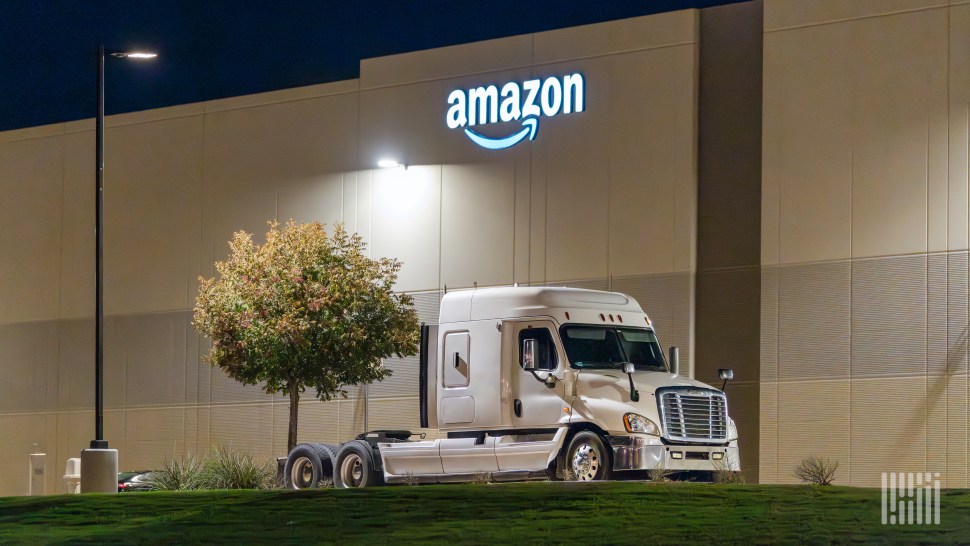
Amazon has its first deal with a union in North America, but it came from a top-down process in a Canadian province, rather than traditional collective bargaining.
The Amazon view of what happened for its workers at a Delta, British Columbia fulfillment center, a Vancouver suburb, was stark.
The contract for a group of workers was “imposed…without a single employee vote ever being counted, and despite a pending effort by some of those same employees to decertify the union purporting to represent them,” Amazon’s J. Ofori Agboka, Vice President, People Experience and Technology, said in an Amazon blog posting.
Meanwhile, the Unifor union, in its statement on what occurred, celebrated that its workers had “won” the first contract between a union and the e-commerce giant in North America.
The Unifor union was formed more than ten years ago through the merger of the Canadian Auto Workers and the Communications, Energy and Paperworkers Union of Canada. It describes itself as Canada’s largest private sector union.
Three-year deal for the unprecedented development
Regardless of what view of the contract one accepts, what happened in B.C. is notable because it means that Amazon, for the next three years barring some legal reversal, will be operating a facility under the terms of a collective bargaining agreement, a first for North America.
There is a Teamsters-affiliated union at a Staten Island warehouse, voted in by a grassroots organizing campaign in 2022 (before tying up with the Teamsters). But the company has refused to bargain with the unit, a dispute that has landed in federal court.
Other efforts to unionize Amazon facilities have come up short. The most notable was in Bessemer, Alabama.
Efforts to unionize the company’s Direct Service Providers that actually deliver parcels have recently been conducted by card check, with none of the DSPs recognizing the efforts (except one in California that saw its contract with Amazon yanked). Although those DSP workers are not Amazon employees, they have sought to have the National Labor Relations Board declare that Amazon is a joint employer with the DSPs.
Union view of the process…
The union says in the headline of its prepared statement announcing the deal that it had “won” the contract. That statement then lays out the process that got it there.
“The B.C. Labour Relations Board certified Unifor Local 114 as the workers’ union in July 2025 after finding Amazon hired extra staff to frustrate the workers’ organizing drive and ran a lengthy and pervasive anti-union campaign,” Unifor said in the statement.
That was followed by a board decision in August that ordered binding arbitration, “finding Amazon’s conduct had affected the parties’ ability to reach an agreement,” the union said.
The contract between the two parties–both the union and the company make reference to it as an “agreement,” although it was not agreed to in the traditional sense–is a three-year pact, ending in November 2029.
…is different from Amazon’s
The Agboka blog post recapped the process that began in 2024 in far more detail than what Unifor says about the months of back and forth.
Amazon’s Agboka says the union told Unifor it had “gathered enough support” among workers at the facility, dubbed YVR2, to hold a vote on unionization. But Agboka said an officer of the province’s Labor Relations Board disagreed with the claim of support, but “the Board ordered a vote anyway.”
An election took place soon after that. But Agboka said the results of that vote were not revealed.
According to the Agboka blog post, a Board decision in July 2025 certified Unifor as the representative of the workers. “We disagreed, believing that our employees’ voices should be heard, so we filed an appeal,” Agboka said in the blog. “The Board-ordered representation stood, and the process continued to move without a single employee vote counted.”
A decertification vote afterward, according to Agboka, also had results that were never disclosed. A legal action by workers opposed to the union has not moved forward in the B.C. Supreme Court, Amazon said.
But concurrently, Agboka said, “The Board ordered Amazon and the union to go through mediation, but we didn’t reach an agreement. So, the Board ordered an arbitrator to make a final decision on what the contract should be.”
The arbitrator’s finding is in the contract that Unifor celebrated in the announcement last week.
Some details revealed; union cites status quo
According to the union, wage increases in the contract will bring hourly rates for the workers in Delta to $CA29 per hour by the end of the three years.
There also are “enhanced severance protections” of up to 18 weeks, and an additional week of vacation for workers with 10 years of service, the union said.
A spokesman for Amazon described other aspects of the contract in an email to FreightWaves.
He said the wage increases would be zero in the first year, 3.25% in October 2027 and 3.5% a year later.
What the spokesman also disclosed was a long list of things that are not covered in the contract, with the status quo holding. Among the highlights: no change in the status of temporary and seasonal workers; no change in measurement of attendance; no right to transfer to another warehouse and no change in health benefits.
Amazon’s plan to fight the decision, noted in the Agboka blog posting, was vague. “We’ll keep challenging decisions that we believe break from long-standing precedent, keep asking for our associates’ decertification ballots to be counted, and take our concerns all the way to the Supreme Court if necessary,” he said.
More articles by John Kingston
Amazon-focused bill likely to pass in NYC but only after changes
Denial of funds to NY over non domiciled CDLs overturned: appellate court
Transportation committee in House set for overhaul post-election