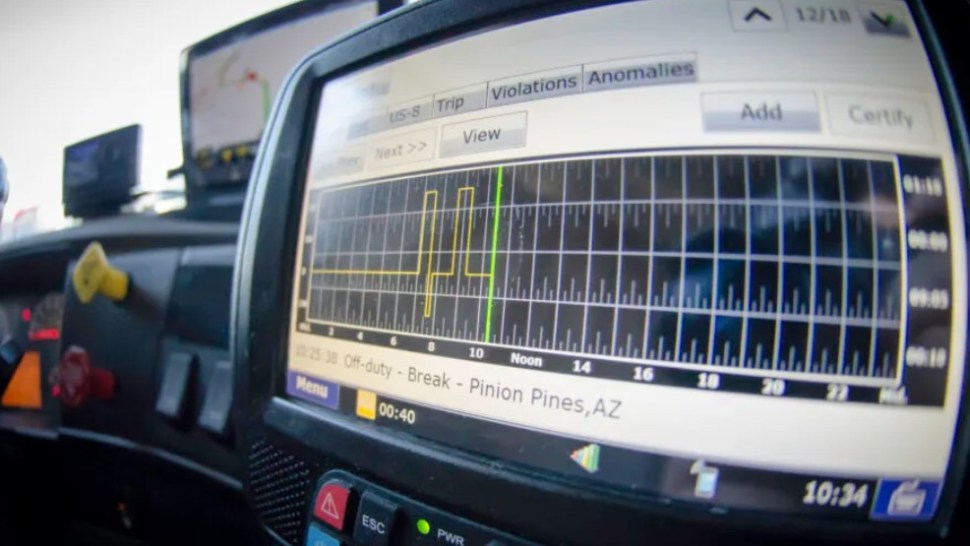
The American Trucking Association wants the Federal Motor Carrier Safety Administration to go outside in its quest to dramatically slow the use of Electronic Logging Devices (ELDs) in freight fraud.
In a report released earlier this week, the ATA said a certification program for approving ELDs for use in the U.S. should take many of its cues from the current Canadian system.
And the report, put together by an internal task force, said that once that certification program is in place, FMCSA should turn to an outside entity to regularly accredit ELDs for use in the U.S.
Kevin Grove, ATA’s director of safety and technology policy, said in an interview with FreightWaves that the task force included 25 members from ATA member companies as well as ATA employees.
Grove said the current process to OK an ELD for use is one of self-certification. The requirements for a company to self-certify are provided by FMCSA.
He added that FMCSA “has recently begun scrutinizing those submissions a little more thoroughly than they might have in the past.”
FMCSA has been aggressively paring the ranks of approved ELDs. Last week, it revoked the authorization of 133 ELDs.
Far surpassing Biden pace
A downloadable Excel file provided by FMCSA on revoked ELDs shows almost 300 revocations since the Trump administration took office. The four years of the Biden administration had less than 200 revocations.
The question the ATA report seeks to answer is what occurs next after the flurry of revocations by the Trump officials running FMCSA runs it course and then how to build a sustainable system that lasts beyond the aggressive approach of the current administration.
As the ATA report says in its introduction, the goal of the task force was to provide “a comprehensive set of policies and actions that will restore trust in the ELD ecosystem in the short term and maintain trust in the ELD system and federal databases of ELD providers over the long term.”
The suggestion of turning to Canada comes after the ATA recommends that FMCSA should “build upon existing certification mechanisms rather than create an entirely new model from the ground up.”
And the existing mechanism it favors is the Great North.
Look to Canada, build a U.S. system
“The Canadian ELD certification framework provides a useful structural model for how independent technical expertise can be incorporated into an effective certification regime,” the ATA says. But the working group at ATA also recommends FMCSA set up its own system, “tailored to the U.S. regulatory environment and administered separately from the Canadian system.”
There is enough in the Canadian system that the ATA working group found attractive that it also says FMCSA, “whenever possible,” should seek to “maintain alignment between the two programs, particularly with respect to technical requirements and testing approaches.”
The structure ATA suggested for third-party certification begins with FMCSA funding “development of an accreditation program to support a third-party ELD certification framework.”
“Under this approach, FMCSA would retain responsibility for establishing and maintaining the technical requirements, resolving questions of regulatory interpretation, and conducting investigation and enforcement activities, while qualified third-party organization(s) would administer accreditation and certification,” the ATA said in its report.
That structure, it said, would allow the agency to keep its focus on its regulatory activities while “leveraging outside technical expertise.”
Already has some input
FMCSA did have an advanced notice of proposed rulemaking (ANPRM) in 2022 on possible revisions to ELD regulations. But that did not result in any policy shifts, though the ANPRM did attract 1,377 comments.
Although nothing came out of it, the ATA working group said the comments and other recommendations in the 2022 ANPRM could be used as a “foundation” for the next step in revising the regulatory framework for ELD governance.
The ANPRM could then morph into the more formal Notice of Proposed Rulemaking (NPRM), the ATA said. FMCSA “should…use the NPRM to gauge interest among prospective accreditation and certification providers and better understand their capacity and requirements for participating in the program,” ATA said.
The ATA’s report avoids a hard timeline. During the NPRM, ATA said, FMCSA can be working concurrently to “establish an appropriate compliance timeline in the final rule that provides sufficient time to stand up the accreditation and certification system and certify existing ELDs before the new requirements take effect.”
The report also stresses that certification “is not a one-time event. It must be maintained through the lifecycle of the devices.”
In the short term, the ATA said, “FMCSA should take a short-term approach that does not require rulemaking to address current known methods of fraud in the existing system.” The long-term solution would follow, it said.
Any solution, according to ATA, should be directed at having the ELD become an ally in fighting fraud, rather than a tool that can be utilized by scammers.
One way to do that: more touch points. “FMCSA’s long-term actions should create more touch points for devices and suppliers,” the report said. “No single touch point would catch all fraud, but, cumulatively, their breadth and frequency would increase the overall chances of detection and reduce the window in which they could operate before being detected.”
One of the short-term solutions the association recommends is to use electronic records of duty status (ERODS) for various giveaways that suggest fraud might be underway.
Telltale data in a fraudulent EROD, the ATA said, could include “out-of-sequence file numbers, impossible distances, and driver info manipulation.”
One way it’s done
As an example of the type of fraud that would use an ELD to get its task done, Grove said he has heard reports of a driver, reaching the Hours of Service limit, would be instructed to call a phone number.
“They can call the number, and then through wireless communication, they’re able to upload new logs to the device that essentially shows the driver has more hours of service available,” Grove said.
An inspection of the records might look “immaculate,” Grove said. But a further inspection of such other data like fuel receipts and bills of lading can tell a very different story.
More articles by John Kingston
Amazon-focused bill likely to pass in NYC but only after changes
Amazon workers’ union gets a contract, but it’s in Canada
SCOTUS action revives shipper/receiver liability post-Montgomery