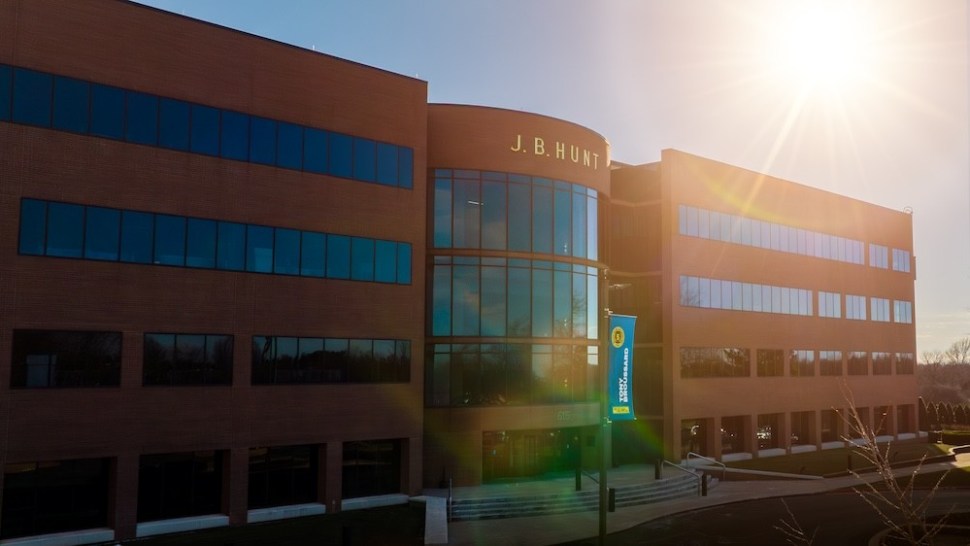
The brokerage arm of J.B. Hunt won one and lost one in an Arizona federal court Thursday in what now is shaping up to be one of the key cases on broker liability as the industry moves to a new legal landscape following the decision in Montgomery vs. Caribe Transport II.
The U.S. District Court for Arizona accepted one J.B. Hunt request for summary judgment in the case of Crystal Gee et. al. vs. J.B. Hunt et. al. But it rejected another.
Plaintiff Crystal Gee is the guardian of the children who were injured in the crash and left without their parents in the fatal crash that is the subject of the lawsuit.
The tragedy that led to the lawsuit occurred in October 2023. A truck driven by Shokhijakhon Bekmuradov, an employee driver of carrier Borderlanders Inc., crossed into the lane of oncoming traffic on U.S. Route 160, a two-lane highway. However, according to the recap by Judge Stephen McNamee, Bekmuradov did not immediately return to his normal lane.
A car heading the other way and carrying Gregory Cox, his partner Lindsey Watson, and their three children came around a corner. That car collided headon with Bekmuradov’s truck. Cox and Watson were killed and the three children were seriously injured, according to the recap.
The load was being shipped by medical equipment supplier Lincare which had hired J.B. Hunt’s brokerage arm to move its products. It was going from Denver to Phoenix, according to the recap. (The price of the load: $1,350). Borderlanders booked the load off the J.B. Hunt online broker’s platform.
Two requests for dismissal
J.B. Hunt requested summary judgment in its favor on two grounds. It sought a dismissal on the plaintiffs’ charge that it was vicariously liable for the driver’s actions and that Bekmuradov was a “statutory employee” of J.B. Hunt. It also sought dismissal on the plaintiffs’ charge that J.B. Hunt’s hiring of Borderlanders was negligent.
The carrier/intermodal/brokerage giant was successful on the first request. But it was not successful on the second request, and the case will go forward.
J.B. Hunt (NASDAQ: JBHT) declined comment on the case, citing the ongoing litigation.
The original defense put up by J.B. Hunt originally relied on the Federal Aviation Administration Authorization Act (F4A) and its prohibition against state action that might impact a “price, route or service.” In its initial response in the case, which the plaintiffs had first filed in March 2024, J.B. Hunt also said it could not be brought into the action as a broker because the safety exception to F4A, which does allow state action on safety-related incidents if they are “with respect to motor vehicles,” didn’t include brokers.
But that defense died with the ruling in Montgomery, forcing J.B. Hunt to find different approaches.
Where J.B. Hunt failed in its argument, allowing the case to proceed, is Judge McNamee’s ruling that the plaintiffs “have presented sufficient evidence in which a rational jury could find that J.B. Hunt knew, or should have known, of the safety risks associated in selecting Borderlanders to transport the Load.”
The plaintiffs had argued that Borderlanders had a problematic past. In an earlier filing, it said the carrier had a “history of hiring inexperienced and incompetent drivers that put the motoring public at risk of catastrophic injury or death.” They said J.B. Hunt should have known that when it hired Borderlanders.
Borderlanders is not part of the action before the Arizona federal court. According to the judge’s decision, the carrier has settled with the plaintiffs and an action against Bekmuradov was dismissed voluntarily with prejudice, ending the case.
That fact is part of the J.B. Hunt argument against the negligent hiring claim. “J.B. Hunt contends that there remains no underlying tort claim against Borderlanders so Plaintiffs cannot prove an essential element of their negligent hiring claim against J.B. Hunt,” Judge McNamee writes in his summary.
Carrier’s safety record
J.B. Hunt, according to the judge, has said the plaintiffs have not provided evidence that Borderlanders had a checkered past. But the judge didn’t accept that.
“Plaintiffs cite evidence that J.B. Hunt never reviewed Borderlanders’ publicly available accident and crash history, and FMCSA safety scores, safety assessment alerts, and inspection violation history before selecting Borderlanders,” the judge writes.
And he agreed. “There remain factual disputes regarding Plaintiffs’ negligent hiring claim against J.B. Hunt, therefore, the Court denies J.B. Hunt’s Motion on this claim,” Judge McNamee wrote.
What the court accepted
On the J.B. Hunt request for summary judgment that was granted by the court, the company’s argument, according to the judge’s filing, is that it was “not liable under the federal leasing regulations because there was no lease between J.B. Hunt and Borderlanders.”
The court agreed with that view. “In this case, it is undisputed that Borderlanders transported the Load under its own authority using its own equipment and driver,” the judge wrote. “Based on the undisputed material facts, J.B. Hunt did not lease equipment to Borderlanders. Thus, there is no lease, and the federal leasing regulations are inapplicable.”
Those regulations that might have held J.B. Hunt vicariously liable “apply only if there is a valid lease,” according to the decision.
View from an outsider
Gregory Reed, a partner at the law firm of Hanson Bridgett and head of its transportation practice, said in an email to FreightWaves that J.B. Hunt’s arguments were “common refrains in the broker and logistics industry.” But he also described them as “unavailing.”
Reed summed up J.B. Hunt’s arguments.
One, according to Reed, was that “Borderlanders remained a FMCSA-authorized (albeit unrated) carrier thus brokers should be free to use such carriers insulated from negligence.”
That goes to the heart of what numerous industry officials have argued in the wake of Montgomery: brokers lack guidelines on what steps they need to take to protect themselves against negligent hiring claims in a lawsuit.
That was particularly stark in the recent Texas nuclear verdict against C.H. Robinson, where it was hit with a more than $600 million verdict despite the carrier it hired in the 2021 wreck that led to three deaths had a Satisfactory rating from FMCSA.
That question of what constitutes sufficient vetting is not as clear in the J.B. Hunt case, since Borderlanders, according to numerous references in the lawsuit’s various briefs, did not have a stellar safety record.
Reed said the second argument by J.B. Hunt was that “Borderlanders’ safety and performance record was insufficient to provide JB Hunt notice because negative incidents were few compared to the carrier’s number of drivers and volume of loads.”
With enough of J.B. Hunt’s arguments rejected that the case will proceed, a jury may be the next step to take up the issue.
“Both (J.B. Hunt) arguments go to the duty of care a company like JB Hunt is required to exercise based on what it should have known, and their failure at this stage in the case demonstrates that courts may be unlikely to take these cases out of the hands of the jury to determine reasonableness,” Reed said.
More articles by John Kingston
SCOTUS action revives shipper/receiver liability post-Montgomery
Denial of funds to NY over non domiciled CDLs overturned: appellate court
DOL sticks with independent contractor proposal, trucking applauds