In 2013, Tim Mark, head of warehouse operations at WaytekWire, an electric parts distributor in Minneapolis, had a problem that today has become all too commonplace – finding a reliable labor pool to handle orders from his company’s facility. Spending more than 90 days to try to fill full-time positions wasn’t cutting it, so Mark had on an idea. With three high schools within a six-mile radius, why not recruit students to work about three hours a day after school as order selectors, walking the warehouse floors and picking products, and pay them $14.50 an hour?
With the promise of paychecks well above minimum wage, eager applicants came knocking. They showed up to work on time, performed their shifts, got home to eat dinner and do homework, and didn’t need to toil weekends or evening hours. Mark said he has hired 30 to 40 students since 2013; some of them go on to college and come back to work for him during breaks and summers.
Not every company is willing to staff its warehouses with adolescent labor. Still, it demonstrates that as e-commerce profoundly transforms supply chains and triggers unprecedented demand for warehouse space, businesses will do what is needed to find qualified workers to fulfill and distribute products.
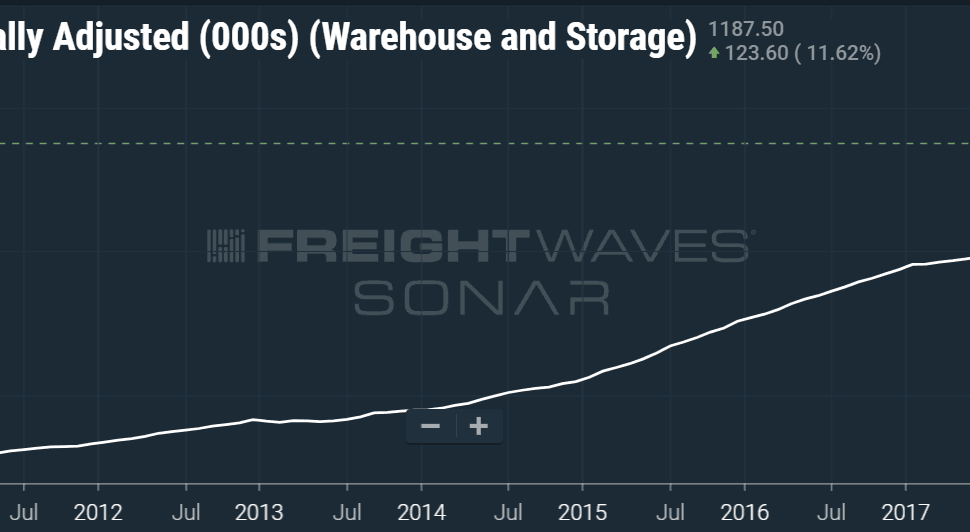
The pace of warehouse worker hiring has soared since 2012, about the time that e-commerce made its presence known. Nationwide, wages have followed suit, rising in that time to an average of $13.75 per hour across all labor classes, according to EmployBridge, a warehouse staffing firm. However, because pay scales barely budged for about a decade before that, wages would need to rise another $0.50-$1.50 per hour just to catch up to real 2002 levels, according to EmployBridge estimates.
Businesses pressured by higher labor costs can resort to automating manual processes. But there is a large up-front expense that often can’t be justified, said Brian Devine, senior vice president of EmployBridge. Besides, robots that bring products to human pickers are not adept at handling the big and bulky goods that make up an increasingly larger slice of the e-commerce pie, Devine said.
Average hourly wages would have to approach or exceed $20 an hour before businesses would be compelled to make broad-based automation investments, Devine said. Even then, a company automating a 500,000 square-foot warehouse with 200 workers could not reduce its workforce by more than half without severely compromising its operation, he added. Though a 50 percent workforce reduction would be significant, it doesn’t conjure up images of a labor-free warehouse.
The hottest area in warehouse automation is not robots that displace workers, but tools that work collaboratively with humans to make them more productive and efficient, said Steve Banker, vice president, supply chain services for ARC Advisory Group, a consulting firm.
The labor squeeze comes at a time when the U.S. industrial property market is on an historic nine-year tear that’s shows no signs of abating this year. Net absorption hit all-time highs last year at 285 million square feet, a 15.7 percent increase over 2017 levels, according to data from Cushman & Wakefield, a real estate services firm. Overall, 2018 net rental rates hit a record $16.40 per square foot, Cushman said. Vacancies last year hit an all-time low of 4.8 percent. In the fourth quarter of 2018, 25 U.S. industrial markets had vacancy rates under 4 percent, based on Cushman data. Ten years earlier, in the fourth quarter of 2008, only one market did.
At the same time, industrial supply slightly exceeded demand last year with 287.4 million square feet of space hitting the market, according to Cushman data. Supply will continue to come on-stream as the market strives for equilibrium. However, it isn’t likely to trigger a cycle of overbuilding, according to Cushman. Of the five tiers it tracks based on warehouse square footage, only one, big-box facilities of 500,000 square feet or more, is exhibiting oversupply. Even in that tier, which has seen the lion’s share of the supply growth in the past six to seven years as e-commerce took off, the excess supply is very small, Cushman said.
All of this new capacity puts warehouse operators in a bind. E-commerce demand is not expected to abate – some peg it to account for 30 percent of all U.S. retail sales (up from about 9-12 percent today) – not far in the future. The space coming on line to meet that avalanche will have to be staffed to some degree. Small wonder that Cushman, in its conversations with clients, said the availability of stable and dependable warehouse labor has become the leading factor in industrial siting decisions. According to Jason Tolliver, the company’s Americas head of logistics & industrial research, knowledge of labor trends and issues has become just as important to warehouse operators as understanding the nuances of filing an environmental impact statement.
Management is not accustomed to extending itself to warehouse labor. However, that may be what is needed to ensure a steady pipeline of workers, experts say. Part of the solution, according to EmployBridge’s Devine, lies in corporate behavior modification. Citing figures from the Bureau of Labor Statistics, more than 96 million Americans over the age of 16 are not employed, he said. A large portion of those 96 million are unable to work due to disability, other infirmities or advanced age. However, a majority of them are capable of working.
The trick, Devine said, is to lure willing and able workers off the sidelines with the promise of flexible, part-time hours combined with decent wages and some amenities. E-commerce is perfect for such workers’ schedules because the flow of goods into warehouses comes in waves and fulfillment is done by the piece, he said. Thus, it is not as regimented as warehousing that supports a traditional manufacturing operation, he said.
Unfortunately, most warehouse executives continue to insist on full-time, uniform work schedules because it’s what the company wants, Devine said. “What the company wants is not what these sidelined workers want,” he added.
In the end, though, it is what the customers want. Minnesota, the home of WaytekWire, has a 3.7 percent unemployment rate, making life pleasant for job-seekers but challenging for businesses like Mark’s. “You have to be able to change your processes to keep your customers,” he said. “They don’t care about your problems. They just want their stuff.”
Brokerage Compliance Symposium
The day before F3. Every compliance issue you face - fraud exposure, carrier liability, FMCSA rules, cargo theft, insurance gaps - navigated by attorneys and operators defining best practices in a changing industry.
F3 Awards Dinner
The night before F3. FreightTech100 companies honored. FreightTech 25 and Shipper of Choice winners revealed live. Cocktail reception into dinner and live music - 300 industry leaders in one purpose-built room.
F3: Future of Freight Festival
Industry-defining keynotes, rapid-fire technology demos, and industry leaders networking in experiences across Chattanooga - plus the inaugural F3 Awards Dinner featuring the FreightTech and Shipper of Choice reveals.
The day before F3. Every compliance issue you face - fraud exposure, carrier liability, FMCSA rules, cargo theft, insurance gaps - navigated by attorneys and operators defining best practices in a changing industry.
The Signal at Chattanooga Choo Choo • Chattanooga, TN Register NowThe night before F3. FreightTech100 companies honored. FreightTech 25 and Shipper of Choice winners revealed live. Cocktail reception into dinner and live music - 300 industry leaders in one purpose-built room.
The Signal at Chattanooga Choo Choo • Chattanooga, TN Register NowIndustry-defining keynotes, rapid-fire technology demos, and industry leaders networking in experiences across Chattanooga - plus the inaugural F3 Awards Dinner featuring the FreightTech and Shipper of Choice reveals.
The Signal at Chattanooga Choo Choo • Chattanooga, TN Register Now