




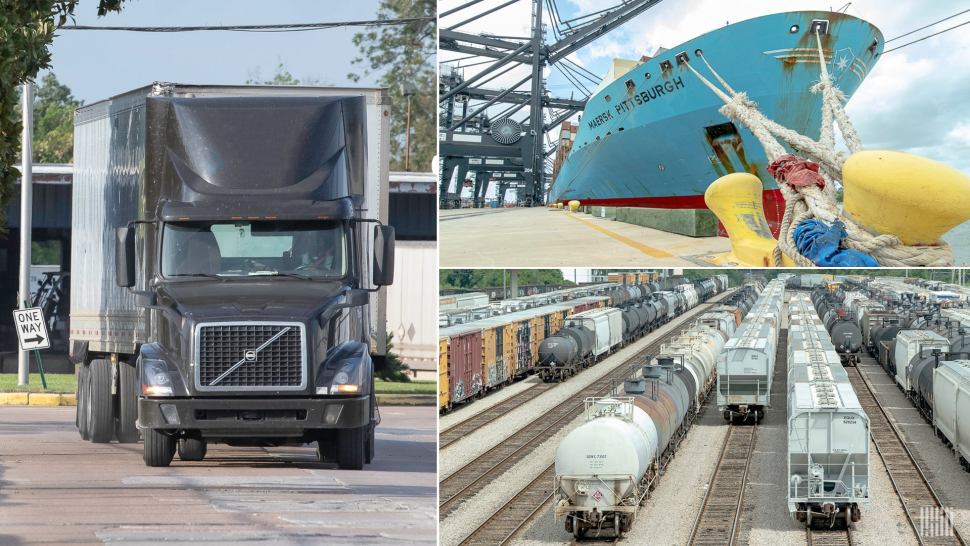
A formal strategy for reducing greenhouse gas emissions in the transportation sector prioritizes maritime and rail over trucking to more quickly get to net-zero emissions by 2050.
The U.S. National Blueprint for Transportation Decarbonization, released Tuesday by the Biden administration, is billed as a “first-of-its-kind” plan to cut GHG emissions in both passenger and freight transportation, building off funding incentives included in the 2021 infrastructure package and the 2022 Inflation Reduction Act.
The blueprint lays out three main strategies for attaining its goal: increasing user convenience, improving vehicle efficiency and transitioning to clean fuels and vehicles.
“While the first two strategies will contribute to reducing GHG emissions and produce significant co-benefits, transitioning to clean options is expected to drive the majority of emissions reductions,” according to the plan.
But in detailing the vehicle efficiency strategy, the blueprint points out that trucks and vans are the largest contributor to freight emissions. “Heavy road freight vehicles in particular can be difficult to decarbonize,” the administration states. “This energy- and emissions-intensive paradigm is a significant reason why transportation has become the largest GHG emissions source in the United States.
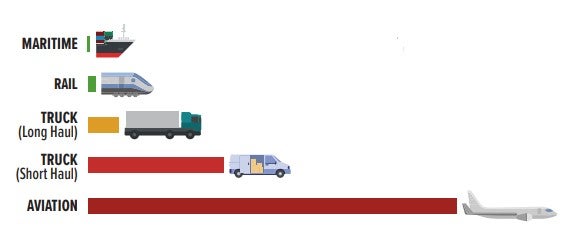
Source: U.S. National Blueprint for Transportation Decarbonization (Argonne National Laboratory, EPA)
“Using more efficient modes and vehicles is essential to reduce overall transportation emissions and energy use. The use of more efficient modes could also reduce the number of vehicles on the road and reduce congestion, improving travel time and traffic flow thereby further reducing GHG emissions and other harmful air pollutants. For freight, maritime and rail offer the cleanest options, followed by trucks and aviation, which results in the highest emissions. Industry can prioritize shifting parts of shipment journeys away from trucks to rail and water shipping when feasible.”
The blueprint acknowledges, however, that choosing the best mode for any given trip “is complex and depends on available mobility options, as well as cost, speed, safety, convenience, and other factors. … Additionally, emerging vehicle technologies and fuels will reduce emissions for many of these travel modes over time and will require an ongoing evaluation of mode-specific emissions and energy efficiency.”
The strategy also calls for continuing to improve and optimize transportation systems within each mode to reduce energy use and emissions — good news for companies developing load-matching services and software. Such services that increase vehicle routing and load factors “will improve efficiency while reducing fuel costs,” the strategy notes.
“In addition, new technologies can help improve multimodal freight transport and logistics and enable the use of shared transport assets and services, and more effectively respond to changes or unexpected delays using real-time data.”
Emissions reductions will also come with improvements to supply chain management that reduce freight miles, such as ensuring vehicles travel with full loads as often as possible, cutting “deadhead” miles, and optimizing routes, according to the administration.
“For example, just-in-time queuing at ports can enable ships to optimize their speed, thus reducing fuel consumption and emissions. Advanced computing and data analytics (e.g., sensors, big data analytics, blockchain) have the potential to improve supply chains by optimizing truck routing and freight logistics.”
Related articles:
Brokerage Compliance Symposium
The day before F3. Every compliance issue you face - fraud exposure, carrier liability, FMCSA rules, cargo theft, insurance gaps - navigated by attorneys and operators defining best practices in a changing industry.
F3 Awards Dinner
The night before F3. FreightTech100 companies honored. FreightTech 25 and Shipper of Choice winners revealed live. Cocktail reception into dinner and live music - 300 industry leaders in one purpose-built room.
F3: Future of Freight Festival
Industry-defining keynotes, rapid-fire technology demos, and industry leaders networking in experiences across Chattanooga - plus the inaugural F3 Awards Dinner featuring the FreightTech and Shipper of Choice reveals.
The day before F3. Every compliance issue you face - fraud exposure, carrier liability, FMCSA rules, cargo theft, insurance gaps - navigated by attorneys and operators defining best practices in a changing industry.
The Signal at Chattanooga Choo Choo • Chattanooga, TN Register NowThe night before F3. FreightTech100 companies honored. FreightTech 25 and Shipper of Choice winners revealed live. Cocktail reception into dinner and live music - 300 industry leaders in one purpose-built room.
The Signal at Chattanooga Choo Choo • Chattanooga, TN Register NowIndustry-defining keynotes, rapid-fire technology demos, and industry leaders networking in experiences across Chattanooga - plus the inaugural F3 Awards Dinner featuring the FreightTech and Shipper of Choice reveals.
The Signal at Chattanooga Choo Choo • Chattanooga, TN Register Now