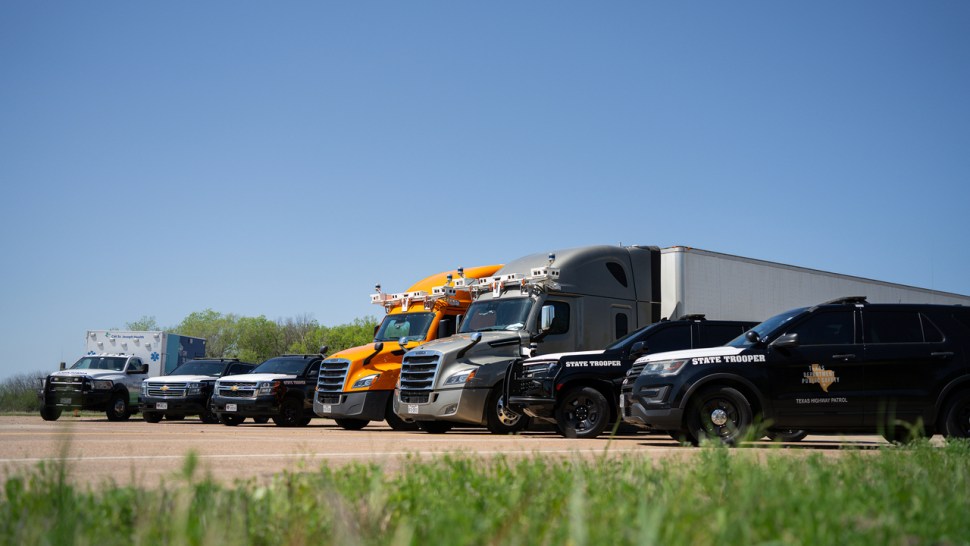
Bot Auto is keeping its remote assistants based exclusively in the U.S., the Houston autonomous trucking company announced Thursday.
These remote assistants sit between a driverless truck and whoever walks up to it but perform no part of the actual driving. The vehicle operates autonomously at all times. Their function is communication and coordination: direct contact with first responders and law enforcement in the field, plus limited vehicle actions during an incident.
“Remote assistants play a critical role in Bot Auto’s operations, providing a human layer of support and oversight for our autonomous fleet. We’re building out America’s 21st-century supply chain. It needs to be extremely resilient, and that’s why it’s critical that these roles are always kept within the United States,” said Brian Moore, Bot Auto’s chief policy officer.
Bot Auto runs a Level 4 fleet out of Houston and sells transportation as a service, positioning itself inside what it calls the Texas trucking triangle.
What Remote Assistance Operators Do at the Roadside
The work is already running in live operations. Remote assistants monitor operations from Bot Auto’s mission control today, confirming vehicle status and passing along cargo and routing information. They can remotely actuate functions such as hazard lights. They can also facilitate a vehicle shutdown at an officer’s direction.
That last capability is the one that matters during a traffic stop. With no one in the cab, the shutdown request has to go somewhere. Bot Auto’s answer is a person in the United States, not one offshore.
The Question the Senate Already Asked
Where those people sit became a Washington issue in February. Waymo Chief Safety Officer Mauricio Peña told a Senate hearing that part of the company’s robotaxi support staff works overseas. Waymo operates four remote assistance centers, two of them in the Philippines and the others in Arizona and Michigan, with roughly 70 agents on duty at any given time, Automotive World reported. The company says those agents supply contextual guidance and cannot control vehicle movement, and that the onboard system stays the real-time authority.
Sen. Ed Markey, D-Mass., took that disclosure and turned it into an investigation. His office surveyed seven developers, including autonomous trucking company Aurora, and published the findings March 31. Waymo was the only one of the seven using overseas remote assistance operators, and the only one where a substantial share of that workforce does not hold a U.S. driver’s license. Latency between vehicles and operators varied by company, with each setting its own threshold for what counts as a safety risk. Every company refused to say how often its operators intervene.
Autonomous vehicle developers “have long boasted they can eliminate road fatalities caused by human error,” Markey said. “Now it is time they are honest about their technology’s reliance on human help.”
Bot Auto was not among the seven. It is getting ahead of that question as autonomous trucking companies gain more adoption.
‘Every Mission Has a Mission Control’
In an emergency, the response window is measured in seconds. A first responder arriving at an incident involving an autonomous truck needs to reach an assistant instantly, communicate clearly and start a vehicle response.
“Every one of our vehicles has a mission, and every mission has a mission control,” said Bart Teeter, Bot Auto’s director of fleet and operational safety. “Our remote assistants aren’t driving the truck, but they are the voice on the other end of the line when an officer needs one, and they can act on the vehicle directly when it matters. Committing to U.S.-based remote assistants is about making sure that when a first responder needs us, there is no delay, no miscommunication, and no gap in accountability. We work hand-in-hand with law enforcement and emergency services, and this is a direct reflection of that responsibility.”
Bot Auto has run ride-alongs and training sessions and coordinated on incident response protocols specific to autonomous trucks as it has scaled operations across Texas.
Federal Regulators Flag First-Responder Interactions
The timing of this announcement didn’t happen in a vacuum. The National Highway Traffic Safety Administration sent a call-to-action letter to autonomous vehicle developers on July 8, seven weeks before Bot Auto’s announcement. Administrator Jonathan Morrison’s agency cited driverless vehicles that drove into active emergency scenes, blocked the paths of ambulances and firefighters or failed to recognize flashing lights, flares, smoke, fire and traffic cones. NHTSA said an automated vehicle that cannot safely interact with first responders is a danger to the general public. The agency scheduled meetings with driverless developers by the end of that month and reserved its authority to take enforcement action.
Bot Auto casts the remote assistant model as one piece of what it describes as a broader safety architecture, built on validation testing and coordination with regulators and emergency services. The company calls domestic staffing a baseline expectation for any autonomous vehicle operator in the United States.
“The ability to clearly and reliably communicate with a remote assistant during an emergency situation is critical to first responders,” said Maj. Omar Villarreal of the Texas Department of Public Safety. “Miscommunication or poor connections can potentially cost valuable time in addressing emergency conditions. Autonomous vehicle operators committing to U.S.-based remote assistants convey that they are committed to their responsibility in engaging first responders by making effective communications a priority.”
Brokerage Compliance Symposium
The day before F3. Every compliance issue you face - fraud exposure, carrier liability, FMCSA rules, cargo theft, insurance gaps - navigated by attorneys and operators defining best practices in a changing industry.
F3 Awards Dinner
The night before F3. FreightTech100 companies honored. FreightTech 25 and Shipper of Choice winners revealed live. Cocktail reception into dinner and live music - 300 industry leaders in one purpose-built room.
F3: Future of Freight Festival
Industry-defining keynotes, rapid-fire technology demos, and industry leaders networking in experiences across Chattanooga - plus the inaugural F3 Awards Dinner featuring the FreightTech and Shipper of Choice reveals.
The day before F3. Every compliance issue you face - fraud exposure, carrier liability, FMCSA rules, cargo theft, insurance gaps - navigated by attorneys and operators defining best practices in a changing industry.
The Signal at Chattanooga Choo Choo • Chattanooga, TN Register NowThe night before F3. FreightTech100 companies honored. FreightTech 25 and Shipper of Choice winners revealed live. Cocktail reception into dinner and live music - 300 industry leaders in one purpose-built room.
The Signal at Chattanooga Choo Choo • Chattanooga, TN Register NowIndustry-defining keynotes, rapid-fire technology demos, and industry leaders networking in experiences across Chattanooga - plus the inaugural F3 Awards Dinner featuring the FreightTech and Shipper of Choice reveals.
The Signal at Chattanooga Choo Choo • Chattanooga, TN Register Now