STUTTGART, Germany – Cellcentric’s newest fuel cell BZA375 fits in the engine bay of a 13-liter diesel truck. The plant where they are currently manufactured is located in Esslingen (in the greater Stuttgart area). The factory meant to build it at scale is being prepared. For now it sits as a reserved plot in an industrial park in the town of Weilheim an der Teck, Germany.
The joint venture of Daimler Truck and Volvo Group won’t build there until Europe has truck-sized hydrogen stations and fuel near €6 (about $6.70) per kilogram, so that end customers can operate fuel cell electric trucks, which have been proven in practice, in a cost-effective manner, its chief technology officer said. That leaves the timing of hydrogen trucking at scale with fuel suppliers, station builders and governments.
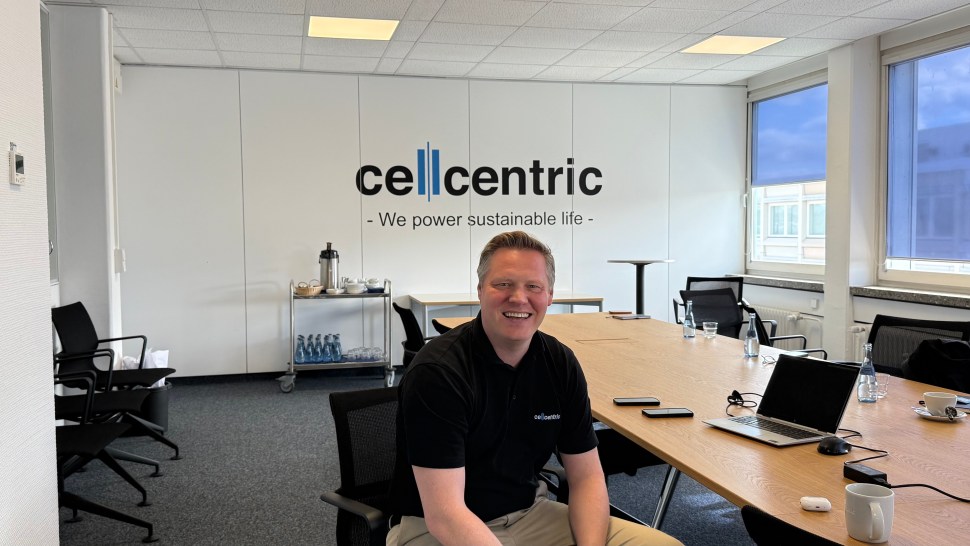
Nicholas Loughlan, cellcentric’s CTO, laid out that plan during a Sept. 17 media visit to the company’s headquarters in Kirchheim/Teck, near Stuttgart.
“You cannot just put a product out there and expect it to scale,” Loughlan said. “You need a whole ecosystem and infrastructure and a whole framework for it to work.”
The visit came two days after Daimler Truck, Volvo, Toyota, Bosch and four energy companies formed an alliance at IAA Transportation to roll out hydrogen stations in step with truck fleets, starting in Germany. In July, Toyota signed a binding agreement to become an equal one-third owner of cellcentric, with closing expected around year-end or early 2027.
One fuel cell replaces two
The BZA150, cellcentric’s current system, powers a 40-metric-ton truck with two 150-kilowatt units. The company stopped it short of full series production and fast-tracked its successor BZA375, Loughlan said.
The BZA375, unveiled in April 2026, delivers up to 375 kW of continuous net power, more than 500 horsepower, from a single unit weighing less than 500 kilograms, about 1,100 pounds. cellcentric rates it at less than 6 kilograms of hydrogen per 100 kilometers in a fully loaded 40-ton truck, or more than 10.2 miles per kilogram, with a service life of about 25,000 hours.
“We do our homework, too,” Loughlan said. “That’s why BZA375 uses 20% less fuel than the BZA150 twin system.”
During the visit, cellcentric said BZA375 also fits North American tractors such as the Volvo VNL and Freightliner Cascadia, along with Europe’s Mercedes-Benz Actros and Volvo FH.
Esslingen builds now, Weilheim waits
The Esslingen pilot plant, about 30 kilometers from headquarters, has handled every production step under one roof since June 2024. The line is building BZA150s for customer fleets that reach operators starting at the end of this year and will move to increased sample production of the BZA375, Loughlan said. Series production of the BZA375 is planned for the turn of the decade.
Weilheim is the second step. cellcentric holds an option until the end of 2029 on 16 hectares, about 40 acres, in Weilheim’s Rosenloh industrial park, and Loughlan confirmed it paid more than €15 million (about $16.8 million) to reserve the land.
“We’re not investing into a huge manufacturing facility in the first place, knowing how, let’s say, the transformation of new technology is sometimes difficult to manage, as we all know,” he said.
No order count triggers construction. Loughlan said the decision rests on how far cellcentric can push Esslingen’s output and how fast demand builds, and a new plant takes “three to four years, as always.”
“There’s not a specific timing and also not a specific number for us,” he said. “It’s more a how do we judge market dynamic.”
The grid case for a second network
Loughlan’s argument for hydrogen starts with the power grid. Running Europe’s entire in-use truck fleet on batteries would take about 500 terawatt-hours of electricity, he said, “roughly the energy consumption that Germany has in a year.”
“That can be done technically, but economically, from a timing perspective and realistic implementation, that probably is not a smart move,” he said.
Germany produced 509.2 TWh in 2025, according to Destatis’ gross electricity production series, and ACEA counts 6.2 million trucks – of which approximately 3.9 million are heavy-duty trucks weighing more than 16 metric tons – in use across the EU.
In an example, trucks fill the lot at the Denkendorf service station on the A8 autobahn near Stuttgart at the end of a shift, Loughlan said, showing an aerial view. The stop has no charger built for trucks today, and planning calls for a 15.4-megawatt grid connection there by 2035, enough for about 15 trucks to megawatt-charge at once, he said.
Energy providers are already telling customers who want new connections for industry or long-haul trucking that they can’t upgrade the grid fast enough, according to Loughlan. That is where building “two infrastructures for heavy-duty becomes a lot more practical, a lot cheaper, and a lot more effective,” he said, adding that electrification should still happen wherever possible.
Stations sized for trucks, fuel priced for fleets
EU rules already set a floor for hydrogen stations. The Alternative Fuels Infrastructure Regulation requires stations of at least 1 metric ton a day with a 700-bar dispenser every 200 kilometers along the core TEN-T road network, plus one in each urban node, by Dec. 31, 2030. cellcentric’s slides call for heavy-duty station designs scalable to 4 metric tons a day.
Europe has 187 hydrogen stations, Daimler Truck CEO Karin Rådström said at IAA, and most dispense at 350 bar. Important to know: These are mainly passenger car refueling stations – not suited for HD trucks with a fuel demand >10 kg at 700 bar or liquid hydrogen.
Price is the wider gap.
“If we can get six euros per kilogram for hydrogen price, we’re okay to start scaling,” Loughlan said. Asked the current price in Europe, he said, “Substantially higher.”
In January, H2 Mobility began selling hydrogen to customers of truck rental firm hylane for about €8 (about $9) per kilogram net at selected German stations, a price the companies said was well below current market levels.
Loughlan credited Germany’s funding program for tying station money to truck deployments. “So we solve the chicken and egg equation,” he said. Germany’s latest call offered €220 million (about $247 million), and applicants requested more than 70 high-capacity stations and 800 heavy-duty trucks, according to the alliance.
The regulatory pressure lands on truck makers. Under the EU’s heavy-duty CO2 standards, new heavy-duty vehicles must cut CO2 per kilometer 45% by 2030 and 65% by 2035.
“It’s an OEM legislation that’s not an end customer legislation,” Loughlan said. “That means the customer will choose the best technology for this job and what’s the best TCO.”
What the fuel cell hasn’t solved
cellcentric’s timelines have slipped before. When Volvo agreed in 2020 to pay €600 million, almost $700 million at the time, for half the venture, the partners planned series production for the second half of this decade. First systems were originally due from Weilheim in 2026, and cellcentric now expects operations there “around 2030,” citing slow hydrogen infrastructure and the price of green hydrogen, Electrive reported.
Cost still depends on volume. “If you don’t produce tens of thousands every year, then, of course, your cost position is not where it can be,” Loughlan said, adding that the early stage needs government support.
He said Toyota will bring experience industrializing fuel cells at scale in passenger cars such as the Mirai.
In North America, cellcentric is holding back, even though Loughlan said the system was developed with U.S. and Canadian codes and standards in mind.
“There’s currently, our assessment at least, not a huge, let’s say, demand for zero-emission trucking in the U.S. right now,” he said. “So we’ve taken a bit of a more observing position.”
Loughlan said stations, fuel price and cellcentric’s own volume have to grow together before fleets commit.
“And then the end customers will go, ‘I’m not only buying one for show purposes, I’m going to buy 10,'” he said.
Why it matters: cellcentric’s BZA375 fits a 13-liter diesel bay and cuts fuel use 20% from its predecessor, but series production waits until the turn of the decade. Whether its Weilheim plant gets built depends on truck-sized stations and hydrogen near €6 per kilogram. Operators will then be able to use heavy-duty fuel-cell trucks for long-haul transport, with overall TCO-comparable to those of diesel trucks.