Small and midsize businesses (SMBs) are spreading their supply chains across more regions and placing orders earlier as shippers grapple with an increasingly complicated mix of supplier delays, freight costs, tariffs and shifting consumer demand.
According to Netstock’s 2026 Supply Chain Planning Benchmark Report, no single disruption is dominating inventory decisions this year. Instead, businesses are confronting a multitude of pressures at the same time — a shift moving from isolated volatility to “supply chain chaos.”
Netstock, a supply chain planning software company, based the report on a survey of more than 2,500 customers worldwide, along with a survey of more than 150 users at small and midsize businesses with less than $250 million in annual revenue.
Supplier lead-time swings ranked as the biggest inventory planning challenge for 29% of respondents, followed by raw material and input costs at 23%, freight and shipping costs at 22%, and demand shifts at 21%.
The challenges become even larger when businesses were allowed to identify multiple pressures: supplier timing appeared among the top three concerns of 77% of respondents, freight and shipping in 72%, raw materials and input costs in 66%, and demand shifts in 57%.
The findings suggest freight demand could become increasingly fragmented as smaller businesses diversify suppliers, shift purchase orders between countries and adjust shipment timing rather than relying on the relatively straightforward inventory-building strategies that characterized 2025.
Last year, tariffs were a dominant concern and prompted businesses to front-load orders and build buffer inventories. In 2026, trade policy remains a factor, but Netstock found that shipping-route disruptions, raw-material costs, demand changes and inconsistent supplier performance are increasingly converging.
More suppliers mean more freight lanes
One of the clearest potential implications for freight markets is the continued diversification of SMB sourcing.
Among businesses sourcing from the U.S., China, Canada and Mexico — four regions tracked consistently across Netstock’s past three benchmark reports — the share sourcing from at least two regions increased from 45% in 2024 to 49% in 2025 and 55% this year.
While diversification can reduce dependence on a single supplier or country, Netstock noted that it also creates additional complexity through more suppliers, lead times and freight routes.
The shift could translate into more complicated freight networks as importers divide purchase orders among multiple countries, potentially creating smaller or less predictable shipment patterns across ocean, air, trucking and intermodal networks.
Businesses also appear to be gradually reconsidering offshore sourcing. Preference for offshore suppliers declined from 31% in 2024 to 28% in 2025 and 21% this year, while preference for domestic sourcing increased from 19% to 21% and then 23% during the same period.
At the same time, the percentage of SMBs sourcing from two or more supplier regions has increased by 10 percentage points since 2024.
China lead times emerge as bigger concern
China remains a major component of those sourcing networks, but businesses relying on Chinese suppliers reported a significant deterioration in lead-time conditions.
In 2025, 61% of SMBs sourcing from China cited long supplier lead times, compared with 52% of businesses sourcing elsewhere. This year, those figures widened to 75% and 42%, respectively.
That expanded the China sourcing gap from 9 percentage points to 33 percentage points in one year.
Supplier reliability more broadly is also under pressure. Netstock found lead-time variability affects 74% of SMBs, long lead times affect 63%, and minimum order quantities affect 60%.
Tariffs have not necessarily resulted in rapid supplier switching, however.
Only 35% of U.S. SMB respondents said they had changed suppliers because of tariffs during the previous 12 months. Among businesses that switched, 44% cited cost as the primary reason, followed by country-of-origin risk at 26%, supplier reliability at 15% and tariff-driven lead-time changes at 11%.
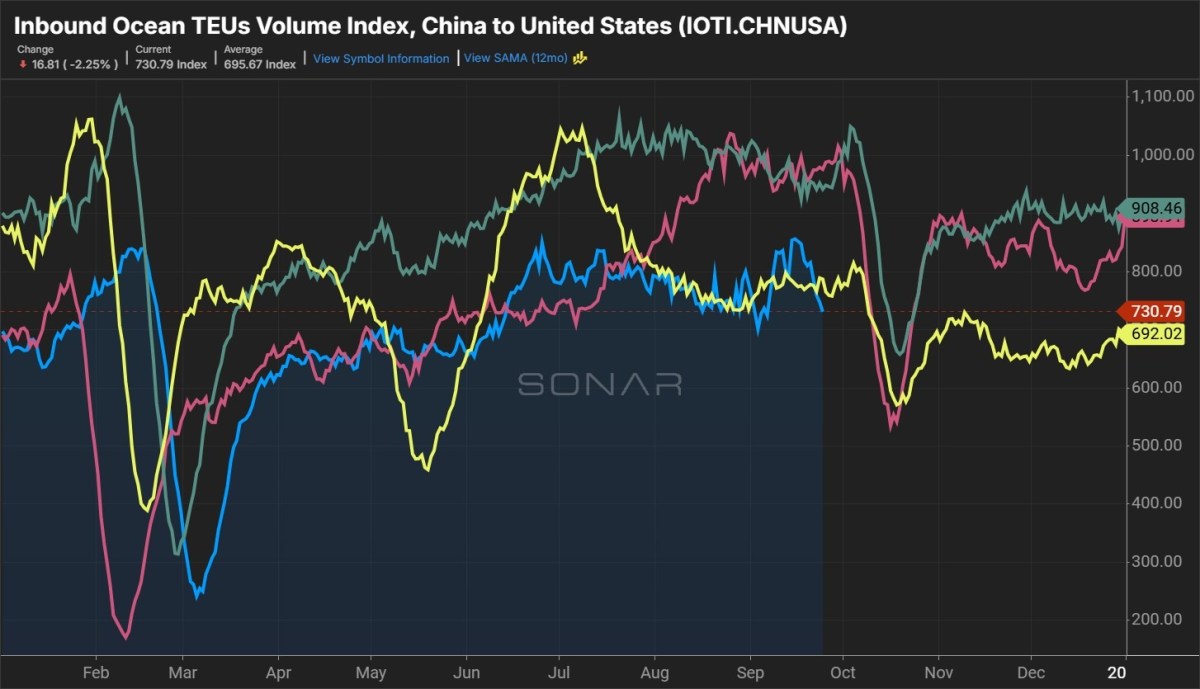
As of Sept. 24, import bookings from China to the U.S. (IOTI.CHNUSA) have been averaging lower than the previous three years, according to FreightWaves SONAR data. The IOTI is an index that measures bookings of container imports with a 14-day moving average.
“[2026] has been far less chaotic, but possibly no less nerve-racking, as shippers navigate rapidly expanding transportation and inventory costs in a very shaky consumer environment,” SONAR’s Head of Freight Market Intelligence Zach Strickland wrote in a recent report. “Politics have become increasingly intertwined with economics, making many uneasy about the state of things despite the aggregate figures painting a fairly stable picture.”
Earlier orders could shift freight demand
Businesses are also attempting to get ahead of peak-season disruptions.
Fifty-three percent of SMBs said they are ordering earlier or buying larger quantities in preparation for peak season, while 39% are relying more heavily on forecasting and planning tools. Only 10% are adding or switching suppliers.
For transportation providers, earlier purchasing can shift freight demand forward, potentially producing stronger volumes ahead of traditional seasonal peaks and softer demand later if businesses have already stocked their warehouses.
But Netstock’s findings also illustrate the danger of front-loading inventory without accurately forecasting demand.
Only 44% of businesses ordering earlier reported service levels above 90%, compared with 62% among companies that were not ordering earlier. Dead-stock rates were not significantly better among early buyers.
Netstock concluded that the defining supply chain challenge of 2026 is no longer solving an individual disruption. Instead, companies increasingly have to manage persistent uncertainty as part of everyday operations.
Why it matters: A broader supplier footprint can shift freight among ocean gateways, cross-border corridors and domestic transportation networks while increasing logistics complexity.
Brokerage Compliance Symposium
The day before F3. Every compliance issue you face - fraud exposure, carrier liability, FMCSA rules, cargo theft, insurance gaps - navigated by attorneys and operators defining best practices in a changing industry.
F3 Awards Dinner
The night before F3. FreightTech100 companies honored. FreightTech 25 and Shipper of Choice winners revealed live. Cocktail reception into dinner and live music - 300 industry leaders in one purpose-built room.
F3: Future of Freight Festival
Industry-defining keynotes, rapid-fire technology demos, and industry leaders networking in experiences across Chattanooga - plus the inaugural F3 Awards Dinner featuring the FreightTech and Shipper of Choice reveals.
The day before F3. Every compliance issue you face - fraud exposure, carrier liability, FMCSA rules, cargo theft, insurance gaps - navigated by attorneys and operators defining best practices in a changing industry.
The Signal at Chattanooga Choo Choo • Chattanooga, TN Register NowThe night before F3. FreightTech100 companies honored. FreightTech 25 and Shipper of Choice winners revealed live. Cocktail reception into dinner and live music - 300 industry leaders in one purpose-built room.
The Signal at Chattanooga Choo Choo • Chattanooga, TN Register NowIndustry-defining keynotes, rapid-fire technology demos, and industry leaders networking in experiences across Chattanooga - plus the inaugural F3 Awards Dinner featuring the FreightTech and Shipper of Choice reveals.
The Signal at Chattanooga Choo Choo • Chattanooga, TN Register Now