Oil markets have often reacted with strong downward moves whenever there has been a suggestion that all-out peace or at least an easing of Middle East tensions was at hand.
That has never been more true than in the days since the Democratic victories on Election Day. And it has now shown up in the benchmark diesel price used for most fuel surcharges.
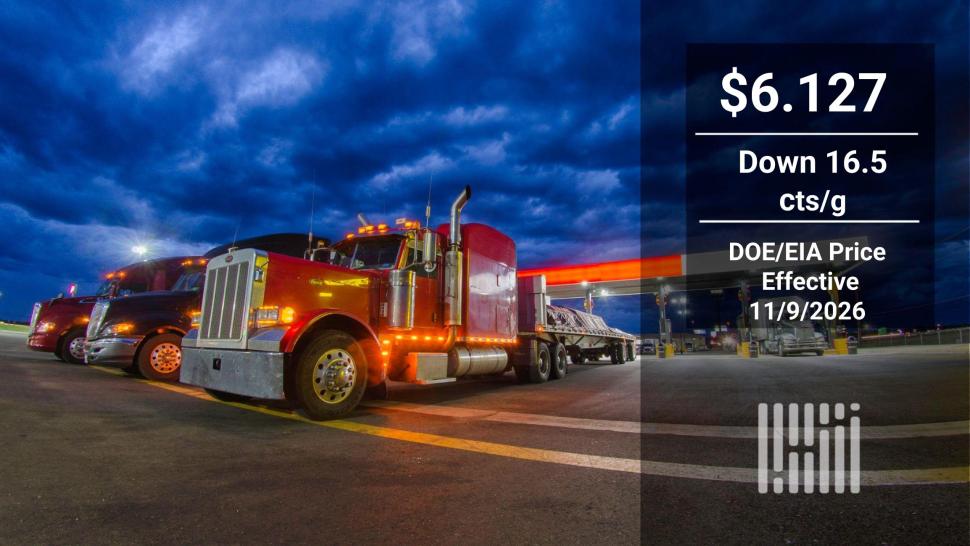
The Department of Energy/Energy Information Administration’s average weekly retail price fell 16.5 cents/gallon to $6.127/g, effective Monday but published Tuesday.
It’s the second consecutive week of a decline, and it takes the price to its lowest level since October 12. That isn’t all that long ago, but neither is the highest price in the history of the series. That was recorded September 22, just seven weeks ago, when it reached $6.529/g.
The decline is coming as the futures market for ultra low sulfur diesel (ULSD) on the CME commodity exchange, and other oil contracts, are experiencing significant post-Election Day declines on the prospect of a Democratic Congress and a possibly chastened administration pulling back on more military action in the Middle East.
ULSD settled at $4.4216/g on the first day of the month. On Monday, it settled at $4.2148/g and at about 11:40 a.m. Tuesday, it was trading at $4.1409/g.
Brent, the world’s crude benchmark, settled at $104.77/barrel on the first trading day of November. It settled Monday at $92.57/b, and at 11:40 was at $91.55/b.
Amrita Sen, director of market intelligence at Energy Aspects, said in an interview Tuesday with Bloomberg Television that she believes the market has “erased it all” in regards to a risk premium as a result of the war.
She said trade data prior to the election suggested there was a significant amount of trade activity preparing for a post Election Day escalation of activity.
“People were positioning for an imminent strike,” Sen said. “When that didn’t happen, you definitely started to see the selloff.”
It’s been replaced, Sen said, by a market that is “now sanguine that the war will end no matter what from the U.S. side, because it’s not just the Democrats but also the Republicans don’t want the war to continue.”
The alternative more bullish view was expressed by the energy research team at Bank of America Merrill Lynch, which took the long view of where the oil market stands after months of lost output, damaged refineries in the Middle East and Russia and flows through the Strait of Hormuz that are heavily dependent on U.S military support.
“Global oil supply disruptions have reached record levels in 2026, with the scale of the production shortfall exceeding anything seen in the historical data going back to 1965,” the team lead by Francisco Blanch wrote in a recent report. “The market entered the conflict unusually well supplied following several quarters of surplus, allowing inventories to absorb much of the initial disruption. But that cushion is being rapidly depleted, with particularly large stock draws in China and declining strategic inventories across OECD economies.”
The report reviews the hits to the world refining sector combined with inventory draws as resulting in a “market that has successfully absorbed an enormous physical shock so far, but with substantially less protection against the next one. Thus, the direction of the US-Iran war remains central to the evolution of oil prices over the next 12 months.”
More articles by John Kingston
Teamsters say they’ve organized Amazon employees in Indiana; company demurs
Transportation committee in House set for overhaul post-election
October truck transportation jobs = September truck transportation jobs