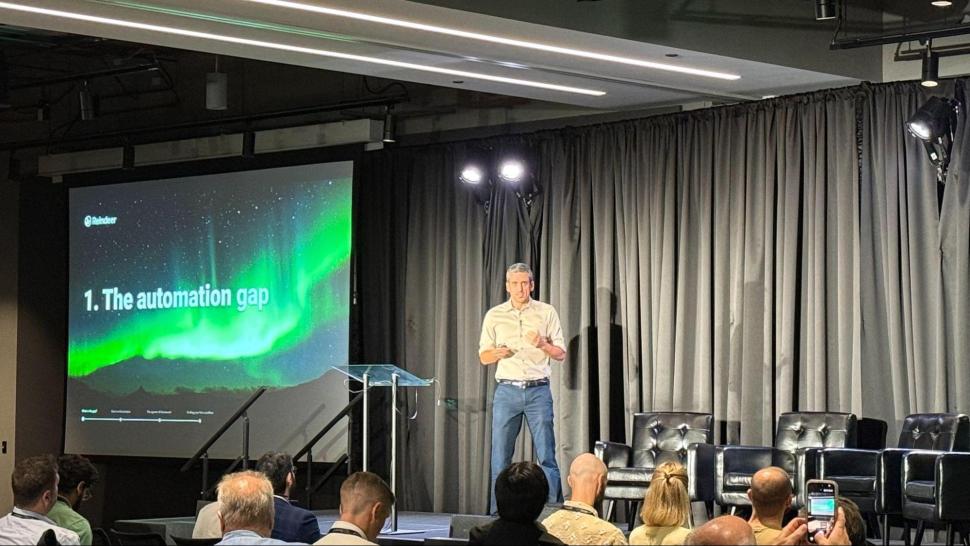
CHICAGO — The market for enterprise AI agents is not being won on model quality anymore, according to Yoav Naveh, founder and CEO of Reindeer, and that shift is reordering where startups plant their competitive bets.
Speaking with FreightWaves at the Supply Chain AI Symposium in Chicago, Naveh laid out a picture of an industry that has burned through two waves of adoption without unlocking the returns executives expected, and is now chasing a third.
“The first wave: assistants. Everybody got a copilot, Claude, ChatGPT,” Naveh said. “We’ve seen a lot of success with assistants around software engineering. Coding agents work really well. Maybe legal, not as well. But generally we haven’t seen assistants make companies 10x or 100x more efficient.”
The second wave targeted the call center, i.e. customer support. “I think that has been a very big low-hanging fruit, really,” Naveh said. “One big workflow, a lot of similar case types in one. I definitely see some success there.”
Now, Naveh said, enterprises are chasing the wave that actually touches the bulk of their labor cost: core operations. “Let’s take all these core workflows that represent 70, 80% of the work that everybody does,” he said.
That is a far messier market than customer support ever was. Naveh estimates these workflows number in the dozens, if not hundreds, inside a single enterprise, spanning finance, procurement, treasury, accounting and supply chain, often with no single department owner.
The Nuance Problem Investors Are Missing
Naveh’s clearest data point on why this market resists one-size-fits-all software comes from a client he described as one of the largest consumer packaged goods companies in the world.
“They say, ‘Hey, we’re doing accounts payable in my company,’ but your accounts payable is different from their accounts payable,” Naveh said. “We work with one of the largest CPG companies in the world. Five different departments, five different accounts payable processes within the same company.”
That fragmentation is the reason Naveh is skeptical of the forward-deployed engineer model gaining traction across the AI startup world, where vendors embed technical staff inside a client to hand-build an agent for one process at a time.
“I’m going to throw three engineers in and sit with your team and build the agent for that particular process. Are they ever going to come back and be available to be sent to another department, or are they stuck maintaining whatever they built as processes change and evolve?” Naveh said. “I think the math doesn’t work because it doesn’t scale.”
Why the Model Won’t Be the Moat for Enterprise AI Agents
Reindeer’s bet runs against a common assumption in enterprise software circles: that owning or fine-tuning a proprietary large language model is a durable edge. Naveh argues the opposite is happening.
“Strong belief that LLMs are going to be a commodity,” Naveh said. “We see that open-source models are maybe six months behind the frontier models. But what we’re thinking is, I don’t need the frontier model for everything anymore.”
“We work now with a large European insurance company. They decided to build their own LLM. We’re happy to plug in their own LLM,” he said. “We’re happy to restrict the list of allowed LLMs based on the company’s data privacy policy, and figure out how to run their case with what’s whitelisted.”
That view puts pressure on any competitor whose pitch centers on model superiority alone. If the underlying model becomes interchangeable, differentiation has to come from somewhere else.
Building Is Easy. Maintaining Isn’t.
That somewhere else, in Reindeer’s model, is the maintenance layer: detecting when a workflow drifts, reconciling the change and adjusting the agent without a new engineering ticket.
“Even after you deploy an agent, the workflow keeps changing,” Naveh said. “If you don’t have a method to have agents detect these changes, reconcile, self-heal, self-learn, we’re not really going to be able to realize what agents can do for you.” Reindeer built what Naveh calls a two-loop system to handle that drift.
Naveh said the economics of building have already shifted in the industry’s favor, which is exactly what makes maintenance the bottleneck now.
“I think everybody wants to build. Building is easy,” he said. He described building an internal dashboard for a colleague in a single evening, then fielding a steady stream of bug fixes and feature requests afterward. “I don’t want to do that,” he said. “That’s not fun. Maintaining is not fun or easy.”
“Five years ago you couldn’t build anything, now you can build amazing things,” Naveh said, describing the gap between a novice and an expert engineer as dramatically reduced by tools like live coding assistants. “The expertise that is needed now is exactly what you said, around all these different things after it’s built, and make sure that what was amazing on the first evening you released it is still amazing six months later.”
For enterprises evaluating AI vendors, Naveh’s framing suggests a different diligence question than the one most are asking. Instead of which company has the best model at POC stage, the more durable question may be which one can keep an agent accurate long after launch, as the workflow underneath it keeps moving.
Brokerage Compliance Symposium
The day before F3. Every compliance issue you face - fraud exposure, carrier liability, FMCSA rules, cargo theft, insurance gaps - navigated by attorneys and operators defining best practices in a changing industry.
F3 Awards Dinner
The night before F3. FreightTech100 companies honored. FreightTech 25 and Shipper of Choice winners revealed live. Cocktail reception into dinner and live music - 300 industry leaders in one purpose-built room.
F3: Future of Freight Festival
Industry-defining keynotes, rapid-fire technology demos, and industry leaders networking in experiences across Chattanooga - plus the inaugural F3 Awards Dinner featuring the FreightTech and Shipper of Choice reveals.
The day before F3. Every compliance issue you face - fraud exposure, carrier liability, FMCSA rules, cargo theft, insurance gaps - navigated by attorneys and operators defining best practices in a changing industry.
The Signal at Chattanooga Choo Choo • Chattanooga, TN Register NowThe night before F3. FreightTech100 companies honored. FreightTech 25 and Shipper of Choice winners revealed live. Cocktail reception into dinner and live music - 300 industry leaders in one purpose-built room.
The Signal at Chattanooga Choo Choo • Chattanooga, TN Register NowIndustry-defining keynotes, rapid-fire technology demos, and industry leaders networking in experiences across Chattanooga - plus the inaugural F3 Awards Dinner featuring the FreightTech and Shipper of Choice reveals.
The Signal at Chattanooga Choo Choo • Chattanooga, TN Register Now