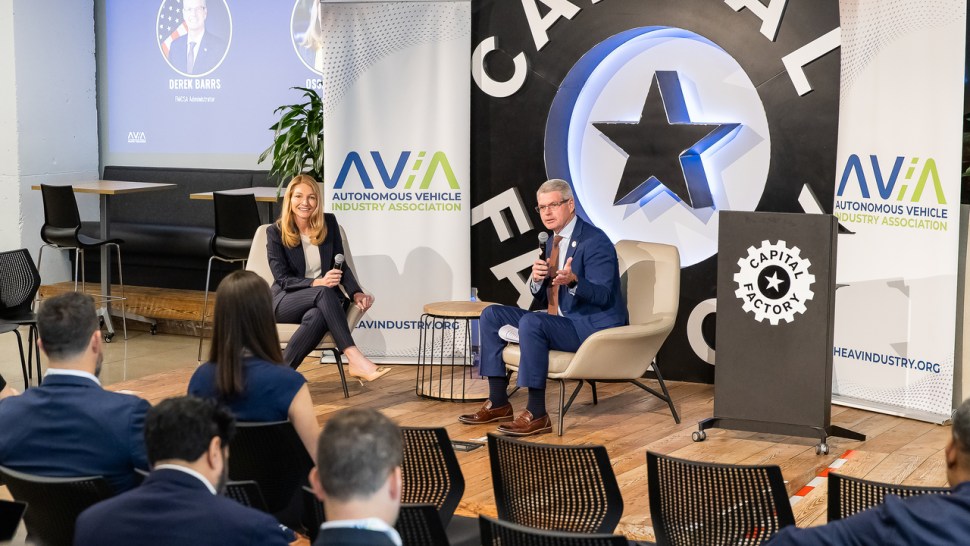
The Federal Motor Carrier Safety Administration granted a five-year exemption on Wednesday that lets carriers running Level 4 autonomous trucks use cab-mounted warning beacons in place of reflective triangles. The exemption runs through Oct. 7, 2031, and covers Aurora Operations plus any other Level 4 carrier that notifies the agency first, under a notice signed by Administrator Derek Barrs.
It replaces four three-month waivers Aurora has operated under since October 2025. Kodiak AI, Waabi and Stack AV opted in along the way.
“Going from a temporary waiver to a five-year exemption gives the industry a lot of confidence,” said Jeff Farrah, CEO of the Autonomous Vehicle Industry Association, in an interview with FreightWaves. “As these companies scale, raise money in the capital markets and set up business partnerships, there are often questions about what they are going to do about the warning-triangle issue. Now there is a firm answer.”
Bart Teeter, director of fleet and operational safety at Bot Auto, said in a statement that the exemption “will give the autonomous freight industry a key piece of regulatory certainty that will allow us to continue to scale safely.”
Federal rules require the driver of a truck stopped on a road or shoulder to turn on hazard flashers and place warning devices in front of and behind the truck within 10 minutes. The required devices are three bidirectional reflective triangles or at least six fusees.
“Now, with autonomous vehicles, we need to evolve some of these requirements, since with an autonomous truck there is not going to be somebody who can get out and put warning triangles behind the vehicle,” Farrah said.
Beacon specifications and operating limits
The beacons must be amber, meet the Class 1 photometric requirements of SAE J595 and sit at least 100 inches off the ground, at or above the top of the side mirrors. Each truck needs at least one rearward-facing light on each side of the cab and one forward-facing light on the front, with redundant power to prevent a single-point failure.
They must activate within five minutes of a stop and keep flashing, alongside the standard hazard flashers, until the truck moves again or is recovered. FMCSA called the five-minute limit “a clear, verifiable safety improvement” over the 10 minutes drivers get to place triangles.
Trucks may run only on roads inside their validated operational design domain. Carriers cannot haul hazardous materials or passengers, or run any operation that would require an H, X, P or S endorsement if a human were driving. Doubles are limited to two 28-foot trailers, and triples are barred. Tankers are permitted.
Every carrier other than Aurora must email FMCSA before starting, certifying under penalty of perjury that it has the beacons and will follow the terms. Carriers must report any crash while the beacons are on, or should have been on, within five calendar days. Annual reports on beacon malfunctions and power issues are due by Nov. 1. States may not enforce conflicting rules on interstate operations covered by the exemption.
“Aurora filed the exemption, and Aurora was part of the first waiver process, but this allows any similarly situated company to use it,” Farrah said. “It is not just Aurora. It is any other autonomous vehicle company doing these operations.”
From 2024 denial to five-year exemption
FMCSA denied Aurora and Waymo’s 2023 request for the same relief in December 2024. Exempting “a class of unspecified carriers using unspecified equipment on unspecified vehicles only further undermines the claimed likely equivalent level of safety,” the agency wrote at the time.
The new exemption names the equipment and the vehicles, and it makes every carrier identify itself.
After the denial, FMCSA issued Aurora a narrow waiver. From Oct. 10, 2025, through Jan. 9, 2026, Aurora ran the beacons on 34 trucks that traveled more than 500,000 miles, the company reported in its application. The beacons were active for nearly 10 hours, and Aurora reported no faults, malfunctions or power issues. FMCSA said the trucks were not involved in any collisions while stopped with the beacons on. Aurora filed its new five-year request in April with limits similar to the waiver’s.
Two studies filed with both applications got a second look. In 2024, the agency flagged that Aurora’s October 2022 “Naturalistic Study of Warning Device Equivalency” showed a slightly lower share of drivers responding to beacons than to triangles in five of eight scenarios. This time it pointed to response distance from the same study: motorists began evasive moves an average of 135.71 meters from the beacons and 133.24 meters from the triangles. A Virginia Tech Transportation Institute study prepared for Waymo in August 2022 found beacons drew earlier braking at night.
Opponents cite trailers, power and weather
Aurora’s application drew 402 comments. Opponents included the Owner-Operator Independent Drivers Association (OOIDA), the Truck Safety Coalition, Advocates for Highway and Auto Safety, REAL Women in Trucking and many individual truck drivers. Supporters included the American Trucking Associations, Waymo, Kodiak AI, Volvo Group North America, Amazon and the National Fraternal Order of Police.
Critics argued a jackknifed or angled trailer could block cab-mounted lights and that a single electrical failure could knock the beacons out. Others said the studies did not cover the range of weather, road and lighting conditions trucks face. Advocates said nearly 10 hours of beacon use during planned stops was not a sufficient basis for a five-year exemption. The Small Business in Transportation Coalition said granting the exemption “would open a can of worms” by holding driverless trucks to more lenient standards than trucks driven by humans. OOIDA urged FMCSA to wait for its own study of warning devices for stopped trucks.
FMCSA answered that the terms confine trucks to their validated operational design domains. It said it lacks data showing triangles significantly improve driver reaction time, and that whether such devices improve traffic safety at all is a historically unresolved question.
The Autonomous Vehicle Industry Association and Volvo urged FMCSA to allow beacons on traditional trucks. The agency wrote that updating warning device requirements for all commercial vehicles “may be ripe for future regulatory action.”
“High-visibility, cab-mounted warning beacons are a critical, 21st-century solution that enhances roadside safety by immediately alerting other road users without ever needing to put a person in harm’s way,” said Gerardo Interiano, senior vice president of government relations and public affairs at Aurora, in a statement.
The industry has coalesced around cab-mounted beacons, an idea Waymo and Aurora first conceived, Farrah said.
“This is a critical step, because this is one of the issues that has been really problematic for the deployment of autonomous trucks,” he said. “Now we have a pathway to deploying in the U.S.”
Brokerage Compliance Symposium
The day before F3. Every compliance issue you face - fraud exposure, carrier liability, FMCSA rules, cargo theft, insurance gaps - navigated by attorneys and operators defining best practices in a changing industry.
F3 Awards Dinner
The night before F3. FreightTech100 companies honored. FreightTech 25 and Shipper of Choice winners revealed live. Cocktail reception into dinner and live music - 300 industry leaders in one purpose-built room.
F3: Future of Freight Festival
Industry-defining keynotes, rapid-fire technology demos, and industry leaders networking in experiences across Chattanooga - plus the inaugural F3 Awards Dinner featuring the FreightTech and Shipper of Choice reveals.
The day before F3. Every compliance issue you face - fraud exposure, carrier liability, FMCSA rules, cargo theft, insurance gaps - navigated by attorneys and operators defining best practices in a changing industry.
The Signal at Chattanooga Choo Choo • Chattanooga, TN Register NowThe night before F3. FreightTech100 companies honored. FreightTech 25 and Shipper of Choice winners revealed live. Cocktail reception into dinner and live music - 300 industry leaders in one purpose-built room.
The Signal at Chattanooga Choo Choo • Chattanooga, TN Register NowIndustry-defining keynotes, rapid-fire technology demos, and industry leaders networking in experiences across Chattanooga - plus the inaugural F3 Awards Dinner featuring the FreightTech and Shipper of Choice reveals.
The Signal at Chattanooga Choo Choo • Chattanooga, TN Register Now