

As the freight industry heads into its highest-volume stretch of the year, the cargo theft numbers tell a deceptively reassuring story. Reported incidents fell sharply in the second quarter of 2026, down roughly a quarter from the year before. But losses over that same period more than doubled, to $304.6 million, with the average theft now running about $564,000. Industry estimates suggest only about 10% of incidents ever get reported at all.
Those numbers tell a story about the state of the industry. Ahead of his presentations at this year’s F3: Future of Freight Festival, we sat down with Aqil Naeem, co-founder and CEO of E3 Group, to hear his perspective on the situation. “There are fewer thefts, but each one costs a lot more,” Naeem said. The drop, he explained, is due to a shift in tactics as bad actors adjust to the industry’s defenses.
“Fictitious pickups barely moved while overall theft events fell,” Naeem said. “Criminals are stealing less often and choosing their loads more carefully.” The takeaway for brokers and shippers heading into Q4, he said, is that a quieter quarter on paper isn’t a safer quarter.
What’s driving the shift, according to Naeem, is how cheap and accessible the tools of impersonation have become.
“A thief can order fake license plates or carrier decals and have them tomorrow, then stick a magnetic carrier name over the real one on the truck door,” Naeem said. “They can buy a carrier’s email login on the dark web and send pickup instructions from the real inbox. They can generate a photo of a truck or a CDL with AI in seconds.” It’s a pattern E3 Group sees repeating across the industry: phishing campaigns and remote-access malware used to take over business emails and carrier accounts.
The transition from smash-and-grab theft to deception-based fraud is why E3 Group built its platform around verifying the person behind the wheel rather than just the paperwork behind the load. Naeem said the economics of organized freight crime have simply gotten too easy.
“The tools of organized crime have never been easier to get,” Naeem said of the shift toward strategic theft. “A fake CDL with barcodes that actually scan can be ordered online. A carrier’s email password can be bought on the dark web. A convincing photo of a truck or a document takes seconds with AI.” Put together, he said, a fictitious pickup can be run from anywhere with a laptop. “It pays better than breaking into a trailer, and the thief never has to set foot in the yard,” he said.
Naeem described impersonation as having matured into “systematic business,” with criminal groups taking over carrier email and compliance accounts. In some cases, they simply buy real carrier companies outright. “The weak point has moved from the trailer lock to identity,” he said. “Most vetting still checks the carrier on paper and never checks the person who actually shows up for the freight.”
Verifying the driver, not just the paperwork
That gap is exactly what E3 Driver Authentication, the company’s driver verification product, is designed to close. Naeem walked through how the process works in practice: “When a driver is assigned to a load, they get a text with a link. There’s no app to download.” From there, he said, they take a few live photos: their CDL, the side of the truck, the cab card, and a selfie, and the system runs those inputs against more than 50 signals in seconds, returning what Naeem called “a clear go or no-go with the recorded proof behind it.” Through it all, the broker always makes the final call.
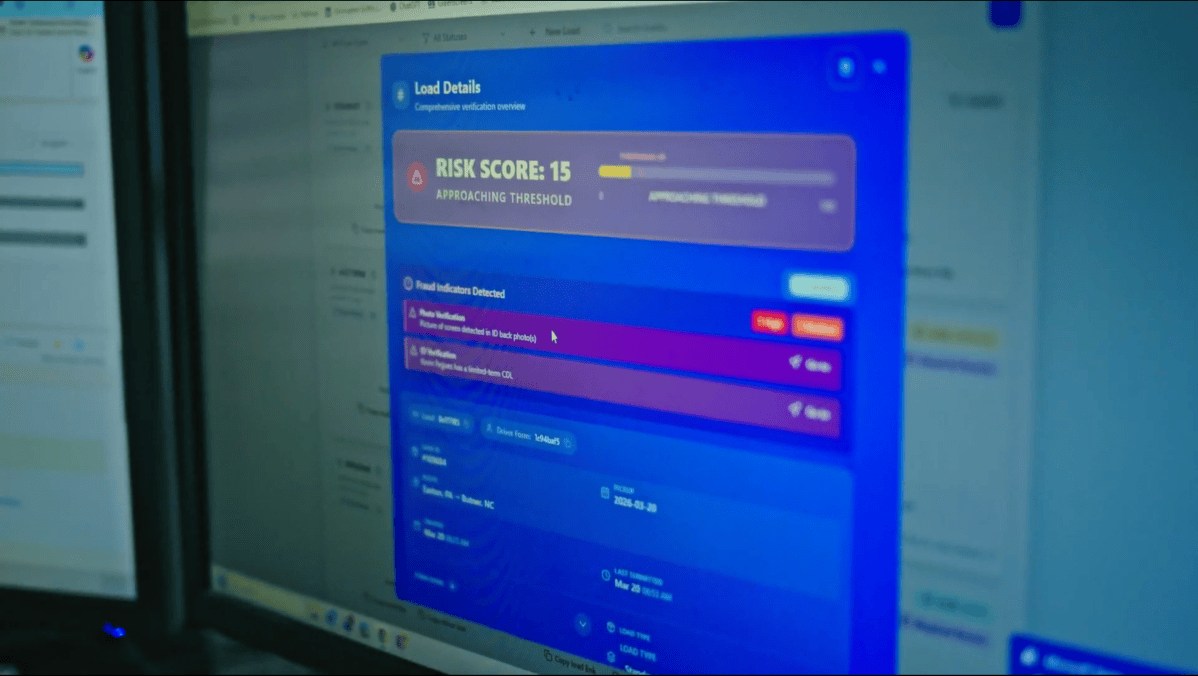
Among the fraud patterns the platform has caught, Naeem pointed to magnetic decals stuck over a truck’s real carrier markings, AI-generated or edited CDL and truck images, and driver switch-outs between authentication and arrival. The system also cross-references the barcode on the back of a CDL against the front of the card, controls the phone’s camera so nobody can upload a recycled photo (Naeem said the platform once flagged a CDL that had been photographed off a tablet screen), and checks VINs across the cab card, door-jamb sticker,and the broker’s own records, alongside location data pulled from cell tower, GPS and IP sources.
The timing matters as much as the checks themselves. “It happens hours before pickup, not at the dock,” Naeem said. “If something’s off, the broker or shipper has time to put a different carrier on the load before the truck ever shows up.”
E3’s answer to the newest wave of fraud tactics is a layered approach that can catch out AI voice cloning and spoofed motor carrier numbers. Caleb Sirak, the company’s co-founder and president, said the platform can distinguish human speech from generated audio, but added that the company doesn’t lean on phone verification in the first place.
“A cloned voice can get through a call,” Sirak said. “It can’t produce a live photo of a real CDL whose barcode matches its front, a face that matches that CDL, or a truck whose VINs match across three sources.” The same skepticism applies to carrier credentials. “Owning the MC is only the starting point,” Sirak said. “We don’t take anything at face value.” Even geography gets checked. If a verification link is sent for a Texas pickup and opened in Kentucky, for instance, E3 Group flags it right away.
The most common vetting mistake
Much of what makes fictitious pickups work, Sirak said, comes down to a basic conflation in how carriers get vetted in the first place. Treating a carrier check as a driver check”is the most common mistake he sees. A broker confirms a motor carrier number, operating authority and insurance, and all of it checks out clean, but a thief who has taken over a real carrier’s account passes every one of those checks.
Identity verification, meanwhile, often gets reduced to the weakest link, such as a phone call or a photo texted in.
“A $25 fake CDL with working barcodes will pass a visual check,” Naeem said, adding that asking for ID over the phone or by email creates legal exposure without making anyone safer. The result, as he put it: “You end up with proof of the carrier and no proof of who’s actually behind the wheel.”
Preparing for peak season
Heading into the holiday stretch, Naeem pointed to a combination of pressures.
“Peak season combines high-value freight, heavy volume and thin staffing,” Naeem said, calling November and December the highest-risk months of the year. With teams stretched thin, he said, “no one has time to double check a carrier, so a thief posing as one gets waived through.”
According to Naeem, there are two steps that cost nothing to implement, even without dedicated fraud technology in place. “Don’t release the pickup number until you know who’s coming,” he said, describing the most reliable manual workaround E3 has encountered in the field: “a FaceTime call with the driver, standing at the truck, on every high-value or theft-prone load before the pickup number goes out.”
The second step is sourcing discipline. Pull insurance and authority records directly from issuing bodies rather than trusting uploaded documents, and call back only on numbers already on file, not numbers you just got from an email signature. Formalizing those habits matters just as much as the habits themselves, according to Naeem, who recommended writing identity checks into a standing SOP and naming, in advance, who has authority to approve last-minute changes to pickup or delivery instructions.
E3’s own platform, Naeem said, is designed to take the manual version of that work off a team’s plate. “E3 driver authentication automates the first step on every load,” he said, noting it integrates with existing transportation management systems and can be running in a day.
A widening gap between targeted freight and everyday loads
The numbers show that criminals are increasingly selective about what they target. It changes the math for shippers when it comes to high-value goods like electronics and copper.
“Criminals operate on a tradeoff between the value of the freight compared to the effort of stealing it,” Naeem said, pointing to shippers who have seen their driver rejection rate fall after adopting E3’s verification process. “By elevating the cost of stealing your freight relative to the market, criminals are disincentivized from stealing your cargo,” he said.
Case in point, Naeem told us about a high-value automotive shipper that, before implementing E3 Shield, had lost multiple loads to fraud. After onboarding, the platform caught a cluster of repeated attempts from the same region using doctored CDLs with falsified expiration dates and misrepresented domicile status, including one case where a fraudster submitted a doctored CDL front paired with a real CDL back in an attempt to beat the system.
“After a month of these attempts being thwarted, we stopped seeing them attempt to get our customer’s freight,” Naeem said. Company-wide, he added, “there has not been a single theft on an E3-verified load,” a claim the company backs with a full fee-refund guarantee.
Where fraud prevention goes from here
The fight against freight fraud is shifting from document-based checks toward continuous identity verification across a shipment’s entire life cycle.
“Technology can keep pace, but only if it stops relying on documents and phone calls,” Naeem said. “The industry needs identity checks throughout the life of a shipment, not just at tender.” He outlined three changes he expects to take hold industry-wide: authentication at every handoff rather than just the first one, clear pass/fail decisions instead of ambiguous risk scores, and audit trails detailed enough for legal teams to rely on in place of today’s ad hoc verification calls.
The technology itself improves with scale. “E3 driver authentication gets better the more drivers we see,” Naeem said. “We’ve done more than 700,000 driver authentications, and every one makes the next check sharper.” Given that individual companies can’t stop crime or fraud as a whole, the goal is to make a given shipper’s freight a harder target. “We stop fictitious pickups before the truck reaches the dock,” Naeem said. “Every load gets the same check, every result is logged, and the broker gets proof of who picked up the freight. That makes your freight harder to steal than the next load, so the thieves move on.”
Click here to learn more about E3 Group.
Click here to catch Aqil during his fire side chat: Verified or Vulnerable at F3: Future of Freight Festival 2026.

Brokerage Compliance Symposium
The day before F3. Every compliance issue you face - fraud exposure, carrier liability, FMCSA rules, cargo theft, insurance gaps - navigated by attorneys and operators defining best practices in a changing industry.
F3 Awards Dinner
The night before F3. FreightTech100 companies honored. FreightTech 25 and Shipper of Choice winners revealed live. Cocktail reception into dinner and live music - 300 industry leaders in one purpose-built room.
F3: Future of Freight Festival
Industry-defining keynotes, rapid-fire technology demos, and industry leaders networking in experiences across Chattanooga - plus the inaugural F3 Awards Dinner featuring the FreightTech and Shipper of Choice reveals.
The day before F3. Every compliance issue you face - fraud exposure, carrier liability, FMCSA rules, cargo theft, insurance gaps - navigated by attorneys and operators defining best practices in a changing industry.
The Signal at Chattanooga Choo Choo • Chattanooga, TN Register NowThe night before F3. FreightTech100 companies honored. FreightTech 25 and Shipper of Choice winners revealed live. Cocktail reception into dinner and live music - 300 industry leaders in one purpose-built room.
The Signal at Chattanooga Choo Choo • Chattanooga, TN Register NowIndustry-defining keynotes, rapid-fire technology demos, and industry leaders networking in experiences across Chattanooga - plus the inaugural F3 Awards Dinner featuring the FreightTech and Shipper of Choice reveals.
The Signal at Chattanooga Choo Choo • Chattanooga, TN Register Now