
Cargo theft losses reached an estimated $304.6 million in the second quarter of 2026, more than double the $135.7 million recorded a year earlier, according to Verisk CargoNet. Reported incidents fell 26% to 677, which means fewer thefts are causing far larger losses.
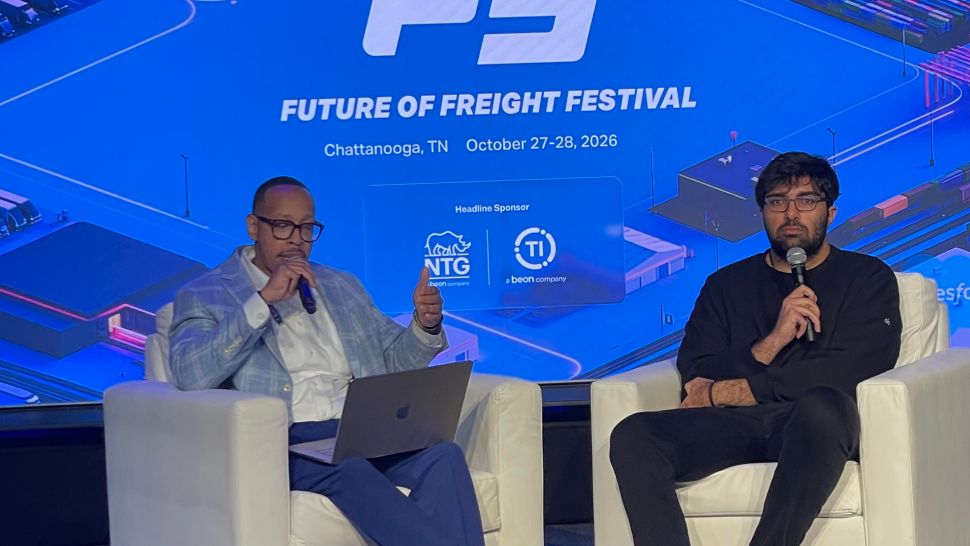
In a recent FWTV interview at FreightWaves F3, Aqil Naeem, co-founder and CEO of E3 Group, said reported numbers likely miss a meaningful share of what is happening. “We have customers of ours that are losing over $50 million a year in cargo losses, they’re just not reporting it,” Naeem said.
The reason, he explained, is reputational. “When you’re a shipper and you’re losing cargo, that looks bad for your brand,” he said. When he asks E3’s customers whether they share data with CargoNet, “a lot of them just opt out of it.”
That gap matters because the trends inside E3’s customer base look different from the headline statistics. Naeem said he can’t speak to trailer hijackings, but in one category he was unequivocal: “Amongst my customer base, fictitious pickup and deception are 100% on the rise.”
Higher-value targets, higher-value losses
Reported fictitious-pickup incident counts have been roughly flat, moving from 165 to 158 year over year in the data discussed during the interview. The cost per incident, however, has climbed. Naeem attributes that less to inflation than to what criminals are choosing to steal. Thieves, he said, are increasingly passing on low-value cargo in favor of higher-value freight, particularly “data center moves.”
He said he recalls seeing a statistic that roughly 92% of stolen high-tech equipment involves fictitious pickups and deception. The scale of a single loss can be enormous. Journalists have contacted him about $40 million loads of GPUs, which on their own would account for more than 10% of the quarterly total cited above.
When everything checks out, and the wrong person shows up
What makes modern fictitious pickup so hard for brokers and shippers to catch is that the paperwork often holds up. Naeem described a pattern in which criminals rely on a valid carrier’s credentials to get through onboarding, then send someone else to collect the freight.
“Everything checks out,” he said. “There might be someone on the inside who shares a pickup number, and the person who actually comes to the gate is different.”
Naeem reviews the thefts his customers have experienced, and the pattern is consistent. “I haven’t seen a single cargo theft happen with an MC that would have failed a carrier vetting solution,” he said. “The real problem is that people are working with good carriers. But information is leaking.”
That leaked information, he said, has a market. He described black markets where pickup codes for large enterprise shippers are traded. “For $5,000, $10,000, you can go ahead and buy a pickup code, the appointment, and the information you need,” Naeem said. “You buy a magnet, you impersonate a carrier, and there’s nothing stopping you from picking up that freight.”
Business email compromise remains a common entry point for sophisticated schemes, but Naeem framed it as a symptom of a broader exposure rather than the root cause. A breached inbox, he said, gives a criminal visibility into pickup codes and pickup times. In his view, it is “more of a logistics question,” and he would not treat solving breached email as the ultimate fix, even though it is the easiest way for someone to get that information.
Rethinking where verification happens
That diagnosis shapes E3’s product. The company positions itself as a driver verification platform built around confirming that the person arriving at pickup is actually affiliated with the carrier the broker booked.
Naeem argued that carrier vetting has reached its limits as a standalone defense. “Increasingly, carrier vetting is starting to become not only commoditized but ineffective,” he said. “You’re essentially doing LLC verification. The person who comes can be completely different.”
He said that regardless of how much customers have invested in vetting, “they just have not seen cargo thefts decline.” He added that he doesn’t know “a single top 25 brokerage” he has spoken with that has seen thefts decline over the past two years.
E3’s approach unifies information from three parties: the broker, the driver and the shipper. The shipper can then confirm that the driver at the gate was actually sent by that broker. According to Naeem, E3 verifies more than 6,000 drivers per day and has verified over 800,000 loads without a single cargo theft incident.
The driver experience, and the 4% who don’t finish
Any verification step adds friction, and drivers are the ones who feel it. E3 reports a 96% seamless completion rate, and Naeem said driver completion is “arguably the most important factor when it comes to driver verification.”
The remaining 4% is revealing, he said. Common drop-off points include drivers who are masking their IP location and decline to turn off a VPN when asked, and drivers unwilling to provide a picture of their CDL. “Obviously, someone who is fraudulent is not going to try to attempt to get through a verification process,” he said.
E3 frames the product as a tool for drivers rather than a hurdle. “We try to be a driver-centric brand,” Naeem said, adding that he talks about the product on SiriusXM and gets “dozens of emails weekly from drivers thanking us for the product.”
Deterrence through identity
One scenario tests the model: a real, credentialed driver working with a theft ring. Naeem said the verification process itself changes the risk calculation. A driver provides a name, vehicle and VIN information, and potentially ELD connections. “You have essentially created the greatest identity profile that any police or any sort of person trying to combat cargo theft would ever want,” he said.
With that much information on file, including a home address, Naeem said, “you are essentially taking on the biggest gamble of your life if you try to steal a load from one of our customers.” That, he argued, is why some would-be thieves drop out of the process.
Handling sensitive driver data
Collecting selfies and CDL scans raises obvious questions about who sees that data. Naeem said E3’s algorithm processes the information and that customers choose their own level of exposure. Some customers “will not want us to show them the CDL at all,” he said, while others “want us to store it in their Snowflake DB, and they want the custody of that data. We can support both sides of the spectrum.”
He also recommended that brokers avoid keeping CDL information in their own systems. “I know brokers that have 1000s of CDLs that they have never deleted,” he said, describing them as $1,000 fines sitting in inboxes, waiting for someone to claim them.
Guarantees, liability and misdirection
On coverage, Naeem was direct about how E3’s guarantee works. The company refunds its fees if an authenticated load is stolen, but cargo loss itself would fall to insurance. “Cargo loss has not happened yet on our platform. The insurance would hold it,” he said. E3 is working toward covering losses itself, he added, and if a customer experiences a theft, “just text me, and I’ll cover the deductible at that point.”
Another vulnerability is misdirection after the driver leaves the facility. Naeem said E3 addresses it with driver instructions. Drivers receive the shipper’s requirements and are asked to confirm their destination. If a driver enters a different location, as can happen with double-brokered freight, E3 flags a risk incident, escalates it and takes the driver off the load. Drivers are also told that if anyone asks them to change course, they should call the broker’s number, not their dispatcher.
Naeem acknowledged the limits. A driver willing to hand over all of their information and then be misdirected on purpose might still become an incident, he said, though he argued that kind of brazenness is unlikely. “We live in a country with laws,” he said.
A liability question, not just a theft question
Naeem closed with a message for brokers who may never buy E3’s product but should rethink their exposure. Verifying who actually comes to the pickup, he said, is “not only essential for cargo theft, but increasingly liability.”
He pointed to litigation as evidence, citing Hardy v. Singh, in which he said parties were found liable for failing to check whether a carrier was double brokering freight, and a suit he said C.H. Robinson and Unilever currently face. “It’s not just a cargo theft question now; it’s becoming a liability question,” Naeem said.
For shippers and brokers watching losses climb despite stronger carrier vetting, the takeaway from Naeem’s argument is that the control point may need to move. The credentials can be valid and the carrier can be sound. The open question is whether the person at the gate belongs there.