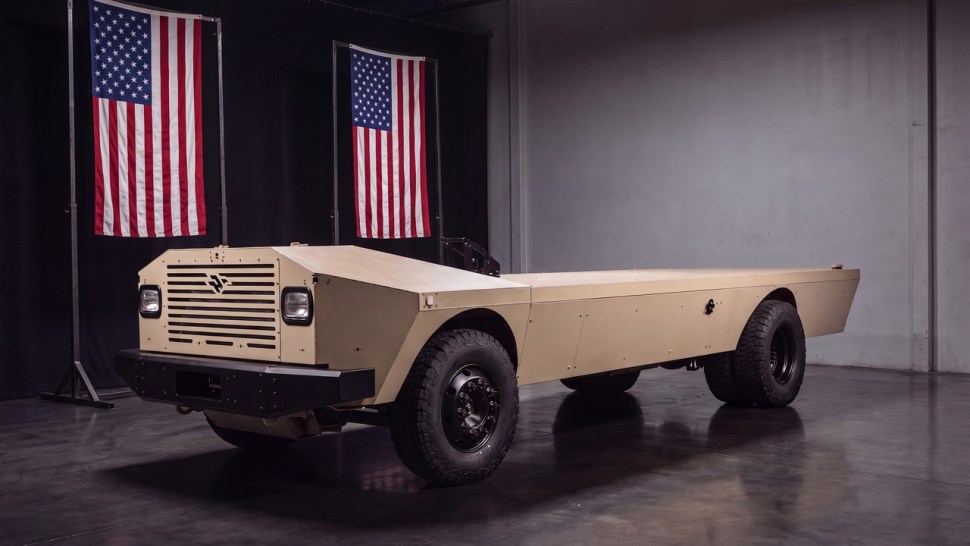
Across the U.S., a final-mile network operates in a similar yet predictable manner: a small truck, a short route, one person in the cab. The U.S. Army runs that same network, except it has more challenges for the person in the cab and the route. Harbinger, the Garden Grove, Calif., builder of electric and hybrid medium-duty chassis, is supplying prototype trucks to tackle what the Army refers to as the last tactical mile.
It started with American Rheinmetall, which was awarded an 18-month Army contract on July 31 for Project Sustainment. It is an effort to field hybrid-powered uncrewed ground vehicles that move supplies to and from the forward line of troops. American Rheinmetall holds the award as prime contractor, and Harbinger is a tier-one supplier building the platform. It is Harbinger’s first defense contract.
What Harbinger is shipping is not a truck with the driver removed. There is no cab, no steering wheel and no pedals, so no Soldier is available to take over when the autonomy quits.
“This is an AGV product. There’s no steering wheel, there’s no pedals. It is not optionally manned. It is a moving trailer-like platform,” said John Harris, co-founder and CEO of Harbinger, in an interview with FreightWaves.
From the Doorstep to the Last Tactical Mile
The Army’s resupply architecture already maps onto a distribution network. Main trains haul bulk to the brigade or battalion, those stocks get pushed down to company-level formations, and what runs the final leg today is a five-ton or a deuce-and-a-half with Soldiers in it.
“They’re really looking at how do we take that five-ton, deuce-and-a-half type size vehicle and how do we remove some of the Soldiers from doing that very exposed mission set,” said Adam Horton, director of business development at American Rheinmetall, in an interview with FreightWaves.
That errand is one of the dull, dangerous and dirty jobs the Army wants automated. To copy it, the military supply network is taking a page from civilian commercial last-mile applications.
“It’s taking a lot of cues from what Amazon, UPS, FedEx are doing where you have those smaller trucks that are getting out there to go that last delivery mile if you will,” Horton said.
Harbinger builds Class 4 through Class 6 chassis, and Chris Haag, vice president for business development and strategy at American Rheinmetall, described the Project Sustainment vehicle as built off “kind of a Class 5 / Class 6 type truck which does door-to-door delivery at that last tactical mile commercially.”
Silent Running Inside the Drone Kill Zone
The first key clarification: these are hybrid drivetrains. “There’s no EVs in this contract, only hybrids,” Harris said.
The architecture is a series hybrid that runs in either mode. The reason is geography paired with range. Harbinger’s plug-in hybrid chassis is rated up to 500 miles commercially, and that number sets how far behind the front the supply node can sit.
“When we’re within the sort of drone kill zone, the 20 to 30 miles of the front line, it’s very compelling to be able to run as an EV, but we also don’t want to have to refuel or reload the vehicle only 30 miles out,” Harris said.
Electric mode buys concealment, something the modern combat zone makes challenging because of the constant contest between thermal imagery and electronic warfare capabilities.
“We can have near-zero noise, near-zero thermal signature, all of these things that make it a really compelling platform to move up to the front line for sustainment purposes without being a huge obvious target because it’s an engine running,” Harris said.
The receiving unit has no fuel, no maintenance bay and no recovery asset, so a vehicle that breaks at the company formation stays broken.
“You’re not going on hardball roads with lanes and markers,” Horton said. “So the autonomy has to be much more robust in order to accomplish that mission.”
Built By-Wire From Day One
Harbinger’s claim on the platform work rests on decisions made before it had a defense customer. The chassis was specified steer-by-wire and brake-by-wire with redundant power from the start.
Vertical integration bought both the cost and the capability, and the actuation hardware that autonomy needs is already on the vehicle. “If we hadn’t vertically integrated, if we’d said we’ll just go to a big steering supplier and buy what they’ve got, it would have been more expensive and dramatically less capable, because there just aren’t systems off the shelf that have this kind of by-wire functionality, in particular in the commercial vehicle segment,” Harris said.
Everybody’s Piece of the Puzzle
Four companies are on the contract. Each carries a different problem to solve. Forterra supplies cross-country Level 5 autonomy for terrain with no roads or lane markings. Primordial Labs supplies Anura, a natural-language interface that enables hands-free operation and is intended to improve the Soldier-to-robot ratio. American Rheinmetall adds the defense-specific hardware and carries the contract.
That division of labor is why a commercial truck builder could take Army work without standing up a defense arm to do it.
“There’s a lot that goes into a defense contract besides just making stuff,” Harris said. “We have this contract set up in a way that has allowed Harbinger to focus on the part that we know how to do, which is make vehicle platforms.”
The award moved through the National Advanced Mobility Consortium under other transaction authority, a pathway built for prototypes and faster than a traditional FAR-based contract. Haag put it in freight terms: “like a prequalified carrier network,” where the government posts a requirement into a membership pool and members answer with solution write-ups and a price proposal.
From a Handful of Prototypes to 5,000
The order book is purposefully small by design. This is a low-volume prototype demonstrator phase, typically three to 10 units, and the Department of War moves from that stage to low-rate initial production before anything reaches high volume.
Low-rate production tests whether the thing can be built the same way twice. “We’re going to buy a hundred and not 5,000 to make sure that they all come out and do the same thing as we expect them to,” Harris said.
What the Army is buying right now is information. “This prototyping phase is typically about figuring out what you actually want. This is where the requirements are evolving, the approaches are evolving,” Harris said.
It is a deliberate posture, reflecting a new trend: a Department of War that hands industry a problem and asks what it has that can solve it.
The next milestone is a National Training Center demonstration in six to 12 months, Horton said, after which the Army returns with requirement changes. The contract carries potential for follow-on orders, according to the announcement. American Rheinmetall and Harbinger announced the partnership itself on May 27.
Cost is the whole bet, and it is a bet on commerciality. “The real uniqueness of our offering is that it is foundationally a commercial vehicle,” Horton said. “So there are some things that are not fully militarized, but I think that allows a lower cost of entry for the Army to get these mass-produced.”
Looking ahead, the demonstration is where the program converts or stalls.
“What we want to make sure we have is Soldier input into the platform, into the Graphical User Interface and how you interact with it, ,” Haag said. “Not just demos, but try to real-world use it as best you can so that it’s like, ‘Wow, this is the thing I’m looking for and it can do all these things and we’re 95% of the way so here’s the other 5%, let’s see if we can get it.’”
Brokerage Compliance Symposium
The day before F3. Every compliance issue you face - fraud exposure, carrier liability, FMCSA rules, cargo theft, insurance gaps - navigated by attorneys and operators defining best practices in a changing industry.
F3 Awards Dinner
The night before F3. FreightTech100 companies honored. FreightTech 25 and Shipper of Choice winners revealed live. Cocktail reception into dinner and live music - 300 industry leaders in one purpose-built room.
F3: Future of Freight Festival
Industry-defining keynotes, rapid-fire technology demos, and industry leaders networking in experiences across Chattanooga - plus the inaugural F3 Awards Dinner featuring the FreightTech and Shipper of Choice reveals.
The day before F3. Every compliance issue you face - fraud exposure, carrier liability, FMCSA rules, cargo theft, insurance gaps - navigated by attorneys and operators defining best practices in a changing industry.
The Signal at Chattanooga Choo Choo • Chattanooga, TN Register NowThe night before F3. FreightTech100 companies honored. FreightTech 25 and Shipper of Choice winners revealed live. Cocktail reception into dinner and live music - 300 industry leaders in one purpose-built room.
The Signal at Chattanooga Choo Choo • Chattanooga, TN Register NowIndustry-defining keynotes, rapid-fire technology demos, and industry leaders networking in experiences across Chattanooga - plus the inaugural F3 Awards Dinner featuring the FreightTech and Shipper of Choice reveals.
The Signal at Chattanooga Choo Choo • Chattanooga, TN Register Now