




During the 1950s the U.S. government sponsored a program that allowed U.S.-flag ships, particularly tankers, to be sold to foreign entities, provided an equal amount of deadweight tonnage was built in U.S. shipyards and flew the American flag.
This program became a significant financial and production stimulus for the country’s shipyards and resulted in many large tankers to enter and strengthen the U.S. merchant marine.
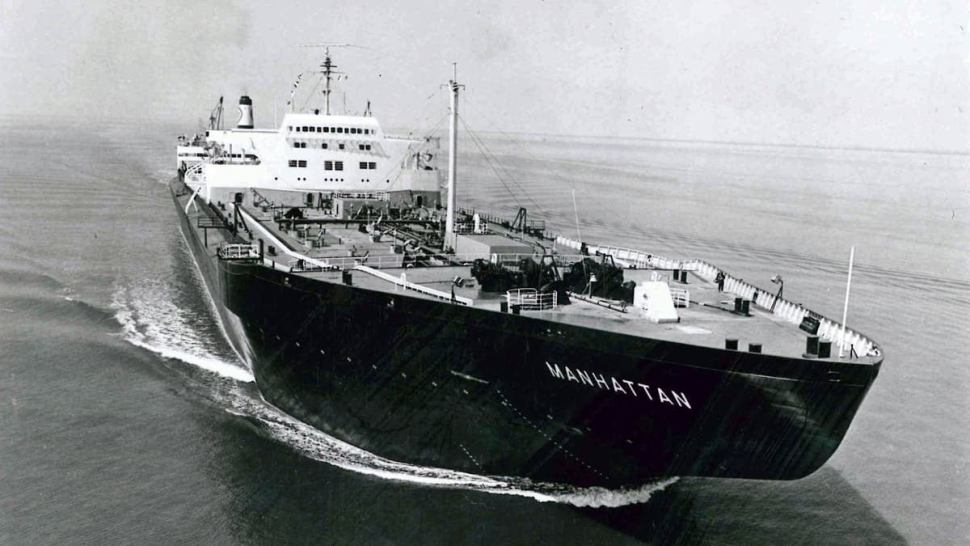
The 106,568-deadweight-ton, “steam tanker” Manhattan was built under the provisions of this program during 1961. At that time it was the largest merchant ship ever built in the U.S. and the largest to ever fly the U.S. flag. It measured 940.5 feet in length, 132 feet in beam, and 67.5 feet in depth.
The Manhattan was built at the Quincy yard of Bethlehem Steel for the Manhattan Tanker Co., a Spyros Niarchos family enterprise. The twin screw, twin-ruddered ship had a maximum speed of over 19 knots, but its normal sea speed was 17.5 knots.
The ship was delivered on January 15, 1962, and immediately employed on voyages to the Persian Gulf, returning to the U.S. East Coast with crude oil. Later that year, the ship was sold to the U.S.-flag company Hudson Waterways.
In March 1963, the Manhattan entered the bulk grain trades. It was the crude oil and grain trades that kept the ship employed throughout its career with one exception.

The U.S.-flag Manhattan, the world’s largest merchant ship, undergoing sea trials in 1962. [Photo Courtesy: Capt. James McNamara]
During the mid-1960s, oil was discovered near Prudhoe Bay, Alaska, and it was not known if the federal government would allow a pipeline to be built across the state to the Port of Valdez, where the oil could then be transported to the lower 48 states.
To gain access to the largest oil field in North America, Exxon (Humble Oil), together with ARCO and BP, chartered the 43,000-horsepower Manhattan and converted it to an icebreaker/oceanographic research vessel to test the feasibility of the route through Canada’s Arctic islands, now known as the Northwest Passage. Forty million dollars were raised for the expedition.

The Manhattan on sea trials after its rebuild in the late 1960s. [Photo Courtesy: Capt. James McNamara]
To speed the conversion to icebreaker, the ship was dry docked at Sun Shipyard in Chester, Pennsylvania, and cut into four sections. The forward piece was replaced by a new icebreaking bow built by Sun and Bath Iron Works of Maine, and later towed to Newport News, Virginia, where it was fitted with a heavy ice belt. The midship section was towed to Mobile, Alabama, where a similar ice belt was fitted. When completed at the Sun yard, the Manhattan measured 1,005 feet by 148 feet, and its weight increased by 9,000 tons. The ship was also outfitted with additional living quarters, laboratories, electronic gear, a helicopter deck and much more. Her 45 cargo tanks were to be used for ballast and not the carriage of oil.

An aerial view of the Manhattan’s main deck, showing laboratories and increased accommodations. [Photo Courtesy: Capt. James McNamara]
On August 24, 1969, the Manhattan commenced its 4,500-mile voyage across the top of North America, of which 650 miles were through ice measuring up to 14-feet thick. Since the ice was 24-feet thick in the McClure Strait, the ship sailed further south through the Prince of Wales Strait. The ship arrived at Prudhoe Bay on September 19, where a symbolic barrel of oil was loaded on the ship’s main deck. Days later the ship departed, heading east via the Northwest Passage, arriving in New York harbor on November 8 to a great celebration.

The following April the ship began a second voyage to test itself against the winter ice. Instead of heading to Prudhoe, the ship headed to Pond Inlet near the top of Baffin Island, where oceanographic research and numerous icebreaking tests were carried out.
By 1971, the Manhattan had resumed its role as a crude oil carrier, spending most of its remaining service years delivering Prudhoe Bay crude via the Port of Valdez to the lower 48 states.
As things worked out, the Trans-Alaska pipeline was finally approved and built. Thus, the fallback proposal of a fleet of Arctic tankers was dismissed. However, what the Manhattan experiment demonstrated was that it was technically feasible for ice-fitted commercial ships to transit the Northwest Passage.
On July 15, 1987, the Manhattan met its untimely end while awaiting another cargo at Yosu, Korea. During Typhoon Thelma, the ship dragged anchor and grounded on a rocky bottom. After refloating, the Manhattan was towed to China to be scrapped.
Brokerage Compliance Symposium
The day before F3. Every compliance issue you face - fraud exposure, carrier liability, FMCSA rules, cargo theft, insurance gaps - navigated by attorneys and operators defining best practices in a changing industry.
F3 Awards Dinner
The night before F3. FreightTech100 companies honored. FreightTech 25 and Shipper of Choice winners revealed live. Cocktail reception into dinner and live music - 300 industry leaders in one purpose-built room.
F3: Future of Freight Festival
Industry-defining keynotes, rapid-fire technology demos, and industry leaders networking in experiences across Chattanooga - plus the inaugural F3 Awards Dinner featuring the FreightTech and Shipper of Choice reveals.
The day before F3. Every compliance issue you face - fraud exposure, carrier liability, FMCSA rules, cargo theft, insurance gaps - navigated by attorneys and operators defining best practices in a changing industry.
The Signal at Chattanooga Choo Choo • Chattanooga, TN Register NowThe night before F3. FreightTech100 companies honored. FreightTech 25 and Shipper of Choice winners revealed live. Cocktail reception into dinner and live music - 300 industry leaders in one purpose-built room.
The Signal at Chattanooga Choo Choo • Chattanooga, TN Register NowIndustry-defining keynotes, rapid-fire technology demos, and industry leaders networking in experiences across Chattanooga - plus the inaugural F3 Awards Dinner featuring the FreightTech and Shipper of Choice reveals.
The Signal at Chattanooga Choo Choo • Chattanooga, TN Register Now