Mexico’s heavy-duty truck manufacturing industry posted a sharp rebound in October, with production surging nearly 130% and exports jumping 159% compared with a year earlier, according to new government data.
Mexican manufacturers produced 16,375 heavy-duty vehicles during October, a 129.6% increase from 7,131 units in October 2025, according to the National Institute of Statistics and Geography (INEGI).
Exports climbed 158.9% to 13,518 vehicles, compared with 5,221 during the same month last year.
The gains highlight the recovery in Mexico’s export-oriented truck manufacturing industry, which relies heavily on the U.S. as its largest customer.
However, the National Association of Bus, Truck and Tractor-Trailer Producers (ANPACT) warned that Mexico’s domestic heavy-duty vehicle market continues to struggle with weak demand, aging fleets and competition from imported used trucks.
“The results for October show mixed signals for the industry, particularly as the domestic market faces significant challenges,” Rogelio Arzate, ANPACT’s executive president, said in a news release. “Although retail sales increased during the month, the year-to-date total remains about 16% below the previous year.”
Mexico’s heavy-duty truck industry rebounds
October’s manufacturing gains helped lift year-to-date production to 133,496 heavy-duty vehicles, an increase of 17.8% compared with 113,299 during the first 10 months of 2025.
Exports totaled 111,912 vehicles from January through October, up 20.3% from 93,037 a year earlier.
The U.S. remained the dominant destination for Mexico-made heavy-duty vehicles, accounting for 104,064 units, or 93% of total exports through October, according to INEGI.
During ANPACT’s monthly news conference, Arzate said exports to the United States rose 173.5% year over year in October, reaching 13,097 vehicles. Shipments to the U.S. were up 18.6% through the first 10 months of 2026.
Canada was Mexico’s second-largest export destination during the January-October period, receiving 4,493 vehicles, followed by Colombia with 2,138.
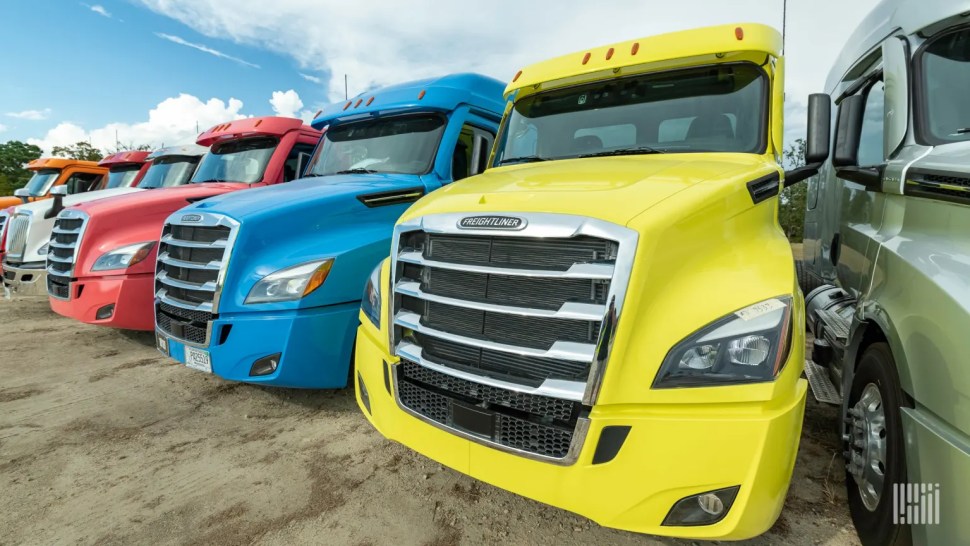
Freightliner accounted for approximately 64% of Mexico’s heavy-duty vehicle production and 71% of exports in October. Together, Freightliner, International and Kenworth represented approximately 97% of production and virtually all exports.
Mexico heavy-duty truck production and exports — October 2026
| Manufacturer | Production | Exports | Production YoY | Exports YoY |
| Freightliner | 10,457 | 9,568 | +160.3% | +164.1% |
| International | 4,208 | 3,583 | +189.6% | +205.2% |
| Kenworth | 1,145 | 366 | +5.8% | -13.7% |
| Combined total | 15,810 | 13,517 | — | — |
| Mexico industry total | 16,375 | 13,518 | +129.6% | +158.9% |
Domestic truck demand remains weak
Despite the manufacturing rebound, Mexico’s domestic heavy-duty vehicle market continues to face challenges.
Retail sales increased 5.1% in October to 3,162 vehicles, compared with 3,009 in October 2025.
However, retail sales for the first 10 months of 2026 totaled 28,479 vehicles, down 15.4% from 33,653 during the same period last year.
Wholesale sales showed stronger improvement, rising 26.8% in October to 3,301 vehicles.
Year-to-date wholesale sales reached 26,912 units, an increase of 10.5%.
The tractor-trailer segment was among the strongest performers. Wholesale sales of fifth-wheel tractors climbed 48.1% in October to 1,438 units, compared with 971 a year earlier.
Cristina Vázquez, economic studies coordinator for the Mexican Automotive Distributors Association (AMDA), said during the news conference that October represented only the second month of positive year-over-year retail sales growth in 2026.
Vázquez also pointed to uncertainty surrounding economic conditions and North American trade policies as factors discouraging fleet investment.
She said some companies were postponing vehicle purchases until they had greater clarity about future operating and investment conditions.
ANPACT warns used-truck imports threaten fleet renewal
ANPACT said competition from imported used heavy-duty vehicles remains one of the biggest obstacles to improving Mexico’s domestic truck market.
During the news conference, Arzate said that for every 100 new heavy-duty vehicles sold in Mexico during the January-September period, approximately 51.4 used vehicles were imported from the United States.
The association argues that the influx of older imported trucks distorts pricing, discourages purchases of new equipment and undermines efforts to modernize Mexico’s commercial vehicle fleet.
ANPACT also raised concerns about increasing imports of buses manufactured in countries without free trade agreements with Mexico.
The association called for stronger vehicle scrappage programs, improved financing options and policies that would encourage smaller trucking companies to replace aging equipment.
Why it matters: Mexico is a critical manufacturing hub for North America’s trucking industry, and its production rebound highlights the importance of U.S. demand even as Mexican carriers struggle to replace aging fleets.