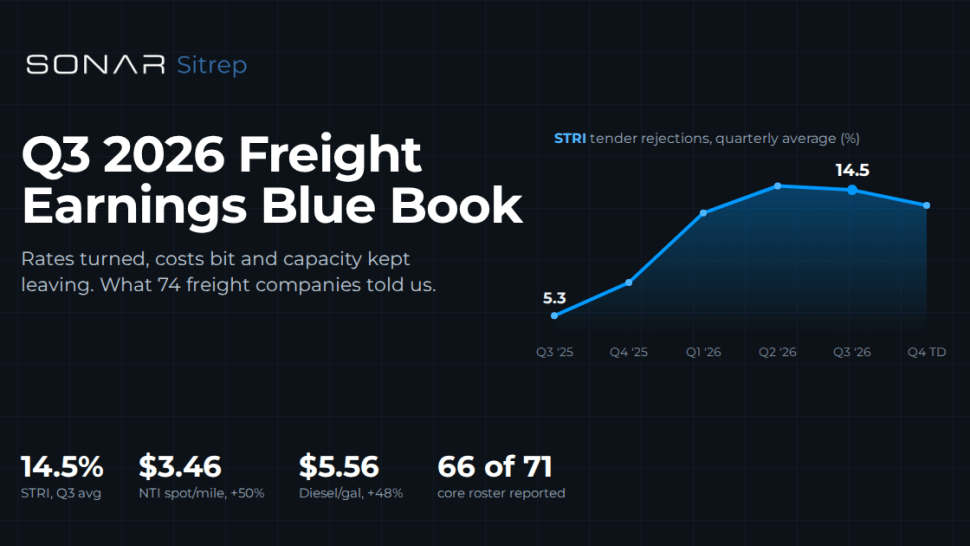
Q3 2026 Freight Earnings: What 74 Companies Told Us
Rates turned, costs bit and capacity kept leaving. Here is what the Q3 2026 freight earnings season says about the market heading into the 2027 bid season.
The short answer
- Q3 2026 freight earnings confirmed a supply-driven recovery: SONAR tender rejections (STRI) averaged 14.5%, nearly triple a year ago, while tender volume (STVI) rose 8.5%.
- Pricing exposure picked the winners. One-way truckload fleets expanded margins; dedicated and small contract fleets absorbed the cost squeeze.
- Diesel was the biggest cost, averaging $5.56 per gallon (+48% y/y), and inflated revenue across every mode.
- LTL tonnage turned and accelerated in October, while ocean and forwarding profits likely peaked.
By the numbers
- 14.5% STRI Q3 average, vs. 5.3% a year ago
- $3.46 NTI spot rate per mile, up 50% y/y
- $5.56 Diesel per gallon, up 48% y/y
- 89.2% Knight-Swift TL adjusted OR, 700 bps better
The Q3 2026 freight earnings season is nearly complete. Of the 71 companies on SONAR’s core roster, 66 have reported, along with eight supplemental companies, from truckload carriers and railroads to ocean lines, brokers and freight technology firms. Our full Q3 2026 Freight Earnings Blue Book scores every segment and the largest carriers. This is the short version.
A supply-driven freight market, not a demand boom
The clearest signal in Q3 came from SONAR’s tender data. Carriers rejected 14.5% of contracted loads on average, up from 5.3% a year earlier, while accepted volume grew in the single digits. That combination points to capacity leaving the market, not a flood of new freight.
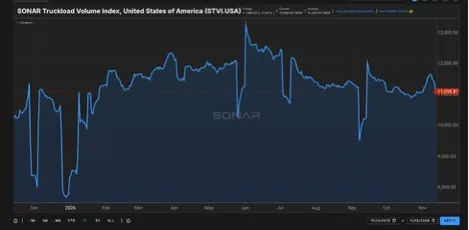
STRI.USA: tender rejections climbed from about 6% in November 2025 to a peak near 17.6% in late June and stood at 12.87% on Nov. 13, roughly double year-ago levels. Source: SONAR.
STVI.USA: outside holiday dips, tender volume has held between roughly 11,000 and 12,500 all year. Steady volume plus high rejections means tight supply. Source: SONAR.
Carrier commentary matched the data. Knight-Swift, Schneider, Covenant and TFI International all shrank their fleets by 4% to 12% and pushed rate. Roper, parent of DAT, described the load board recovery the same way: driven by supply, not demand.
Truckload: pricing exposure picked the winners
Truckload delivered the season’s sharpest split. Carriers with large one-way networks repriced quickly; fleets tied to dedicated contracts and annual index escalators could not keep up with fuel, wage and insurance costs.
| Carrier | One-way rev/truck/week | Dedicated rev/truck/week |
| Werner | +34.3% | +5.6% |
| Schneider | +21.4% | +3.1% |
| Covenant (expedited) | +12.0% | +6.2% |
Knight-Swift, with about three-quarters of its truckload revenue in one-way freight, lifted revenue per mile 12.2% while cost per mile rose 3.8%, improving its adjusted truckload operating ratio by 700 basis points to 89.2%. J.B. Hunt’s dedicated segment went the other way, with operating income down 22%. Smaller contract fleets fared worst: Pamt posted a 109.1% truckload operating ratio, its 12th straight truckload loss.
The carriers that could reprice fast won Q3. Everyone else is waiting on the 2027 bid season.
LTL tonnage turned the corner
After two years of declines, LTL volumes turned positive at Old Dominion in September and accelerated across the group in October: ArcBest’s tonnage rose about 15%, Saia’s about 10% and XPO’s about 6.5%. Shipments are getting heavier, which suggests LTL is winning freight that tight truckload capacity no longer moves cheaply. XPO posted the best margin progress, with an adjusted LTL operating ratio of 80.1%, 260 basis points better.
Rail: fuel split the Class I railroads
All six Class I railroads grew revenue 12% to 15% on volume gains of just 3% to 6%. How each absorbed a 56% to 69% jump in fuel expense decided its margins. CSX improved its operating ratio about 420 basis points, while Norfolk Southern’s worsened 280 basis points. Intermodal was the bright spot, with record volume at CSX and a 27% intermodal revenue gain at Union Pacific.
Ocean and forwarding: record profits, softer 2027
Ocean carriers and forwarders posted the biggest profit swings of the season, almost entirely on price. Maersk’s loaded rates rose 46% on slightly lower volume, and Expeditors grew earnings per share 62% as AI-related air freight from hyperscalers and their suppliers surged. Carriers expect 2027 to be softer: Drewry projects container capacity growth of 8.8% against 6.2% demand growth.
What to watch into the 2027 bid season
VCRPM1.USA: van contract rates climbed from about $2.31 per mile a year ago to $2.88, a 12-month high, accelerating in October. Source: SONAR.
Contract rates are still climbing. Knight-Swift expects to open bids with low-to-mid double-digit increases, and Werner expects double-digit gains on the one-way business it reprices in the first half of 2027. Truck orders now trail deliveries ahead of final EPA 2027 rules, so capacity is likely to rebuild slowly. Watch STRI and VCRPM1 through January: if rejections hold above 12%, double-digit contract increases become the base case.
Frequently asked questions
How did freight companies perform in Q3 2026?
Most beat expectations on rising rates, but results split by pricing exposure. One-way truckload fleets such as Knight-Swift expanded margins sharply, while dedicated and small contract fleets absorbed fuel, wage and insurance inflation. Of SONAR’s 71-company core roster, 66 have reported.
Is the 2026 freight recovery driven by demand?
No. SONAR data shows a supply-driven market. Tender rejections (STRI) averaged 14.5% in Q3 versus 5.3% a year earlier, while tender volumes (STVI) rose only 8.5%. Carriers described capacity leaving the market rather than a surge in freight.
How much did truckload rates rise in Q3 2026?
SONAR’s National Truckload Index (NTI) averaged $3.46 per mile in Q3, up about 50% from a year earlier, and van contract rates (VCRPM1) averaged $2.70, up 17.5%. Contract rates reached $2.88 in mid-November ahead of the 2027 bid season.
How did diesel prices affect Q3 freight earnings?
Diesel averaged $5.56 per gallon in Q3, up 48% year over year, and was the most-cited cost headwind. Fuel expense rose 56–69% at the railroads that disclosed it and 64% at FedEx, compressing margins until surcharges caught up.
What should shippers expect in 2027 freight bids?
Carriers are asking for higher contract rates. Knight-Swift expects to open bids with low-to-mid double-digit increases, and Werner expects double-digit increases on the one-way business it reprices in the first half of 2027.
Get the full Q3 2026 Blue Book
The full report covers every segment, company scorecards for the largest truckload, LTL and rail carriers, and the SONAR data behind them. SONAR subscribers can track every index in this article daily, by market.
Subscribe to SONAR | Try FreightWaves Market Monitor
Data: SONAR quarterly averages (Q3 2026 vs. Q3 2025) and company Q3 2026 earnings releases, filings and calls. Operating ratios for CSX are calculated from reported operating margin.