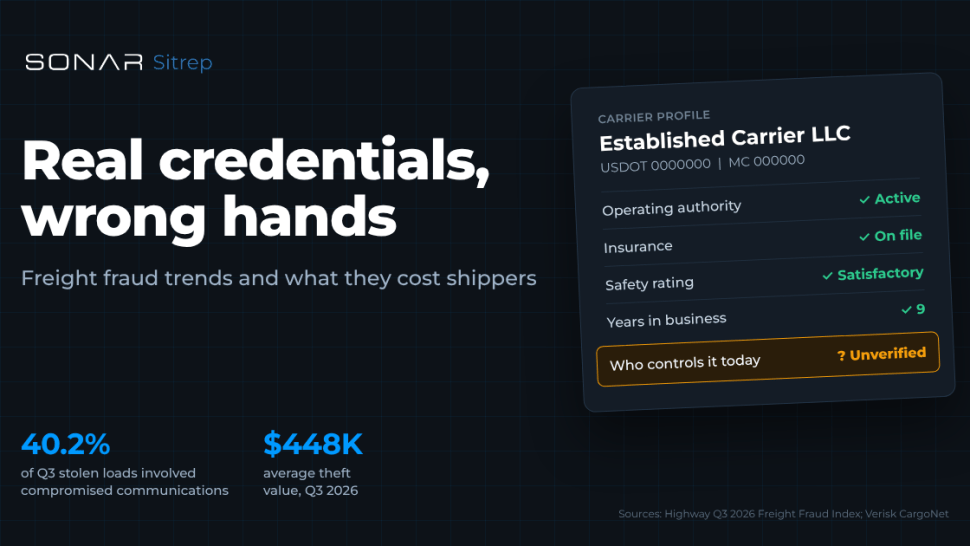
Freight fraud trends and what they cost shippers
How hijacked carrier identities, a tight truckload market and a shifting liability landscape put shippers on the front line of cargo theft.
EXECUTIVE SUMMARY
Freight fraud no longer depends on fake carriers. In Q3 2026, more than 80% of the stolen loads reported to Highway involved real carrier credentials in the wrong hands: hijacked inboxes, purchased motor carrier authorities and rogue carriers with clean records. Reported theft counts fell from Q2 at both Highway and Verisk CargoNet, but the value of each theft is climbing, and the operational burden is moving down the chain to the shipper’s dock.
SONAR data shows why the pressure is unlikely to ease. National truckload tender rejections (STRI.USA) sit at 12.78%, roughly double the 6.3% of a year ago; reefer rejections (STRIR.USA) are near 22%; and Q4 has historically added another leg higher. Tight capacity creates urgency, and urgency is the condition fraud schemes exploit.
Key findings:
• Highway logged 184 stolen loads in Q3 (-28.1% QoQ); compromised communications accounted for 40.2% of them and direct theft by carriers for 36.4%.
• Verisk CargoNet counted fewer Q3 incidents (547, -33% YoY) but higher losses ($230.1M, +12% YoY); average theft value rose about 72% to $448,456.
• Theft did not simply track capacity: STRI was flat from Q2 to Q3 while Highway’s stolen loads fell 28%, consistent with Highway’s view that verification controls made the difference.
• The three leading theft states (California, New Jersey and Texas) are all running below the national rejection rate, which suggests hot spots reflect freight hubs and resale demand more than capacity tightness.
• The carrier base is contracting: on preliminary data, new for-hire fleets are down about 35% year over year and for-hire tractors about 6.4%, shrinking verified capacity as holiday demand builds.
• Reefer freight carries a double exposure: some of the tightest capacity in the market and the food and beverage freight thieves target most.
• The affirmed C.H. Robinson verdict (now above $700M with interest) raises broker risk costs that are likely to flow into shipper rates and routing guides.
 & Market Monitor Exclusive
Keep reading with or Market Monitor
and Market Monitor customers.