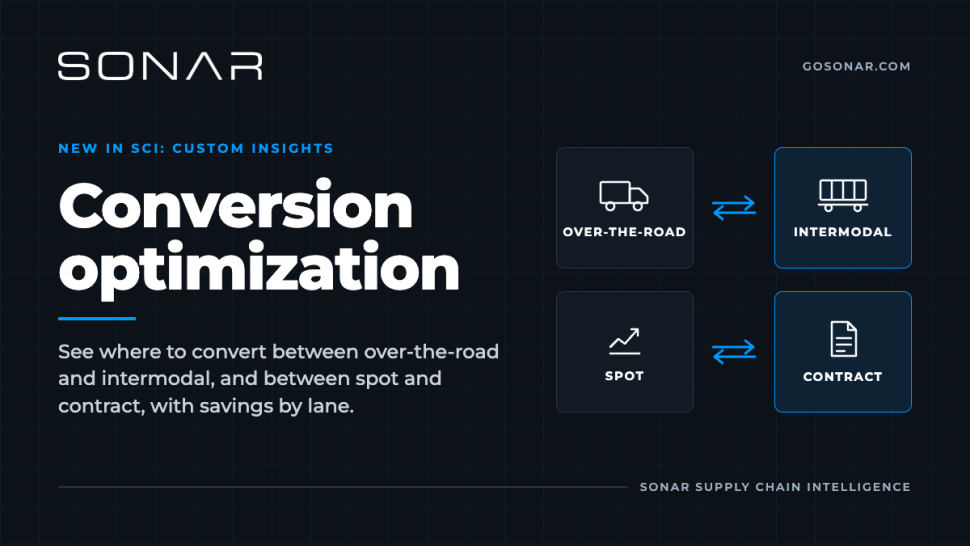
The newest module in Supply Chain Intelligence: Custom Insights uses a shipper’s own freight data to flag lanes that could move from truckload to intermodal, or between spot and contract, and estimates the savings lane by lane.
SONAR has added mode conversion optimization to SCI: Custom Insights, part of its Supply Chain Intelligence (SCI) platform, with Conversion Optimization. The new module uses a shipper’s own network data to show where freight can convert between over-the-road truckload and intermodal, and between spot and contract, and estimates the savings on each lane. Shippers can adjust the volume they want to test, and SCI recalculates total estimated savings across every selected lane.
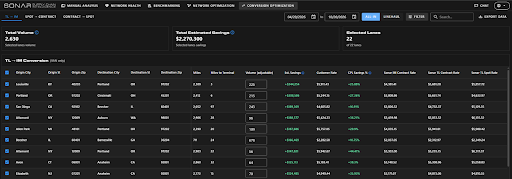
The Conversion optimization view in SCI: Custom Insights, with tabs for truckload to intermodal, spot to contract and contract to spot.
At a glance
- What it is: a mode and pricing-strategy optimizer inside SCI: Custom Insights
- What it finds: lanes ready for truckload-to-intermodal, spot-to-contract or contract-to-spot conversion
- What it calculates: estimated savings per lane and in total, based on the volume you choose to convert
- Who it’s for: procurement, network planning and finance teams at shippers in the SONAR Shipper Consortium
- Released: October 2026
What is SCI Conversion optimization?
Conversion optimization is a module within SCI: Custom Insights, the consortium-powered experience in SONAR Supply Chain Intelligence. It shows shippers where they can convert between over-the-road truckload and intermodal, and between spot and contract, to reduce transportation costs, using their own freight data and SONAR market benchmarks.
It covers both conversions in three views:
- Over-the-road to intermodal: lanes where rail intermodal can carry the freight for less than over-the-road truckload
- Spot to contract: lanes where freight repeatedly lands on the spot market and a contract rate would be cheaper and steadier
- Contract to spot: lanes where contracted rates sit above the spot market and moving volume to spot would save money
How does Conversion optimization work?
- Three conversion views: separate tabs for truckload to intermodal, spot to contract and contract to spot
- Side-by-side rates: each lane shows the shipper’s current rate next to SONAR intermodal contract, truckload contract and truckload spot rates
- Terminal distance: truckload-to-intermodal lanes show miles to the nearest rail terminal
- Estimated savings: shown per lane in dollars and as a cost-per-load savings percentage, plus a total across all selected lanes
- Adjustable volume: change the volume on any lane to match planned changes, and total savings recalculate automatically
- Filters and export: set a date range, select lanes and export the data for bid planning and rate reviews
The volume control matters. Few shippers will move 100% of a lane to intermodal overnight. Testing 20%, 40% or 60% shows the savings at each level, so teams can build a realistic conversion plan.
Why mode decisions matter right now
The gap between intermodal and truckload contract rates shifts with the market, and so does the gap between spot and contract pricing. When over-the-road contract rates climb faster than intermodal, conversion savings grow. [STAT: current intermodal vs. van contract savings from SONAR]
Most shippers make these calls once a year, during the RFP. Conversion optimization lets them revisit the decision whenever the market moves, not just at bid time.
How it fits into the SCI platform
Conversion optimization is the newest module in SCI: Custom Insights, which launched in September 2026. It builds on:
- Custom Insights’ network view, which pairs a shipper’s own data from the SONAR Shipper Consortium with market benchmarks to track network health
- Redesigned SCI experience with a Risk and Efficiency Quadrant for faster RFP guidance
- Manual Analysis, the original SCI workflow, still available for mini-bids, project freight and new lanes
- New contract-based datasets released alongside Conversion optimization: Routing Guide Premium (RGP), Routing Guide Acceptance Share (RGAS) and Contract Rate Change Direction (CRCD)
Together, they move SCI from showing where a shipper is overpaying to showing what to do about it.
Who should use it
- Procurement teams planning RFPs, mini-bids or mid-cycle rate reviews
- Network planners weighing intermodal for long-haul, high-volume lanes
- Finance leaders forecasting transportation spend and looking for savings
- Logistics managers with lanes that keep falling to the spot market
How to get started
SCI: Custom Insights users can log in to SONAR and open Conversion optimization within Custom Insights. Shippers not yet in the Shipper Consortium can ask their account manager about contributing data. For a walkthrough, contact your SONAR account manager. Shippers new to SONAR can request a demo.
FAQs:
What is SONAR SCI Conversion optimization? It is a module in SCI: Custom Insights, part of SONAR Supply Chain Intelligence, that finds lanes where a shipper could save money by converting between over-the-road truckload and intermodal, or between spot and contract, and estimates the savings.
Which mode conversions does SONAR SCI evaluate? Two: between over-the-road truckload and intermodal, and between spot and contract (in both directions).
Can I test converting only part of a lane’s volume? Yes. Users set the volume they want to evaluate on each lane, and SCI recalculates total estimated savings across all selected lanes.
How does Conversion optimization fit into SCI: Custom Insights? It is a module inside Custom Insights. Custom Insights pairs a shipper’s own data with SONAR benchmarks to show network health, and Conversion optimization uses that same data to recommend mode and pricing-strategy changes by lane.
When should shippers consider truckload-to-intermodal conversion? Usually on long-haul, high-volume lanes with flexible transit times, especially when truckload contract rates rise faster than intermodal rates.
How do I access Conversion optimization? Shippers using SCI: Custom Insights can find it inside Custom Insights in SONAR. New users can request a demo or learn more about SONAR at gosonar.com.