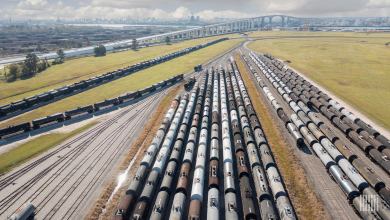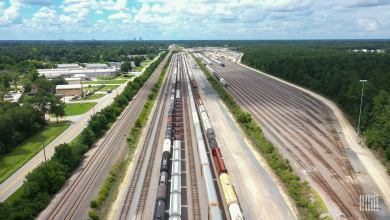
Union Pacific could control traffic flows to address network congestion
If UP and customers can’t reduce the number of active railcars on the network, the railroad may temporarily resort to metering.
The letter sent by the National Grain and Feed Association to regulators about subpar rail service is finding support among other rail industry stakeholders.
The Class I railroads say they have been trying to improve service, which has deteriorated amid the COVID-19 pandemic. But the Surface Transportation Board questions whether headcount reductions come into play.
U.S. Agriculture Secretary Tom Vilsack wants the Surface Transportation Board to move forward with proceedings that would address rail service for grain and agricultural products shippers.
The National Grain and Feed Association is asking the Surface Transportation Board to compel three Class I railroads to provide weekly and annual service updates.
The board held a two-day hearing on reciprocal switching to help it determine how it should move forward.
Congress should fund the Surface Transportation Board, agreed panelists at a U.S. House hearing on the board’s funding reauthorization. But they disagree on what STB’s role should be in regulating the freight railroads.
The American Chemistry Council chats with FreightWaves about why government leaders should keep transportation issues at the forefront of policymaking, especially in light of anticipated growth in production of chemicals.
From capital investments to competitive access, issues that CSX has brought before the Surface Transportation Board reflect concerns facing the freight rail industry as a whole.
Several rail shippers had asked the Surface Transportation Board to temporarily suspend a proceeding on a voluntary arbitration program for small rate disputes, but the board denied that request.
Economist Steve Pociask opines on why he thinks the Surface Transportation Board should tread carefully when deciding how to proceed with the issue of reciprocal switching.
The Surface Transportation Board is advancing two rulemakings on small rate disputes concurrently to determine how best to address such disputes. The railroads prefer one rulemaking while shippers prefer another.
STB has allowed agri-food shipper Sanimax to proceed in its complaint against Union Pacific over service issues.
Industry observers grapple with the complexities of implementing reciprocal switching on U.S. rail networks.
The agency is seeking comments from freight railroads on whether it should collect data pertaining to first- and last-mile movements.
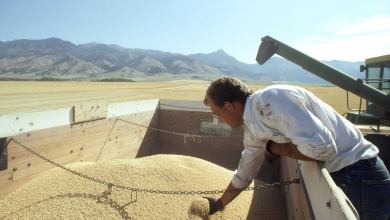
As fall harvest nears, grain shippers and freight railroads are taking steps to ensure network fluidity for export-bound grain trains in and out of the Pacific Northwest.
Both Canada and the U.S. have provisions that allow for reciprocal switching, or interswitching. But rail shippers’ ability to participate in the program differs in the two countries.
SMART-TD must negotiate with Class I railroads on train crew size; Rail Customer Coalition calls on STB to take up reciprocal switching; ASLRRA praises progress on infrastructure bill; and Canadian Pacific urges KCS shareholders to vote against the proposed CN-KCS merger.
President Joe Biden’s order last week calls upon the Surface Transportation Board to examine hot topics among rail shippers, including reciprocal switching. The challenge will be balancing the wants and needs of shippers and the freight railroads.
Canadian Pacific and CN note the end of the public comment period for CN’s proposed voting trust, which would be used to acquire Kansas City Southern. But in order for regulators to review the voting trust application, the Surface Transportation Board may need to clarify further the parameters for gauging whether a rail merger is in the public interest, some stakeholders say.