




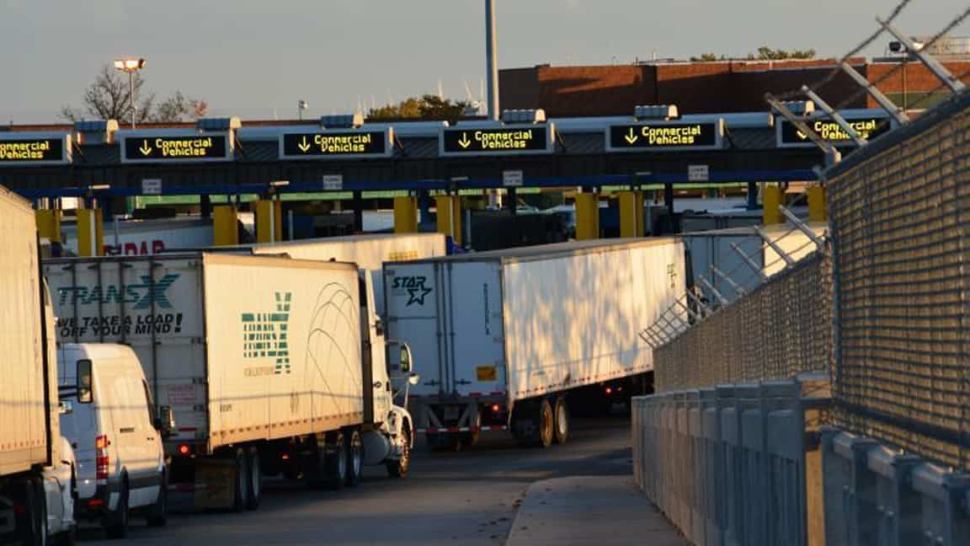
If a project currently in development proves as successful as backers hope, the time it takes to move freight across the U.S.-Canadian border could be cut in half.
The joint effort between the Buffalo and Fort Erie Public Bridge Authority, which owns the bridge and customs facilities on both sides, and U.S. Customs and Border Protection (CBP) is designed to implement facial recognition along with license plate scanners to pre-screen commercial vehicles, hoping to cut congestion on the Peace Bridge, which spans the Niagara River between Buffalo, NY, and Fort Erie, Ontario, Canada.
Ron Rienas, general manager of the Authority, tells FreightWaves the program is still in “live testing,” and if the results prove satisfactory, the project will move into the pilot phase, perhaps early in 2019.
The Authority, which is a binational bridge authority, has owned and operated the Peace Bridge since 1933. Over 531,000 commercial vehicles have crossed into the U.S. over the Peace Bridge year-to-date. Another 524,000 have crossed into Canada.
The addition of facial recognition joins previously deployed license plate scanners that Customs has been using since 2017. Rienas says the combined technology solution will be joined in 2019 by x-ray machines that will scan trailers. All of these efforts will allow Customs officials to quickly screen vehicles and drivers. He says this is the first known instance of this type of joint solution on vehicles.
“We’re looking at doing this at speed,” he says. “The camera system is on the Canadian side, when the truck is probably going about 5 mph.”
Rienas says the hope is that vehicles can be screened before they cross the 3,580-foot-long bridge, which typically takes three to four minutes. If the system notifies Customs of any abnormalities or concerns, the truck is pulled aside for additional inspection, otherwise, the driver would be given a green light to continue driving.
The addition of facial recognition technology to any project can bring out detractors, but Rienas says it shouldn’t be an issue in this case as between 85 percent and 90 percent of truck drivers already crossing the border are in the Free and Secure Trade (FAST) program, which speeds up border crossings by registering drivers, their photos, and fingerprints for security checks.
“This is just automating the process,” he points out.
Currently, all trucks crossing into the U.S. must file an electronic manifest. Nothing changes in that regard, but under the new program, the images of the driver’s face and license plate will be used to verify the information in the manifest before the driver arrives at the customs station.
“CBP is able to do the assessment on the vehicle and driver ahead of time,” Rienas notes. “This allows information to be gathered in Canada and sent to [Customs] officials on the U.S. side. If enforcement is needed, it takes place in the U.S.”
The other significant change once the pilot launches will be the position of the x-ray machines. Now, a Customs official may choose to send a truck through an x-ray machine, but once the system is up and running, all trucks will drive through the x-ray. This means that border officials will not only be able to match the driver’s face and truck registration to what’s on the manifest, but also what’s inside the vehicle.
“[The facial recognition] will speed the process up, but the other thing we are doing is moving the non-intrusive inspection, the x-rays, to the Canadian side,” Rienas says. [Combined], this will speed up the process by up to 50%.”
The hope is that the pilot goes smoothly and Customs is able to implement the program for all commercial vehicles entering the U.S.
“This is a pilot and is cutting-edge technology to do it at speed, so there are still some [issues] that will need to be worked out,” Rienas points out.
Brokerage Compliance Symposium
The day before F3. Every compliance issue you face - fraud exposure, carrier liability, FMCSA rules, cargo theft, insurance gaps - navigated by attorneys and operators defining best practices in a changing industry.
F3 Awards Dinner
The night before F3. FreightTech100 companies honored. FreightTech 25 and Shipper of Choice winners revealed live. Cocktail reception into dinner and live music - 300 industry leaders in one purpose-built room.
F3: Future of Freight Festival
Industry-defining keynotes, rapid-fire technology demos, and industry leaders networking in experiences across Chattanooga - plus the inaugural F3 Awards Dinner featuring the FreightTech and Shipper of Choice reveals.
The day before F3. Every compliance issue you face - fraud exposure, carrier liability, FMCSA rules, cargo theft, insurance gaps - navigated by attorneys and operators defining best practices in a changing industry.
The Signal at Chattanooga Choo Choo • Chattanooga, TN Register NowThe night before F3. FreightTech100 companies honored. FreightTech 25 and Shipper of Choice winners revealed live. Cocktail reception into dinner and live music - 300 industry leaders in one purpose-built room.
The Signal at Chattanooga Choo Choo • Chattanooga, TN Register NowIndustry-defining keynotes, rapid-fire technology demos, and industry leaders networking in experiences across Chattanooga - plus the inaugural F3 Awards Dinner featuring the FreightTech and Shipper of Choice reveals.
The Signal at Chattanooga Choo Choo • Chattanooga, TN Register Now