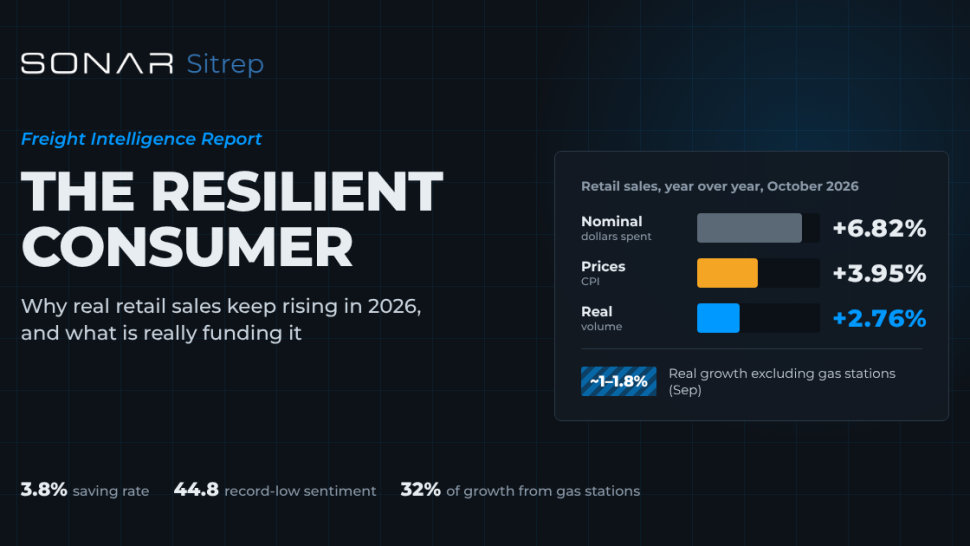
Real versus nominal sales, the New York Fed’s K-shape claim, and what jobs, wages, and sentiment say about consumer strength
Retail and food services sales were $748.2 billion in October 2026, up 6.82% from a year earlier. Deflated by CPI, real sales were up an estimated 2.76% in October, about 4.4% above their April 2024 trough, despite CPI inflation of an estimated 3.95%, PPI inflation of 6.52%, and record-low University of Michigan sentiment (44.8 in May). Fuel is the main distortion: gas station sales were up 28% and diesel prices about 60%, moves large enough that a CPI deflator cannot cleanly separate price from volume. Gas stations supplied 32% of September’s dollar growth; excluding them, real growth was roughly 1% to 1.8%, a range that brackets the 1.6% pre-Covid pace.
Other drivers are a saving rate that fell to 3.8% (5.1% a year earlier, 6.5% in 2017 to 2019), larger tax refunds, and wealth gains concentrated at the top, with credit a smaller factor. The New York Fed reads its income-group data as a K-shaped economy. Its own series show a one-time gap that opened in 2023 and parallel growth since 2024 (+7.3%, +6.5%, and +5.2% for low-, middle-, and high-income households through February 2026), which fits a slower low-income recovery from Covid better than a widening K. Jobs are stable but low-hire, and real wages and total compensation are flat. 2026 looks like a return to normal growth funded by a lower saving rate, not by rising purchasing power.
 & Market Monitor Exclusive
Keep reading with or Market Monitor
and Market Monitor customers.