The leaders of the Federal Motor Carrier Safety Administration like to boast they held five listening sessions to get feedback on their Advanced Notice of Proposed Rulemaking for possible changes in the Hours of Service rule.
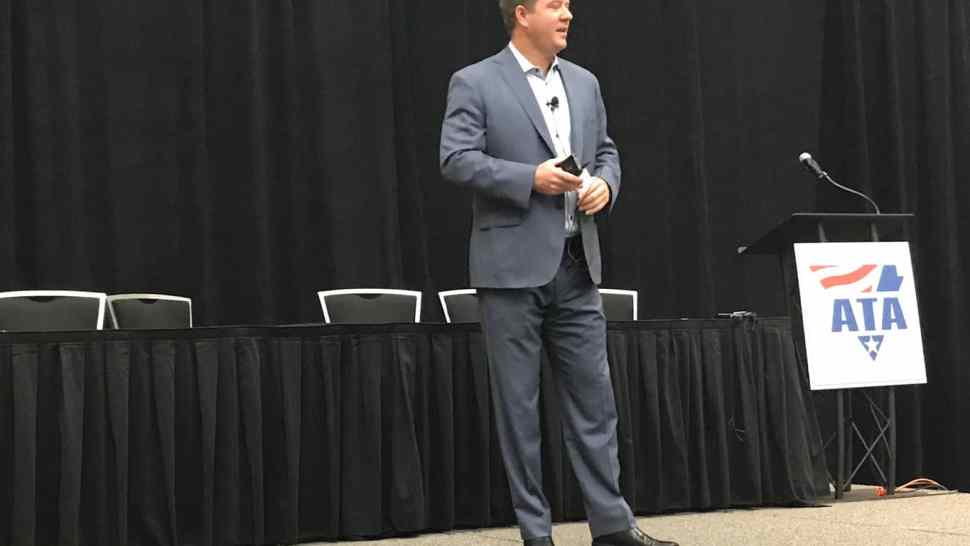
On Sunday at the American Trucking Association’s Management Conference & Exhibition in Austin, they effectively had number six, albeit in a shorter form.
Jim Mullen, FMCSA’s chief counsel, took to the stage for an hour to answer a variety of questions about the ANPR. It’s not accurate to say that the ANPR is a proposal; it isn’t. It is a series of four FMCSA-created questions that hint at possible changes in the HOS rules, and a request for comments on an OOIDA-led proposal that would effectively turn the 14-hour limit into a 17-hour limit.
But in the ATA meeting, one of the key topics of discussion isn’t even in the ANPR. It’s the FMCSA changes in the rules of personal conveyance, and how they’re defined. The consensus is that there is a lot of ambiguity in them, and that is creating some problems and a possible basis for additional review.
“People tell us they don’t want us to be too prescriptive, so there is discretion,” Mullen said. At the same time, he said FMCSA has received letters requiring greater clarification on the rule.
The key issue seems to be how many miles can be called personal conveyance when getting to a parking spot. The rules are that a driver may not use personal conveyance to get a jump on the next day’s miles. Or as the rule says: “For example, bypassing available resting locations in order to get closer to the next loading or unloading point or other scheduled motor carrier destination.” But can the driver head in the general direction of the next day’s route before parking? And if so, how many miles?
One audience member said a leading ELD provider puts a 99-mile limit on personal conveyance in its system. But as was noted, that is a recommendation put in by the provider; there is no 99-mile rule on personal conveyance in the law.
Mullen said during one of the listening sessions, a fleet owner conceded that before the ELD mandate, personal conveyance was never an issue. They would just “take an eraser” in the past and create the additional hours that now might need to be used under the guidance of personal conveyance. Now, Mullen said, “we’re damned if we do and damned if we don’t.” There may be a need for more guidance. “Will it fix every problem?” he said. “Probably not.”
The essence of the problem was illustrated when somebody from the audience asked whether personal conveyance involved going from the final delivery back to home. “How far is your trip home?” was shouted out from someone else in the audience. (For the record, the personal conveyance guidance said acceptable personal conveyance driving included “Authorized use of a CMV to travel home after working at an offsite location.”
One of the issues that was in the ANPR is to alter the sleeper berth rule that now allows an eight hour-two hour split of the 10 hours off-duty. FMCSA’s consideration of the possibility of changing that to a 5-5 or 7-3 split brought one piece of news from the meeting: a proposed pilot program to test the impact of that using a select group of drivers has been put off. Mullen said there are numerous studies that can be used now by FMCSA, rather than wait for the results of a pilot. In the process, the race to promulgate any changes in HOS can be speeded up.
Steve Rush, the president of trucking company Carbon Express, echoed comments he had made a day earlier in a presentation by FMCSA Administrator Raymond Martinez. Rush’s argument is that switching away from the current 8-2 split will effectively lift the 14-hour day to a longer day, and that the carriers, after years of being on what amounted to the short end of the stick in transactions, would lose the pricing power it has gained in the last year or two.
The ongoing clock–which would halt for a longer period of time in a 5-5 split–is “there for a reason,” Mullen said. “And it is safety related.” FMCSA will look for a “sweep spot…is this the best mechanism to regulate safety?” Maintaining shipping rates is not a concern for FMCSA, he stressed: “decreasing capacity is not our space.” “The safety benefits are where we need to come down on that issue,” Mullen said.
Discussing other areas in the ELD and HOS issues:
–Mullen said that one of the least controversial questions is whether a driver should be able to add as much as two hours of driving time because of “adverse conditions.” But he said defining those adverse conditions is an area that needs clarity. And it gets particularly tricky, he said, in an era of apps that can show a driver where traffic backups are and when bad weather is coming.
–Mullen said the majority of the 2,300 responses FMCSA received were in favor of eliminating the 30-minute required rest break. Keeping the break was second, but a third option was to require the break but make it part of the on-duty but not driving time, thereby giving 30 minutes back to the driver. Mullen said that in the listening sessions, many drivers–he said drivers were overwhelmingly the attendees at the listening sessions–said they inevitably take breaks of that length as part of their regular business. The view of many of these drivers, Mullen said, is “you are telling us when to take it, and we don’t like it.”
(He also noted that a response to any rule that is no more than “I don’t like it” is not moving the needle on making a change.)
–Full implementation of the ELD rule actually does not occur until the end of 2019, when the ability to operate on a grandfather exemption with an AOBRD expires. One audience member said the fleets still operating with AOBRDs are not ready for the transition, and asked if FMCSA was “pretty firm” on that date or whether there would be a grace period. It was Mullen’s colleague Jack Van Steenburg, FMCSA’s assistant administrator and chief safety officer, who said from the audience that there had been “no discussion at all” on an exemption to the end of the AOBRD period. “In December of next year, all will be playing on the same ballfield,” he said. But Van Steenburg also said the discussion “brings home that we need to be doing updates to remind people of the date.”
–Mullen conceded there is anecdotal evidence that speeding has risen as drivers try to comply with the less-forgiving regime created by the ELD mandate. “But we have not seen any evidence of it, which is comforting,” he said. “I hope that it is a red herring being used to get us to grant more flexibility.”
Brokerage Compliance Symposium
The day before F3. Every compliance issue you face - fraud exposure, carrier liability, FMCSA rules, cargo theft, insurance gaps - navigated by attorneys and operators defining best practices in a changing industry.
F3 Awards Dinner
The night before F3. FreightTech100 companies honored. FreightTech 25 and Shipper of Choice winners revealed live. Cocktail reception into dinner and live music - 300 industry leaders in one purpose-built room.
F3: Future of Freight Festival
Industry-defining keynotes, rapid-fire technology demos, and industry leaders networking in experiences across Chattanooga - plus the inaugural F3 Awards Dinner featuring the FreightTech and Shipper of Choice reveals.
The day before F3. Every compliance issue you face - fraud exposure, carrier liability, FMCSA rules, cargo theft, insurance gaps - navigated by attorneys and operators defining best practices in a changing industry.
The Signal at Chattanooga Choo Choo • Chattanooga, TN Register NowThe night before F3. FreightTech100 companies honored. FreightTech 25 and Shipper of Choice winners revealed live. Cocktail reception into dinner and live music - 300 industry leaders in one purpose-built room.
The Signal at Chattanooga Choo Choo • Chattanooga, TN Register NowIndustry-defining keynotes, rapid-fire technology demos, and industry leaders networking in experiences across Chattanooga - plus the inaugural F3 Awards Dinner featuring the FreightTech and Shipper of Choice reveals.
The Signal at Chattanooga Choo Choo • Chattanooga, TN Register Now