
Article brought to you by Evolutionary Operating System, Inc.
For decades, the freight industry’s biggest technology investments have gone to the biggest freight companies. Enterprise carriers and mega-brokerages with dedicated engineering teams have adopted increasingly sophisticated transportation management systems and software integrations. Meanwhile, many small-to-medium-sized businesses are running TMS platforms that are sometimes a decade or more old. Even if not, they’re typically paying enterprise prices for software that wasn’t built around how a smaller operation actually runs.
This imbalance is the starting point for Evolutionary Operating System, Inc. (Evos), an autonomous AI operations company launching to the public on October 14. The reasoning, according to founder and CEO Urav Shah, runs in a fairly straight line: decades of technology investment have gone almost entirely to the enterprise end of the market, leaving small and mid-size logistics companies running on aging systems that were never built around how differently each of those businesses actually operates.
Those systems can handle the routine, predictable share of the work, but not the edge cases, such as the judgment calls that don’t fit a standard workflow. That work falls back on a person to notice, decide and process by hand. Shah argues that’s created a structural capacity problem for small and mid-size logistics companies, one that’s compounding as the industry’s most experienced operators retire and take tacit knowledge with them.
“There’s been twenty to thirty years of big tech ignoring the small and mid-market,” Shah said. “That’s created a real capacity gap. Evos is the only company that does the work instead of just showing you the work.”
What Shah describes is a platform that configures itself around a given business, learning how that company’s own team uses judgment to work through its edge cases, then handling that work on their behalf rather than simply flagging it for a person to finish.
That’s the execution layer, and it’s how Shah draws the line between Evos and the wave of AI copilots and assistants now built into most major TMS platforms. Those tools still need someone to drive them, and they’re largely unequipped to handle the edge cases that make up a vast portion of day-to-day tasks in smaller operations. Some AI agents might suggest a status update or flag an exception, but a person still has to act on it.
Because Evos was designed to be an execution layer, it can help run entire desks, such as dispatch, track-and-trace, or billing, end to end, on top of an organization’s existing systems.
The biggest challenge, according to Shah, is not just building software that can act. It’s building software that acts the way a specific company would. Every logistics operation runs a little differently, and that variation shows up constantly in the edge cases that consume an ops team’s day.
Shah gave an example of the kind of interrogation Evos runs during onboarding to capture that logic. Why did a given load go on one truck instead of another available one? Because that customer gets priority service. Why not the newer truck? Because it was already committed to a spot load with tighter lead time. Multiply that by every recurring judgment call a dispatcher makes, and the pattern of behavior is the configuration data that lets Evos’ autonomous operator match the specific execution needs of that one company rather than applying a generic workflow across every customer.
In a deliberate architectural choice, Evos runs what it calls large action models rather than large language models. The system is trained on patterns of decisions and behavior rather than on text. Every customer has its own model, trained solely on that company’s own historical data, with no shared central model pooling information across customers. Reinforcement learning happens on anonymized behavioral patterns specific to that one operation.
Shah said the approach is a direct response to a hesitation he hears constantly from smaller operators: reluctance to hand over proprietary operational knowledge to an external AI platform. Keeping each customer’s model self-contained means that tribal knowledge stays tribal. It’s neither contaminated by the way other companies behave nor at risk of any IP infringements.
Shah also points to how Evos builds those models as a further differentiator from other point-solution automations. Most of those tools run on top of frontier large language models from major AI labs, which ties their underlying costs to whatever those labs are charging at any given time. Because Evos trains and runs its own models rather than routing requests through a frontier model, Shah argues its cost structure stays fixed instead of exposed to that volatility, which he expects to matter more as frontier-model pricing eventually shifts to reflect what those labs actually spend on compute.
Tacit knowledge retention extends to how Evos is addressing the industry’s aging workforce. As ops teams around the country struggle to replace experienced talent, Evos has built a way to preserve what a retiring dispatcher or fleet manager knows before it disappears from the business entirely, and expanded the capacity of existing teams in the process. That includes things like the escalation logic, the workarounds, and the decision criteria that were never written down for a new hire to learn.
None of that works, though, if deployment takes the months typical of an enterprise software rollout. Evos says a new autonomous operator can go live in under 24 hours from first conversation, without migrating a customer’s existing data, using a library of more than 150 pre-built integrations with common freight systems.
Shah described a graduated-autonomy model for how those operators earn trust once deployed: a new operator starts by handling a portion of a workflow autonomously while routing judgment calls to a human for approval, rejection, or revision, and the system reasons from those revisions going forward. If it’s told once to avoid an older truck that needs more frequent fuel stops on a tight-deadline load, it can start weighing that same tradeoff on future loads without being told again.
As an illustration of the kind of problem Evos is building toward for smaller carriers specifically, Shah pointed to an operator currently in development that scans a carrier’s planned routes for backhaul opportunities (a truck headed from Chicago to New York with nothing booked for the return leg, for example) and surfaces a set of matching loads for a dispatcher to confirm. Today, he said, that kind of open capacity is usually found manually, often scrambled together at the last minute, if it’s found at all.
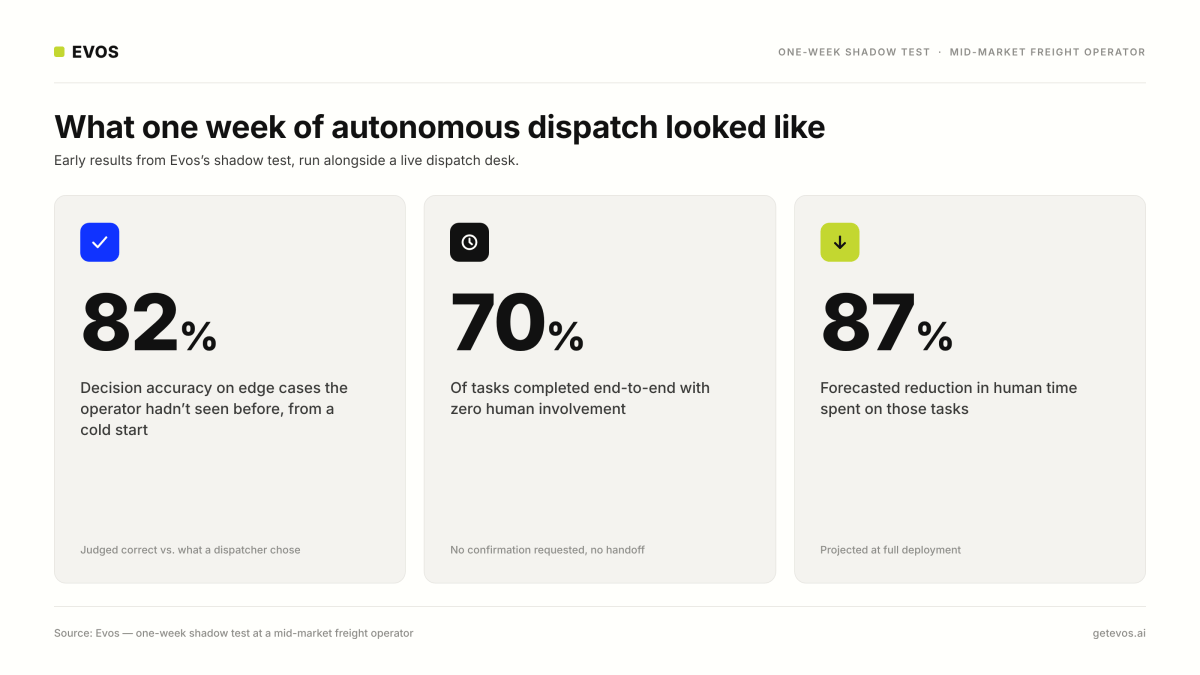
Most AI tools still need constant prompting: someone has to ask, review, and act on every answer. An Evos operator is given a function, not a prompt, so the team ends up managing outcomes instead of inputs.
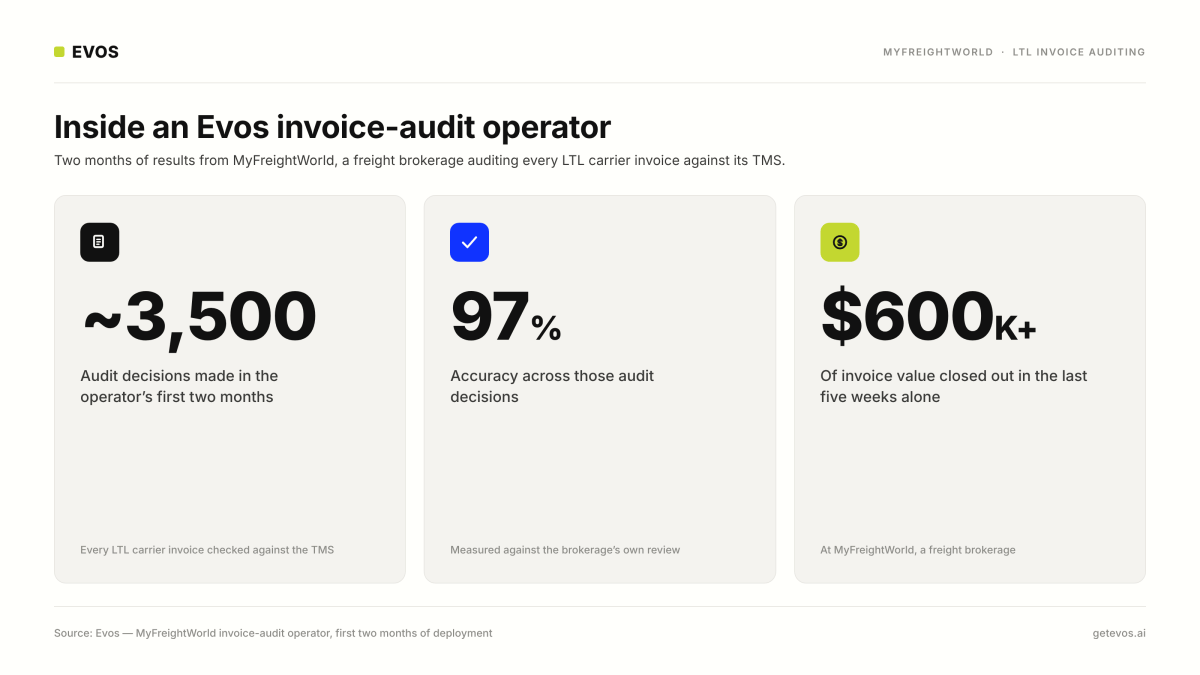
One freight brokerage, MyFreightWorld, runs an Evos operator that audits every LTL carrier invoice against its TMS. In its first two months, the operator made nearly 3,500 audit decisions at 97% accuracy, and in the last five weeks alone it has closed out more than $600,000 of invoice value.
“Evos has helped us revolutionize our billing process with zero upfront investment, and also at an impressively fast speed measured in days and weeks,” said Mike Chalfant, president of MyFreightWorld. “It’s increased our accuracy and dramatically increased efficiency, which has ultimately led to a better experience for our customer base. The performance of the operator has given us confidence and excitement to continue to add to the functionality and explore new possibilities. Adding Evos to the stack has been a terrific thing for our company, and we’re excited to continue to grow our partnership.”
Those numbers point back to the same argument, according to Shah. The technology gap in freight software is largely the result of who enterprise vendors built for.
“We’re the only company that does the work instead of just showing you the work,” Shah said. While the largest carriers are already investing heavily in automation, the small and mid-size operators need a tailored solution they won’t find elsewhere.
That’s why, according to Shah, Evos’ autonomous operators are designed to help the logistics businesses most exposed to the industry’s capacity gap and the most likely to lose institutional knowledge as their veteran staff retire.
Click here to learn more about Evos.
Brokerage Compliance Symposium
The day before F3. Every compliance issue you face - fraud exposure, carrier liability, FMCSA rules, cargo theft, insurance gaps - navigated by attorneys and operators defining best practices in a changing industry.
F3 Awards Dinner
The night before F3. FreightTech100 companies honored. FreightTech 25 and Shipper of Choice winners revealed live. Cocktail reception into dinner and live music - 300 industry leaders in one purpose-built room.
F3: Future of Freight Festival
Industry-defining keynotes, rapid-fire technology demos, and industry leaders networking in experiences across Chattanooga - plus the inaugural F3 Awards Dinner featuring the FreightTech and Shipper of Choice reveals.
The day before F3. Every compliance issue you face - fraud exposure, carrier liability, FMCSA rules, cargo theft, insurance gaps - navigated by attorneys and operators defining best practices in a changing industry.
The Signal at Chattanooga Choo Choo • Chattanooga, TN Register NowThe night before F3. FreightTech100 companies honored. FreightTech 25 and Shipper of Choice winners revealed live. Cocktail reception into dinner and live music - 300 industry leaders in one purpose-built room.
The Signal at Chattanooga Choo Choo • Chattanooga, TN Register NowIndustry-defining keynotes, rapid-fire technology demos, and industry leaders networking in experiences across Chattanooga - plus the inaugural F3 Awards Dinner featuring the FreightTech and Shipper of Choice reveals.
The Signal at Chattanooga Choo Choo • Chattanooga, TN Register Now