Rates, capacity, earnings and the supply chain risks shaping air cargo into 2027
A review of 2026 air cargo demand, rates and capacity, carrier and forwarder earnings, and how much slack the system has left, using SONAR data.
EXECUTIVE SUMMARY
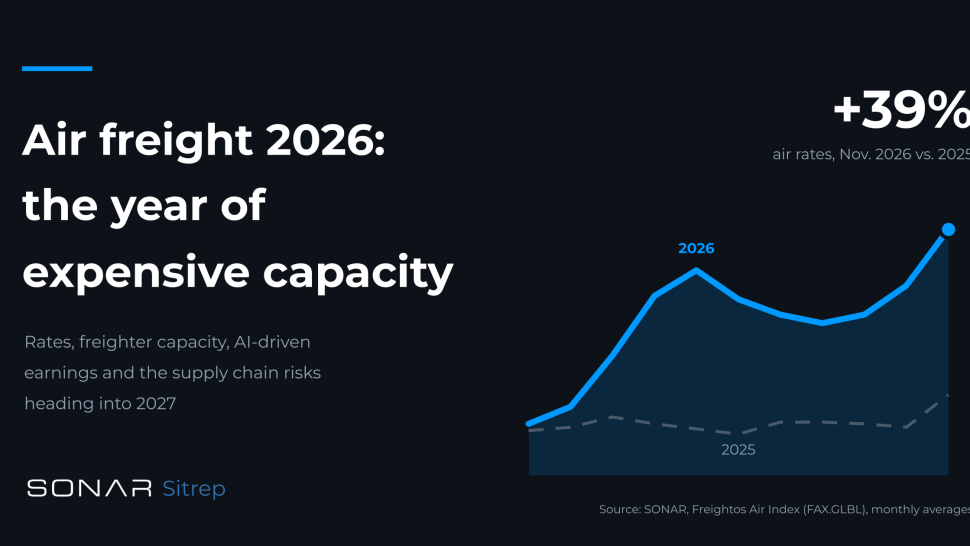
Air cargo entered 2026 expecting lower rates and got rates roughly 30% higher instead. The February escalation of the Middle East conflict removed about 12% of global capacity overnight, jet fuel doubled, and AI hardware filled the planes that were left. The result is a market running with almost no slack, where a single disruption can halt flows with little warning, as the Nov. 13 FAA ground stop showed.
Key findings: SONAR’s Freightos Air Index (FAX.GLBL) averaged $3.11/kg in October, up 36% year over year, and $3.44/kg in November to date (+39%). U.S. outbound scheduled capacity (OACT.USA) ran about 4% to 8% below 2025 for nine straight months before turning positive in October, led by freighters (OACTF.USA, +11% to +14%) rather than passenger bellies. Forwarders with AI and data center exposure posted sharp air profit gains, winning on rate more than volume. Ocean volumes to the U.S. are still growing, so air’s gains came from high-value freight rather than a broad shift off the water. The risks heading into 2027 are fragility, fuel and demand concentration, not a lack of freight.
 & Market Monitor Exclusive
Keep reading with or Market Monitor
and Market Monitor customers.