




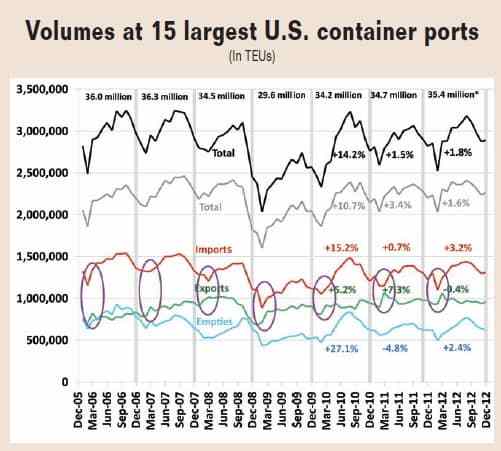
The gap between loaded import and export container volumes has steadily narrowed in the first quarter of the calendar year, which suggests that if recent trends are to continue, the new norm may be for exported containers to outnumber those imported during the early months. Ocean carriers, ports, distribution centers, trucking companies and railroads are already reacting and adapting by investing in new facilities and equipment.
This reversal of the container equipment imbalance looks set to continue for several reasons.
The first is the seasonal pattern of demand for U.S. exports, which due to increased demand for manufacturing related-products, is now being extended into the early spring. Shipments of these goods, which include plastics, iron and steel, cotton, chemicals and vehicles/auto parts, often peak in March. This follows the traditional seasonal pattern of peak-level imports in the early fall, and peak-level exports of scrap paper and oil seeds (soy) in the last three months of the calendar year, which make use of available empty containers.
A second supporting trend is the investment in infrastructure and development of consumer cultures in emerging markets. During 2009-2010, this was driven by infrastructure projects such as high-speed rail in China. Since then, some of these economies, like China, have changed their focus from building capacity to developing a consumer culture. The United States has both comparative and competitive advantages in the production of goods which require a lot of capital but need little labor, such as fuel and agricultural products, and are being increasingly sought by these new consumers.
U.S. exports of agricultural products have been led by an increased global demand and the higher rate of containerization, in particular for soy and cotton. The reasons are relatively straightforward; agricultural commodity prices have risen sharply, making them more tolerant of higher freight rates. Soy has risen to $14.60 per bushel, up from $5.05 since 2002. At these higher prices, foreign customers would prefer not to receive large amounts at once, which could result in spoilage or waste. Furthermore, due to quality and other technical issues, it’s important to preserve the geographical identity of some products. Containerization is a good solution.
The rebalancing of trade flows in the United States has created a need for new export-oriented infrastructure. Repositioning empty containers from urban areas of consumption to rural areas of production is one such challenge. This repositioning can be costly.
Investments by railroads and logistics service providers are expanding the options to accommodate larger volumes of exports. A well-known example is the transflow facility in Yermo, Calif., recently built by Union Pacific Railroad. Others are investing in facilities and developing inland infrastructure to meet these needs. The U.S. Department of Agriculture is also assisting this process as anyone who receives the weekly OSCAR (Ocean Shipping Container Availability Report) would know.
With these supporting investments in the United States and the growing incomes in emerging markets, the potential for U.S. exports to continue to grow and eventually exceed containerized imports, for even part of the year, is very real. Container freight industry participants need to stay ahead of this trend.
Kemmsies, chief economist, and Solomon, senior economist, both work for marine infrastructure engineering firm Moffatt & Nichol. They can be reached by email (Kemmsies and Solomon) or telephone at (212) 768-7454.
Brokerage Compliance Symposium
The day before F3. Every compliance issue you face - fraud exposure, carrier liability, FMCSA rules, cargo theft, insurance gaps - navigated by attorneys and operators defining best practices in a changing industry.
F3 Awards Dinner
The night before F3. FreightTech100 companies honored. FreightTech 25 and Shipper of Choice winners revealed live. Cocktail reception into dinner and live music - 300 industry leaders in one purpose-built room.
F3: Future of Freight Festival
Industry-defining keynotes, rapid-fire technology demos, and industry leaders networking in experiences across Chattanooga - plus the inaugural F3 Awards Dinner featuring the FreightTech and Shipper of Choice reveals.
The day before F3. Every compliance issue you face - fraud exposure, carrier liability, FMCSA rules, cargo theft, insurance gaps - navigated by attorneys and operators defining best practices in a changing industry.
The Signal at Chattanooga Choo Choo • Chattanooga, TN Register NowThe night before F3. FreightTech100 companies honored. FreightTech 25 and Shipper of Choice winners revealed live. Cocktail reception into dinner and live music - 300 industry leaders in one purpose-built room.
The Signal at Chattanooga Choo Choo • Chattanooga, TN Register NowIndustry-defining keynotes, rapid-fire technology demos, and industry leaders networking in experiences across Chattanooga - plus the inaugural F3 Awards Dinner featuring the FreightTech and Shipper of Choice reveals.
The Signal at Chattanooga Choo Choo • Chattanooga, TN Register Now