




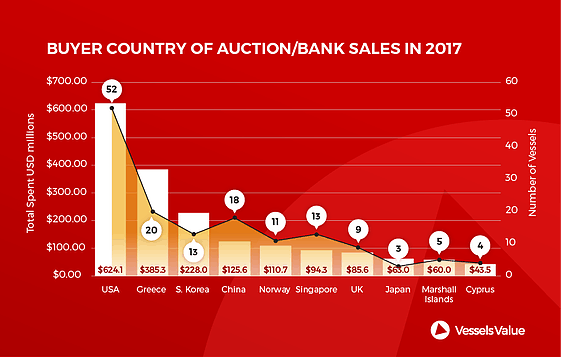
U.S. owners have spent $624 million on 52 distressed vessels so far in 2017 via auction or at bank sales as of Nov. 13, according to VesselsValue. The amount came in at just under double what Greece has spent thus far, $385 million. South Korea is third on the list with $228 million in purchases, followed by China and Norway, with $125.6 million and $110.7 million, respectively. Singapore (13 vessels purchased at $94.3 million), the United Kingdom (nine vessels, $85.6 million), Japan (three vessels, $63 million), the Marshall Islands (five vessels, $60 million) and Cyprus (four vessels, $43.5 million) round out the top 10.
The top U.S. buyers of auction/bank sale vessels in 2017 have been JPMorgan Global Maritime, which has purchased 12 vessels at a total cost of $250 million, followed by Eagle Bulk Shipping, which has paid $153 million so far for 12 vessels.
Rounding out the top five were Navios Maritime Partners (14 vessels, $113 million); Rowan Companies (two vessels, $60 million); and Enterprise Offshore Drilling, which spent 22.2 million for 13 vessels, according to VesselsValue data.

“These asset types hit 25 year historical lows during 2016, with these values now rebounding,” VesselsValue explained in a statement. “Asset values reached a 25 year low for bulkers, containers and offshore vessel types in 2016, with a spike in the number of bankruptcies and vessel seizures by banks.”
“Many in the markets are confident that continued scrapping and a reduction in ordering will balance out supply and demand, bringing asset values back in line,” the report added. “Savvy investors have been getting involved in the last 12 months in order to capitalize on the asset value increase.”
