




By Chris Dupin
There is renewed interest in an 85-year-old technology that may help shipping companies lower fuel costs and reduce their impact on the environment.
It's called the Flettner rotor, after German engineer and inventor Anton Flettner, who demonstrated the technology in a 1926 transatlantic crossing.
Companies such as German wind turbine manufacturer Enercon, New York-based Magnuss LLC, and Singapore's WindAgain are all working on modern versions of Flettner's invention.
Last summer, Enercon put into service its E-Ship 1, a multipurpose ship equipped with four rotors that is being used to deliver turbines.
It was the first new commercial rotorship put into service in decades, but the company would not discuss the project with American Shipper, saying it still considered the ship experimental.
(One source suggested the company is keeping mum because of its experience with sophisticated bearing systems for windmills; Flettner rotors or components for them could be a big new market. And, he noted, companies in the business are weary of press queries about their sexy, green technology.)
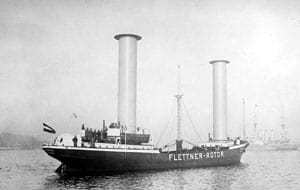
Flettner first demonstrated the feasibility of the technology when he purchased the schooner Buckau in the 1920s, removed its masts and outfitted it as a 'rotorship.'
It looked unlike any other sailing ship. Instead of sails made with fabric, the ship was outfitted with two 50-foot-tall cylinders that looked like outsized smokestacks and were rotated with small electrical motors. The rotors propel the ship forward using the so-called 'Magnus effect,' named after German scientist Heinrich Magnus who first described it in 1852.
| Anton Fletter purchased the schooner Buckau in the 1920s, removed its masts and outfitted it as a 'rotorship.' Renamed the Baden-Baden, he sailed it from Europe across the Atlantic to New York in 1926. |
Odd-looking as his ship appeared, the Magnus effect is a well-known phenomenon ' familiar to physics students and athletes alike as it's the force that causes balls to curve in baseball, golf or tennis. It's also important to artillery men since it can affect a spinning shell's trajectory.
The force is similar to the lift created by an aircraft wing, and indeed aircraft designers have experimented with the Magnus force, including one company, iCar 101, which is attempting to design a flying car.
Researchers from the University of Edinburgh and the National Center for Atmospheric Research in Boulder, Colo., have proposed building a fleet of Flettner ships that would sail continuously around the oceans, shoot micron-size drops of water high into the atmosphere to form clouds that would reflect solar energy and help reverse global warming.
As exotic as those ideas sound, promoters of the Flettner rotor note it is an old and proven technology. After Flettner experimented with his schooner in Europe, he renamed his rotorship the Baden-Baden and sailed it across the Atlantic to New York in 1926. There it attracted wide attention from the media ' even making the cover of Popular Science.
The German Navy was intrigued enough by the concept to experiment by placing three Flettner rotors later that year on a larger ship, the 3,000-ton Barbara. But instead of going into naval service, Barbara was chartered to a company that used it in the fruit trade to the Mediterranean.
Eventually the masts were removed from both ships and they operated as conventional freighters.
Flettner's idea never got traction because of the cheap cost of fuel, said James Rhodes, managing partner of Magnuss, who spoke about the technology this spring at the annual meeting of the Connecticut Maritime Association. But the rising cost of bunker fuel and increased environmental regulations have revived interest in the concept, he said.
The rotors would augment existing propulsion systems on ships, allowing them to throttle back, achieving a 30 percent to 35 percent reduction in fuel costs, and still keep voyage speed. Rhodes said a company spending $3 million to $5 million annually on bunker fuel might see a payback on the capital cost of installing rotors in two or three years.
The Magnus effect varies according to the angle at which wind strikes the rotors, but is most pronounced when wind is abeam, striking the ship roughly perpendicular to the keel. But Rhodes said one of the attractive features about the phenomena is that a vessel will get some benefit from many wind angles.
He said his firm partnered with FleetWeather to identify traffic routes where wind is effectively abeam or within 30 degrees.
'We found that the most highly trafficked routes of the world had wind abeam,' he said.
Magnuss plans to initially try to attract owners who have ships on dedicated routes with favorable wind conditions. An example, he said, would be the trade from Australia to China. (Ships sailing back to Australia to China would also benefit from the rotors; they would just need to spin them in the opposite direction on the return voyage.)
The technology could also be useful by carriers to attract shippers, he said, as many are seeking to 'green their supply chains.'
Rhodes has a background in investment banking and was chief executive officer of energy advisory firm Eco Capital, which focused on renewable energy, clean technology and carbon finance.
'The U.S. carbon business never had any legs based on policy ' or the lack of ' so we started Magnuss as a means by which we could create something, develop a real device that if it works will save money for an industry that is big, important and requires a disruptive technology for the future,' he said.
Contrary to other sail technologies, the Flettner rotor would require little attention from the crew, he said.
Magnuss plans to make telescoping rotors ' Rhodes calls them 'vertically variable ocean sail systems' ' which helmsmen would deploy with the touch of a button, then retract them to deck level when the ship passes beneath a bridge, loads or discharges cargo, or if wind conditions were unfavorable ' coming directly from the bow or blowing so hard that they might damage the rotors.
The company intends to initially concentrate on owners of dry bulk ships, because those ships would require the smallest amount of modification. Magnuss expects to install rotors on ships within 18 months.
He envisions putting four rotors on each ship ' down the center line of vessels without gear, and along the sides of ships with cranes. He said no dry docking would be necessary to install the rotors, which would not require modifications to the scantling of the ship but would be attached below deck at the hull of the ship.
J'rn Winkler, CEO of WindAgain, said his firm is already building rotors and expects to install them on a ship within the year.
He said his company is in discussion with three companies about installing the rotors on their ships ' operators of dry bulk, and oil and chemical tankers.
Winkler said the Flettner rotor is not suitable for containerships because the technology is useful on ships moving at 11 to 15 knots where containerships move much faster, even those that are slow steaming. And containerships' decks are generally piled high with containers anyway.
Like Magnuss, WindAgain plans on making the rotors collapsible ' his firm has worked on several different approaches to that, including a version that folds down onto deck with an elbow joint.
Winkler is the founder of DK Group, a company that pioneered another fuel-saving technology in the past decade, an air cavity system that puts a layer of bubbles between the hull of a ship and the water to reduce resistance. DK, which demonstrated the technology on a 2,800-deadweight-ton dry cargo ship ACS Demonstrator, said those bubbles can reduce fuel consumption up to 15 percent.
The size and number of rotors that would be placed on a ship would vary according to wind conditions the ship trades in, Winkler said, and payback periods could range from three to five years.
But the rotors could be gigantic, up to 40 meters (about 130 feet) in height and could turn up to 200 rpm. He said they would need to be made of steel because composite materials rotating would build up static charges that would be highly dangerous on a tanker, for example.
Winkler said with Flettner rotors, 'the critical challenge is production,' making a system with large, heavy components that can run reliably for years in harsh weather conditions.
But he and Rhodes agree that, with thousands of ship owners looking to reduce both operating costs and their environmental impact, the Flettner rotor's time may have arrived.
'This is a very big market,' Winkler said.
Brokerage Compliance Symposium
The day before F3. Every compliance issue you face - fraud exposure, carrier liability, FMCSA rules, cargo theft, insurance gaps - navigated by attorneys and operators defining best practices in a changing industry.
F3 Awards Dinner
The night before F3. FreightTech100 companies honored. FreightTech 25 and Shipper of Choice winners revealed live. Cocktail reception into dinner and live music - 300 industry leaders in one purpose-built room.
F3: Future of Freight Festival
Industry-defining keynotes, rapid-fire technology demos, and industry leaders networking in experiences across Chattanooga - plus the inaugural F3 Awards Dinner featuring the FreightTech and Shipper of Choice reveals.
The day before F3. Every compliance issue you face - fraud exposure, carrier liability, FMCSA rules, cargo theft, insurance gaps - navigated by attorneys and operators defining best practices in a changing industry.
The Signal at Chattanooga Choo Choo • Chattanooga, TN Register NowThe night before F3. FreightTech100 companies honored. FreightTech 25 and Shipper of Choice winners revealed live. Cocktail reception into dinner and live music - 300 industry leaders in one purpose-built room.
The Signal at Chattanooga Choo Choo • Chattanooga, TN Register NowIndustry-defining keynotes, rapid-fire technology demos, and industry leaders networking in experiences across Chattanooga - plus the inaugural F3 Awards Dinner featuring the FreightTech and Shipper of Choice reveals.
The Signal at Chattanooga Choo Choo • Chattanooga, TN Register Now