




By Chris Gillis
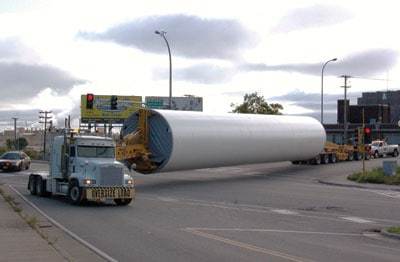
Transporting wind turbine components may be a tedious process, but manufacturers and companies tasked with putting these gigantic machines together still operate in a just-in-time world.
A recent survey found that many trucking firms engaged in the transport of turbine components need to bolster their systems' connectivity to help wind energy shippers coordinate deliveries with wind farm developers.
'Suzlon's goal is to provide the customer and installation crews with the most accurate data possible on when the cargo will arrive so they can plan their construction timeline,' said Kristopher Helling, logistics manager for Suzlon Wind Energy, a turbine manufacturer based in India.
'With several erection cranes and 50-plus people on site waiting on component arrival, accurate communication is key,' he said. 'The crews can plan around a delay for the most part with some advance notice, but when a crew has already walked a crane in place and then hears of a delay, costs can quickly add up.'
Allyn International Services, a Fort Myers, Fla.-based supply chain management, tax and customs consulting firm, conducted the survey this spring in partnership with energy supply chain intelligence company PowerAdvocate to determine the overall shipper satisfaction levels with freight transportation provided by U.S. motor carriers to the wind energy business.
'The survey found that carriers are doing a good job transporting overdimensional, heavy cargo from point A to point B, but are not maximizing their use of technology, such as EDI (electronic data interchange) or transportation management systems, to improve the overall performance of the supply chain,' said Mike Smyers, business development team manager at Allyn.
| While renewable energy shipments have grown dramatically. A supply chain approach to the industry is just turning the corner. |
The survey based these questions against the services of 20 trucking companies in the wind energy business, including Admiral Merchants Motor Freight, American Transport, ATS Specialized, Centurion Heavy Haul, Circle V Specialized, Combined Transport, Daily Express, Dallas Mavis, Dysart Trucking, Energy Transportation, Fitzley, Heavy Transport Co., J.K. Hackl Transportation Services, Landstar Carrier Services, LoneStar Transportation, Mammoet USA, Sycamore Specialized Carriers, System Transport, Trinity Logistics Group, and Universal Am-Can Ltd.
Bruce McArver, a supply chain specialist for Allyn, said the survey was distributed to nearly 150 logistics executives in the wind energy market, with a response rate of more than 35 percent. Companies that participated ranged from less than $24 million to more than $14 billion in annual revenue.
'We tried to get balanced results' among the types of firms engaged in the wind energy business, such as turbine manufacturers, wind farm developers and electric power companies, McArver said.
Damage Control. Many of the surveyed companies remain concerned about possible damage to equipment during transport. Turbine blades, for example, are single pieces measuring 115 to 160 feet long with weights in the 25,000-pound range for machines with power outputs of 1.5 megawatts to 2.5 megawatts apiece.
'Suzlon's cargo is manufactured in India and sent to the U.S. by bulk vessels. Total supply chain is three months to order a component, schedule factory production, plus 30 days at sea, and inland transport to the site,' Helling said. 'Any type of cargo damage can have serious consequences to a project and pose a large risk of liquidated penalties from our customers.'
The rapid increase in wind turbine shipments to the United States and from domestic factories to wind farms has encouraged many carriers to enter the market and spend millions of dollars on specialized trailers to transport these oversized, heavy components. It's estimated in the wind energy industry that transportation accounts for up to 20 percent of the cost of a complete wind turbine.
'The number of companies in wind transportation has doubled over the past couple years since everyone has seen the premium rates these loads were getting,' Helling said. 'With that many people entering the market, I feel proper training of the drivers has taken a backseat in a rush to secure cargo.'
Landstar entered the wind energy business about two and a half years ago. The company began by moving a small number of tower sections, blades and nacelles in its first year of involvement. By the end of 2008 it was handling hundreds of these components.
 |
| Folladori |
He said Landstar provides long combination vehicle (LCV) certification to ensure it's using the most experienced drivers in the industry when moving wind turbine pieces.
Fort Worth, Texas-based LoneStar Transportation, a heavy freight transporter involved in the wind energy business since its earliest years, uses a tiered system of skills evaluation and overall experience to place its drivers with certain loads. 'We give them experience at the wind sites before they're even put on the road,' said David Ferebee, vice president of sales and marketing at LoneStar.
Both Landstar and LoneStar have invested heavily in EDI systems to communicate shipment information with their wind energy customers.
'We have several wind power accounts that are completely paperless,' Ferebee said. But not everyone in the wind energy supply chain is ready to support this type of electronic communications. 'Some of the wind farm developers don't have the capability to integrate with our system,' he added.
Question 8 of the survey addresses how well carriers are using technology and providing real-time shipment visibility. Survey participants gave low scores for this question. Some carriers, such as LoneStar, have EDI capability (such as Set 214, 'Transportation Carrier Shipment Status Message'), but this does not mean that the carriers are integrated with the shipper's Enterprise Resource Planning (ERP) or transportation management system (TMS), Smyers explained.
'Currently we do not have any (trucking) companies integrated with our operating system,' Helling said. 'We are aggressively moving towards that goal before the end of the year.'
'Real-time cargo visibility is very important for planning work at the (wind farm) site and keeping costs low,' Smyers said. For example, most turbines use a three-blade configuration and these blades are balanced as a set. For 1.5-megawatt turbines, blades can sometimes be hauled two per truck, but the third blade must still arrive in proper order at the wind farm for crews to efficiently complete the turbine's rotor assembly, he added.
Due to the financial tightening among banks and investors by the end of 2008, the wind energy business in the United States has slowed significantly. The American Wind Energy Association and other trade groups believe the market should rebound in mid-2010.
When this occurs, Helling doesn't expect transportation capacity among truckers to be a major issue. 'The amount of capacity added to the market since 2006 is tremendous. Many trailer manufacturers have been booked solid for the last couple of years,' he said.
'Suzlon has built key relationships over the past few years with a few key industry leaders that we continue to support during market drops like we see now,' Helling said. 'Also, the average length of haul is decreasing now that we are railing cargo, thus decreasing the amount of trailers needed.'
'Landstar relies on close communications with our wind energy customer base in forecasting equipment demand. We also maintain close contact with our equipment manufacturers to review changes in design that will result in better utilization and reduced costs of operation for Landstar and the customer,' Folladori said. 'The customers that embrace their carrier base by communicating the potential changes they are considering in their supply chain and ask for feedback on how that will effect equipment, cost and utilization have a strategic advantage.'
Allyn and PowerAdvocate hope the survey's results will be used by wind energy companies and their truckers as a benchmark to improve transportation services for turbine components. (For more details, access Allyn's Web site at www.allynintl.com.)
'Suzlon has its own carrier evaluation form, but it is nice to know what other industry professionals feel about the same carriers,' Helling said. 'I would normally not have a chance to speak with the logistics department at each wind turbine manufacturer. The survey allows me to get a feeling for the carrier without letting them carry cargo.'
Brokerage Compliance Symposium
The day before F3. Every compliance issue you face - fraud exposure, carrier liability, FMCSA rules, cargo theft, insurance gaps - navigated by attorneys and operators defining best practices in a changing industry.
F3 Awards Dinner
The night before F3. FreightTech100 companies honored. FreightTech 25 and Shipper of Choice winners revealed live. Cocktail reception into dinner and live music - 300 industry leaders in one purpose-built room.
F3: Future of Freight Festival
Industry-defining keynotes, rapid-fire technology demos, and industry leaders networking in experiences across Chattanooga - plus the inaugural F3 Awards Dinner featuring the FreightTech and Shipper of Choice reveals.
The day before F3. Every compliance issue you face - fraud exposure, carrier liability, FMCSA rules, cargo theft, insurance gaps - navigated by attorneys and operators defining best practices in a changing industry.
The Signal at Chattanooga Choo Choo • Chattanooga, TN Register NowThe night before F3. FreightTech100 companies honored. FreightTech 25 and Shipper of Choice winners revealed live. Cocktail reception into dinner and live music - 300 industry leaders in one purpose-built room.
The Signal at Chattanooga Choo Choo • Chattanooga, TN Register NowIndustry-defining keynotes, rapid-fire technology demos, and industry leaders networking in experiences across Chattanooga - plus the inaugural F3 Awards Dinner featuring the FreightTech and Shipper of Choice reveals.
The Signal at Chattanooga Choo Choo • Chattanooga, TN Register Now