




By Eric Kulisch
International trade has traditionally been the province of large companies with the resources to scout out suppliers and customers far from home, put multi-modal logistics strategies in place to move their goods across borders at the lowest possible cost and comply with a morass of trade regulations.
Some small companies have used intermediaries to overcome cultural, linguistic, financial, regulatory and logistical hurdles in overseas markets, but the Internet and related technologies, combined with express delivery services, are making it easier for companies of all sizes to get into the export game.
A new report commissioned by Internet marketplace eBay Inc. says there is great potential for very small businesses to grow exports because the advantages of online commerce supersede some of the normal barriers to trade. Government policies that explicitly support export activity by Internet-enabled, direct-to-consumer small businesses would create more wealth and jobs, and indirectly benefit large shippers as well, the San Jose, Calif.-based tech firm argues in a companion white paper it calls a “roadmap” to Commerce 3.0.
Only 1 percent of U.S. companies export, and of those that do 58 percent export to only one country — typically Canada or Mexico, according to the U.S. Commerce Department. In 2010, a record 287,000 small and midsized enterprises were identified as exporters.
The economic study of eBay trade flows by law firm Sidley Austin LLP and Professor Marcelo Olarreaga of Geneva University found that 97 percent of U.S.-based eBay users that sell more than $10,000 worth of goods per year are exporters, that U.S. sellers on eBay reach an average of 19 countries and that 81 percent of eBay users export to at least five countries.
eBay hosts 105 million active users, many of which are technically “micro” businesses run by individual entrepreneurs with one to three employees. Twenty percent of eBay’s U.S. traffic involves international transactions, which is much greater than for traditional retailers with a focus on importing goods.
The Internet and small businesses are combining to transform retailing in many cases into an export industry, Brian Bieron, eBay’s senior director of global public policy, said Oct. 24 at an event in Washington where the report was released.
“These are little, tiny, micro global businesses,” he said.
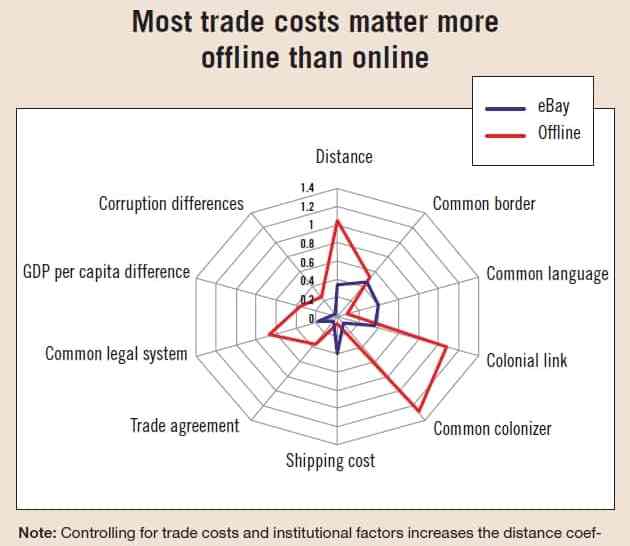
The reason small companies are finding success in foreign markets is that trade friction is 60 percent less for Internet-enabled businesses than for those that follow traditional trading methods, according to eBay’s white paper for sustainable growth in cross-border e-commerce.
With technology, companies are less inclined to avoid international markets because of the perceived difficulty in finding customers or risk that they won’t get paid. Instead of taking out advertising or traveling around the globe, companies can simply upload a product to an online shopping mall and attract buyers.
Consumers, for example, can find sellers anywhere in the world through search engines and shop anywhere using mobile devices. Distance becomes less important because buyers and sellers are connected online, with all products viewable with the click of a mouse or tap of a touchscreen. Marketplaces like eBay offer buyer protection programs, seller rating systems, dispute resolution mechanisms and secure payment technology such as PayPal to ensure trust in transactions.
FedEx Express, a popular conduit for moving packages of goods purchased online, estimates that global e-commerce will reach about $1 trillion next year, with annual increases in value of 20 percent, Ralph Carter, managing director for legal, trade and international affairs, said during the panel discussion.
Next year will also mark the first time the number of smart-phone users exceeds the number of personal computer users. Purchases by mobile phone will reach 7 percent of total electronic sales by 2016, he said.
If trade costs for all international transactions were as low as the eBay marketplace real GDP would increase an astonishing 15.6 percent, according to the report. Company officials acknowledge that such a jump in productivity is unrealistic, but say even a fraction of the savings would translate into tangible economic benefits for nations.
The report also says start-up online exporters tend to gain greater market share and have a lower failure rate after five years than their offline counterparts. That success dovetails with historical trade data which shows companies that export products and services tend to boost profits more and offer better-paying jobs than domestic-only firms.
Nonetheless, eBay users have export volumes that are far below their potential, according to company officials.
Online Policies. The Obama administration has made export growth a major focus of its strategy to revive the economy, setting a goal in 2010 to double exports within five years. Experts point out that emerging markets hold the most potential for companies to realize growth. In 2011, U.S. exports reached $2.1 trillion in value, supporting almost 10 million jobs, and this year the nation is on track to exceed that figure, according to the Commerce Department.
Under President Obama, the government has finalized and implemented three free trade agreements; made a concerted effort to increase awareness of federal resources for matching companies with potential buyers, conducting customized market research and providing trade financing; partnered with industry associations to spread the word about export promotion programs at the federal, state and local level; increased capabilities to respond to trade violations by foreign governments; launched a pilot program to help metropolitan areas develop export plans customized to their strengths and goals; and beefed up export assistance programs at the Small Business Administration.
|
Related Magazine Content
|
The Commerce Department’s International Trade Administration will soon re-launch its Export.gov Website to make it more user-friendly. Information will be matched to a company’s market and its level of export readiness, Michael Masserman, executive director of export policy, promotion and strategy, said. In 2011, the ITA launched an online tool that provides tariff information for 85 percent of goods going to countries where the United States has free trade agreements.
Small businesses now generate a third of all U.S. exports by value, up from 27 percent 10 years ago.
Policies that simplify trade for small businesses would create a surge of exports and change the political dynamic from vilification to support of trade, eBay officials said. The current trade system was built to support giant, multinational corporations, not mom-and-pop traders, they add. Meanwhile, many Americans believe outsourcing to low-cost countries and cheap imports have cost them manufacturing jobs at home.
“There is a tremendous opportunity for government to make the underlying logistical trade regime work for the really little business” and create real economic benefits, Bieron said.
eBay urged the U.S. government when negotiating trade agreements to include language reducing barriers to cross-border express delivery services, data exchange and customs clearance, as well as harmonizing postal tracking services, so micro businesses that rely on Internet services to access overseas markets can count on more reliable, predictable and affordable shipping. Shipping costs tend to represent the largest expense for online transactions because products are not shipped in bulk.
eBay also recommended the United States lead the way in pushing mutual recognition of trusted trader security programs to make it easier for small firms to benefit from trade facilitation measures, specifically by allowing larger logistics providers to incorporate small customers under their approved supply chain security plans.
Applying to the U.S. Customs-Trade Partnership Against Terrorism or the European Union’s Authorized Economic Operator programs, for example, requires a significant investment in man hours and resources. Participating companies are eligible for reduced inspections and other preferential treatment at the border, because they are considered low-risk from a security and trade compliance perspective.
“It is harder for small businesses to absorb the costs that come with customs paperwork and the fees are proportionally harder for small businesses to mitigate. Customs complexity not only makes exporting prohibitive for potential new merchants, but can frustrate existing merchants and drive them to abandon global trade,” the report said.
Raising the threshold would enable small companies to offer more returns, because low-value shipments would escape customs paperwork and duty payments, it said.
FedEx and eBay officials support bills pending in the House and Senate that would set the floor for duties at $1,000 and $800 times the rate of inflation, respectively. Neither bill has picked up much support so far.
In late 2011, 10 countries in the Asia-Pacific Economic Cooperation gave preliminary consent toward adopting a baseline de minimus value across APEC below which no country could go.
FedEx’s Carter said raising de minimus has several advantages. It reduces the fiscal burden on the government because the amount of administrative resources required to collect all the duties outweighs the actual amount of revenue. It also allows customs administrations to focus their resources on goods with a higher value that pose a higher risk of duty evasion. And if imports can enter a country without duties, private companies don’t have to hire customs brokers to classify products and file paperwork, which would eliminate delays at the border trying to figure out how much is owed, he said.
“I can think of no other policy tool that is as easy to implement and would have as great an impact as higher de minimus,” Carter said.
Once the United States raises its bar on duties for low-value shipments there will be expectations for its trading partners to follow suit, he added.
“What you see is everyone maxing out what they can do, that’s simple, that’s below the threshold, that’s small enough to be shipped easily,” Mark Mastandrea, senior director of global shipping initiatives for eBay, said. “And there’s this recognition that there’s this huge marketplace that we’re just barely scratching the surface on.”
Democratizing trade so that average Americans experience its benefits will “show that the system doesn’t have to work only for elites” and that policymakers are making a conscious effort to help all rungs of the business community engage in cross-border trade, Bieron said.
The revolutionary effect of the Internet on trade isn’t limited to the United States. Other regions also “want to get very small businesses engaged in the global economy because it’s an opportunity to join globalization without emigrating to a developed country or moving to a megalopolis and becoming a factory worker.
“The idea is that the Internet now creates the infrastructure, technologically, for an artisan or small business anywhere in the world to actually reach customers everywhere,” Bieron said.
What’s standing in the way is logistics.
“Internet-enabled markets have some aspects that have so dramatically reduced the cost of doing cross-border business that what was before effectively impossible for small businesses is now possible. But moving stuff across borders in small amounts is still really very hard. There is a lot of complexity.
“So, the barriers have come down enough that some of the commerce is now flowing over the top. And we’re saying government can help reduce those barriers further,” he said.
eBay’s Logistics Play. eBay also announced the start of a trial service to make it easier for small businesses to ship across borders. The Global Shipping Program essentially is a pre-packaged freight forwarding option that consolidates shipments from eBay users around the country to take advantage of bulk transportation rates, provides the total landed cost before purchase, takes care of all customs requirements and provides full end-to-end tracking.
Not being able to accurately calculate international transportation is a big problem for small shippers, because customers recoil from having to pay taxes and shipping fees above the estimated amount at time of delivery.
Mastandrea told American Shipper that eBay has contracted with Pitney Bowes, a large mail services and document management company, to handle the freight delivery. At the Pitney Bowes hub, goods are sorted, labeled, packaged and shipped to the destination country using a network of freight forwarders and postal services.
Sellers have to opt into the Global Shipping Program and the buyer pays for the shipping. It enables them to sell to buyers in multiple countries, while only being responsible for shipping domestically to the freight center.
The pilot program is starting in the United States with a limited number of sellers and will be rolled out to more destinations in the coming months, Mastandrea said during the presentation.
The service resembles one for larger retailers offered by a company called FiftyOne, which plugs software into the retailer’s e-commerce platform that automatically configures the display in the language and currency of the nation the shopper is from, runs a credit check of the buyer, processes the payment, and then uses Pitney Bowes to calculate the international shipping costs (with the aid of an embedded application), pay the taxes and manage deliveries. (see “Grabbing exports by the e-tail,” Nov. 2009 American Shipper).
 |
| Sources: eBay data for 2010, sellers with sales of at least $10,000. U.S. offline: Bernard et al. (2007). France (all businesses): Eaton et al. (2009). France (large businesses only): Mayer & Ottaviano (2007). |
Snow Sport Deals is a six-employee company in Shady Side, Md., which sells refurbished skis, snowboards and related gear collected from ski resorts. A majority of its orders are from individuals through eBay, Amazon.com and its own Website, while about 20 percent of the business is wholesale to distributors in China and Russia. Only about 5 percent of its direct-to-consumer business is international, mostly to Canada.
Expanding into foreign markets has proven difficult, even with a cousin on staff who spent three years as an attorney at U.S. Customs, because trying to determine the total delivery cost in advance is so time consuming, Chapman said. Shipping oversize products, such as skis, by parcel is also too expensive.
A market surplus of snow boots in sizes 9.5 and under makes sales difficult in the United States and Canada, while there is a shortage of boots in larger sizes for teenage boys. Chapman said those smaller boots are considered large in Asia and that’s a niche market he’d like to target for direct consumer sales if tariff and logistics challenges can be minimized.
It’s a huge benefit for a small enterprise, he explained, to have someone figure out the landed cost and shipping arrangements.
“If the form is bigger than a half-page and it takes me five minutes it’s just not going to get done at a company my size. So that’s where we need help,” he said.
Snow Sport Deals exports to a handful of countries on a random basis, “but I can’t scale it. What I want is an accelerator. I want to jump my business to 30, 40 percent international sales. Right now it’s too cumbersome,” Chapman said.
(eBay’s economic report and roadmap Towards Commerce 3.0 can be found at www.ebaymainstreet.com/commerce3us)
Brokerage Compliance Symposium
The day before F3. Every compliance issue you face - fraud exposure, carrier liability, FMCSA rules, cargo theft, insurance gaps - navigated by attorneys and operators defining best practices in a changing industry.
F3 Awards Dinner
The night before F3. FreightTech100 companies honored. FreightTech 25 and Shipper of Choice winners revealed live. Cocktail reception into dinner and live music - 300 industry leaders in one purpose-built room.
F3: Future of Freight Festival
Industry-defining keynotes, rapid-fire technology demos, and industry leaders networking in experiences across Chattanooga - plus the inaugural F3 Awards Dinner featuring the FreightTech and Shipper of Choice reveals.
The day before F3. Every compliance issue you face - fraud exposure, carrier liability, FMCSA rules, cargo theft, insurance gaps - navigated by attorneys and operators defining best practices in a changing industry.
The Signal at Chattanooga Choo Choo • Chattanooga, TN Register NowThe night before F3. FreightTech100 companies honored. FreightTech 25 and Shipper of Choice winners revealed live. Cocktail reception into dinner and live music - 300 industry leaders in one purpose-built room.
The Signal at Chattanooga Choo Choo • Chattanooga, TN Register NowIndustry-defining keynotes, rapid-fire technology demos, and industry leaders networking in experiences across Chattanooga - plus the inaugural F3 Awards Dinner featuring the FreightTech and Shipper of Choice reveals.
The Signal at Chattanooga Choo Choo • Chattanooga, TN Register Now