




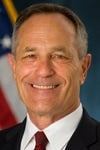
| Bersin |
Bersin, speaking in Philadelphia at a meeting of the Commercial Operations Advisory Committee, articulated his vision for border security and trade promotion strategies that complement each other, with a heavy reliance on risk management and expedited clearance for trusted shippers and travelers.
‘We need to reinvent our security regime,’ he said.
It was his first opportunity to personally address the 20 members of the private sector body since taking office two months ago and repeat previous statements before Congress and elsewhere that he wants to design security programs that don’t harm commerce.
The former Southwest border coordinator for the Department of Homeland Security acknowledged to reporters during a break that risk management, layered security and separating low-risk and known traffic from that which is high-risk or unknown are not new concepts, but that he intended to develop more robust protocols to realize their full potential.
‘We need to implement it in practice to a much greater scale and with much greater fidelity to the end point of expediting lawful traffic and seizing unlawful and dangerous traffic.
‘The determination to have it contributed to by the private sector, by the trade community, have it adopted and have it implemented to much greater effect and benefit is the novel dimension,’ Bersin said.
His statement carried overtones to former CBP Commissioner Robert Bonner’s so-called Green Lane under which shippers that demonstrate their supply chain security practices meet high standards get a virtual free pass to avoid inspections.
CBP officials have stressed since 9/11 that their twin missions are border security and trade facilitation, although many importers and exporters say security requirements still trump efforts to simplify Customs clearance and compliance procedures. Importers in the highest tier of the voluntary trusted trade program known as the Customs-Trade Partnership Against Terrorism complain that they still do not receive sufficient tangible benefits to justify the expenditure of resources required to participate.
Bersin told Congress last month that he wants to build on trusted trader and traveler programs such as FAST, SENTRI, NEXUS and Global Entry.
The Free and Secure Trade program offers expedited clearance for carriers and shippers enrolled in C-TPAT by reducing the amount of documentation required at crossing, providing dedicating lanes to FAST participants and reducing inspection levels. Under the program, drivers must be pre-vetted as low-risk through a review of their identification and citizenship documents.
SENTRI and NEXUS are southern and northern border programs, respectively, that allow registered travelers to speed through border checkpoints and Global Entry offers the same benefit at airports for international travelers.
The implication of his philosophy, Bersin said Tuesday, is that CBP can’t increase security measures unless it does a better job of segmenting traffic by risk.
‘We’re trying to find a needle in a haystack. There are two ways to do that. One, we can use very pinpointed intelligence to reach into the haystack. Or, you can blow a lot of the hay away from the haystack to make it easier to find the needle,’ he said.
The critical piece to using risk management instead of blunt inspection tools at the border is advance information, he said.
‘If you share information with us about your supply chain — with whom you do business, what’s shipped, whom you trade with, and who you let do business on your behalf and other information we may require — to establish you as a trusted shipper, then we have two reciprocal obligations: To use that information appropriately and protect its confidentiality for competitive reasons as well as institutional proprietary reasons and to facilitate the movement of your goods across physical boundaries.
‘This is the bargain that I propose to the private sector’ to enhance security and economic competitiveness at the same time, Bersin said.
CBP in the future intends to extend the offer to foreign companies and nations ‘to permit us to do our inspections and segmentation as far away geographically and as early in time as we can from the arrival,’ he added.
Left unsaid was whether the new Importer Security Filing, or ’10+2′ rule, still does not provide enough detailed transactional data about imports. The rule requires importers to provide 10 pieces of information about its supplier, container stuffing location, cargo contents and consignee 24 hours prior to vessel loading in a foreign port. It was implemented because ocean carrier manifest information is very vague for targeting purposes.
Asked during the break what extra information the trade community could still provide, Bersin said, ‘There’s a fair amount that could be disclosed earlier in the process.’
Pointing to the container manifest as an example, he said, ‘The first information we get is fairly sketchy. It gets more specific as the container comes closer to the American shore. It seems to me that with the confidence that that information would be protected, there could be a lot more instructive statement about what’s in the container which would permit much more targeted judgments about exactly what kind of achievements could be gotten, on top of C-TPAT treatment.
‘What we need to do is get more people into the most expedited tier of the program, and that necessarily involves knowing more about not only the shipper but the shipment.’
The Container Security Initiative, the Secure Freight Initiative and C-TPAT are all due ‘for a relook and a renewal of purpose, and multiplication of the original promise.
‘That’s not to say these programs haven’t served well. They have,’ but CBP needs to develop more flexible inspection arrangements and evaluate the mix of technology, personnel and overseas partnerships ‘to see whether or not we can rebalance that to get a more effective and efficient result,’ Bersin said.
To demonstrate his seriousness about achieving quick trade facilitation results, Bersin announced that CBP has taken concrete steps to significantly shorten the amount of time it takes for a customs broker to obtain his or her license after passing the broker exam. ‘ Eric Kulisch
Brokerage Compliance Symposium
The day before F3. Every compliance issue you face - fraud exposure, carrier liability, FMCSA rules, cargo theft, insurance gaps - navigated by attorneys and operators defining best practices in a changing industry.
F3 Awards Dinner
The night before F3. FreightTech100 companies honored. FreightTech 25 and Shipper of Choice winners revealed live. Cocktail reception into dinner and live music - 300 industry leaders in one purpose-built room.
F3: Future of Freight Festival
Industry-defining keynotes, rapid-fire technology demos, and industry leaders networking in experiences across Chattanooga - plus the inaugural F3 Awards Dinner featuring the FreightTech and Shipper of Choice reveals.
The day before F3. Every compliance issue you face - fraud exposure, carrier liability, FMCSA rules, cargo theft, insurance gaps - navigated by attorneys and operators defining best practices in a changing industry.
The Signal at Chattanooga Choo Choo • Chattanooga, TN Register NowThe night before F3. FreightTech100 companies honored. FreightTech 25 and Shipper of Choice winners revealed live. Cocktail reception into dinner and live music - 300 industry leaders in one purpose-built room.
The Signal at Chattanooga Choo Choo • Chattanooga, TN Register NowIndustry-defining keynotes, rapid-fire technology demos, and industry leaders networking in experiences across Chattanooga - plus the inaugural F3 Awards Dinner featuring the FreightTech and Shipper of Choice reveals.
The Signal at Chattanooga Choo Choo • Chattanooga, TN Register Now