




Nearly all prominent trade lanes across the globe have seen average containership size increase over the years as carriers continue to deploy larger but fewer vessels.
The Asia to North America East and Gulf Coast trade has seen average vessel size drastically increase in the wake of the Panama Canal expansion in 2016, with average vessel size on the trade now surpassing the Asia to North America West Coast trade. Throughout this report, North America refers to the U.S. and Canada only.
When carriers initially take delivery of containerships of 18,000 TEUs or more, they are deployed on the Asia-North Europe trade. Once these behemoths get under way on the Asia-Europe trade, it causes the trade’s previously biggest containerships to get pushed onto other routes, particularly the Asia to North America trades, which creates a domino effect onto other trades.
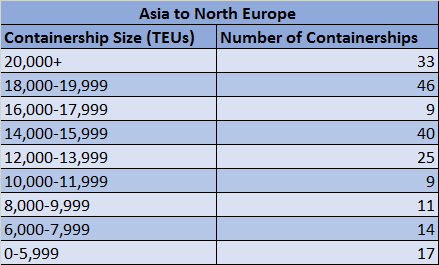
Data from BlueWater Reporting shows there are currently 33 vessels of 20,000 TEUs or more and 46 vessels of 18,000 TEUs to 19,999 TEUs operating on the Asia to North Europe trade, as illustrated in the chart below.
The largest vessels currently deployed on the Asia to North America West Coast trade are two 17,816-TEU vessels, while four vessels ranging in size from 14,000 TEUs to 15,999 TEUs are deployed on the trade, as illustrated in the chart below, which also was built using data from BlueWater Reporting.

BlueWater Reporting also shows that although the Asia to North America East and Gulf Coast trade does not see vessels as large as the Asia to North America West Coast trade, there are currently five vessels in the 14,000- to 15,999-TEU range serving the trade, as illustrated in the chart below.

The increase in average containership size between the October reporting periods in 2015 and 2018 was especially high on the Asia to North America East Coast trade, the North Europe to South America West Coast trade, the Asia to Mexico trade and the North Europe to Mexico trade, as illustrated in the chart below, which was constructed using data from BlueWater Reporting.

The Asia to North America East and Gulf Coast trade saw average vessel size rise 48.6 percent between October 2015 and October 2018, from 5,848 TEUs to 8,690 TEUs, largely due to the Panama Canal’s third set of locks opening in June 2016, allowing the canal to handle vessels over 14,000 TEUs. Prior to the expansion, the waterway could only handle vessels up to 5,000 TEUs. Thirteen of the 18 loops serving the Asia to North America East and Gulf Coast trade currently utilize the Panama Canal, while the remaining five rely on the Suez Canal, according to BlueWater Reporting.
The North Europe to South America West Coast trade saw average vessel size rise 117.6 percent between the October reporting periods in 2015 and 2018, from 3,757 TEUs to 8,174 TEUs, also thanks to the Panama Canal expansion. All three loops that currently allocate capacity on the trade utilize the Panama Canal.
To date, the largest containerships to sail through the Panama Canal are 14,414-TEU vessels operated by CMA CGM.
Meanwhile, average vessel size on the Asia to Mexico trade increased 32 percent between October 2015 and October 2018, from 6,402 TEUs to 8,451 TEUs, while average vessel size on the North Europe to Mexico trade increased 39.5 percent, from 4,566 TEUs to 6,369 TEUs. The sharp increase in average vessel size on the Asia to Mexico and North Europe to Mexico trades largely can be attributed to Mexico in general becoming a booming manufacturing hub, especially for automobiles.
“Mexico has risen to become the seventh-largest car manufacturer in the world, and a large proportion of the additional container traffic to the country is made up of raw materials and components consigned to the growing number of car assembly plants and suppliers,” Drewry said last October. “New investments from Kia, Toyota, BMW and Daimler Benz will see Mexican car manufacturing capacity reach five million vehicles by 2022, up from 3.4 million in 2015.”
The Panama Canal expansion had little impact in the increase in average vessel size on the Asia to Mexico and North Europe to Mexico trades, considering data from BlueWater Reporting shows only one in nine loops currently serving the Asia to Mexico trade utilizes the Panama Canal, while only one in six loops serving the North Europe to Mexico trade relies on the waterway.
Simon Heaney, senior manager of container research at Drewry, told BlueWater Reporting in November, “Based on our sample of Mexican ports, total port throughput was up by approximately 8 percent year-over-year in the first half of 2018.”
While average containership size continues to rise, the number of containerships deployed continues to decline, as illustrated in the chart below, which was built using data from BlueWater Reporting.

Stepping It Up. Scrapping of smaller vessels continues to be way more common than the scrapping of larger vessels, which will continue to contribute to the steady increase in average vessel size on trade routes throughout the globe.
Data from Clarksons Research’s October issue of Container Intelligence Monthly shows that containership demolition for 2018 is expected to total 67,400 TEUs, down from 398,600 TEUs in 2017, 654,400 TEUs in 2016 and 197,200 TEUs in 2015.
However, containership demolition is expected to pick back up again in 2019 at 161,100 TEUs. Of the 67,400 TEUs expected to be scrapped in 2018, only 11.4 percent will involve vessels of 6,000 or more, while of the 161,100 TEUs expected to be scrapped in 2019, only 12.8 percent will involve vessels of 6,000 TEUs or more.
Additionally, carriers continue to set new records by ordering larger containerships, despite the ongoing threat of overcapacity.
The largest containerships that have entered service are Orient Overseas Container Line’s six 21,413-TEU “G-Class” vessels. OOCL took delivery of five of these vessels in 2017 and the final one in January of this year.
However, CMA CGM has nine 22,000-TEU vessels on order, while Mediterranean Shipping Co. has 11 23,000-TEU vessels on order and Hyundai Merchant Marine has 12 23,000-TEU vessels on order.
Mitigating Larger Ships. Although trades will generally continue to see average vessel size increase, various factors will mitigate this growth.
For instance, not all carriers are interested in buying larger containerships right now — or even any containerships at all.
Maersk Line is not planning on ordering any large ships before 2020 at the earliest, A.P. Moller – Maersk CEO Søren Skou said during the company’s third quarter 2018 earnings conference call.
Additionally, Hapag-Lloyd CFO Nicolás Burr said during the company’s third quarter 2018 earnings conference call that Hapag-Lloyd does not “have the necessity at this moment to order vessels.”
Secondly, although many prominent carriers continue to partake in the competition to have the largest containership, in general, they appear to actually be putting a larger focus on ordering smaller vessels.
The charts below show that as of October, 289 container vessels under 12,000 TEUs were on order, compared to just 260 a year agp, according to data from Clarksons Research’s October 2017 and October 2018 issues of its Container Intelligence Monthly.


Additionally, 108 container vessels of 12,000 TEUs or more were on order as of October, down from 111 as of October 2017.
And even though newbuilding prices for containerships of all sizes have been declining for the past few years, they are beginning to pick back up. The average newbuilding price for an 18,500-TEU containership at the end of 2017 stood at $140 million, down from $145.5 million at the end of 2016 and $154 million at the end of 2015, according to Clarksons Research.
However, it appears prices are rising, with the average newbuilding price for an 18,500-TEU containership totaling $146 million as of September. The average newbuilding price for containerships of all sizes fell between the end of 2015 and the end of 2017, but increased between the end of 2017 and this September.
© 2018 BlueWater Reporting (www.BlueWaterReporting.com) Used with permission
Brokerage Compliance Symposium
The day before F3. Every compliance issue you face - fraud exposure, carrier liability, FMCSA rules, cargo theft, insurance gaps - navigated by attorneys and operators defining best practices in a changing industry.
F3 Awards Dinner
The night before F3. FreightTech100 companies honored. FreightTech 25 and Shipper of Choice winners revealed live. Cocktail reception into dinner and live music - 300 industry leaders in one purpose-built room.
F3: Future of Freight Festival
Industry-defining keynotes, rapid-fire technology demos, and industry leaders networking in experiences across Chattanooga - plus the inaugural F3 Awards Dinner featuring the FreightTech and Shipper of Choice reveals.
The day before F3. Every compliance issue you face - fraud exposure, carrier liability, FMCSA rules, cargo theft, insurance gaps - navigated by attorneys and operators defining best practices in a changing industry.
The Signal at Chattanooga Choo Choo • Chattanooga, TN Register NowThe night before F3. FreightTech100 companies honored. FreightTech 25 and Shipper of Choice winners revealed live. Cocktail reception into dinner and live music - 300 industry leaders in one purpose-built room.
The Signal at Chattanooga Choo Choo • Chattanooga, TN Register NowIndustry-defining keynotes, rapid-fire technology demos, and industry leaders networking in experiences across Chattanooga - plus the inaugural F3 Awards Dinner featuring the FreightTech and Shipper of Choice reveals.
The Signal at Chattanooga Choo Choo • Chattanooga, TN Register Now