




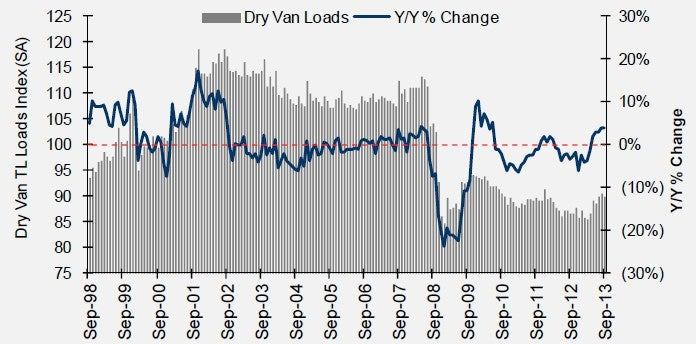
Y/Y dry van TL load comps have increased slightly, but mostly because of corresponding declines in LOH; absolute values remain depressedSource: American Trucking Associations, Stifel format.
Truckload yields have been positive for the past 14 quarters, but were on a steady path of deceleration since their 2Q11 peak. 3Q13 results were sequentially flat, which could mean nothing, as it barely changes the downward trend line, or it could signal an end to the slide. Rising yields would necessitate a more meaningful capacity tightening, in our view. We note that these results exclude fuel surcharge, so the trend reflects a degradation in core pricing momentum, as volume trends have stagnated.
Truckload yields (ex. fuel) had been decelerating since their 2Q11 peak; flat 3Q sequential comps could be indicative of a bottom, especially if capacity finally begins to tighten, but we do not view that as a near-term event Source: American Trucking Associations, Stifel format.
Better utilization and capacity discipline, especially among the larger, more well-capitalized carriers, has helped breed an improving trend in revenue-per-tractor-per-week, a very important metric.
Source: American Trucking Associations, Stifel format.Revenue per tractor per week has improved steadily since 1Q09 Source: American Trucking Associations, Stifel format.
Ultimately, slow recovery in the core economy has produced a sluggish freight climate, which has hindered traction on the yield side and made it difficult to make strides in average industry operating ratios. As revenue-per-tractor-per-week has improved, so too has the cost of operations increased.
Source: American Trucking Associations, Stifel format.OR has stagnated over the last few years despite productivity improvements, as it is difficult to grow margins amidst rising cost and a sluggish freight economy Source: American Trucking Associations, Stifel format.
Less-than-truckload volumes have been uninspired for the majority of the last two years, which, in our view, has helped carriers stay disciplined with respect to pricing and capacity additions. However, as the soft market persists, carrier discipline may begin to falter.
Source: American Trucking Associations, Stifel format.An unimpressive freight market has led to low y/y LTL tonnage comps for most of the last 2 years; robust ISM readings from July-September may have driven somewhat better volumes in 3Q13 Source: American Trucking Associations, Stifel format.
LTL yields (as measured by revenue-per-hundredweight, including fuel surcharge) have been positive for the past three years, but appear to have decelerated. Net of fuel, however, underlying pricing trends remain steady, but may soon come under pressure in the face of tepid volume fundamentals, especially as larger national accounts come up for rebid.
Source: American Trucking Associations, Stifel format.LTL y/y pricing comps have decelerated, but remain favorable ex. FSC Source: American Trucking Associations, Stifel format.
Average weight per shipment increases have stalled due to the slow recovery and are generally not a big cause of yield changes.
Source: American Trucking Associations, Stifel format.Average weight per shipment has leveled off over the last 3 years Source: American Trucking Associations, Stifel format.
It’s been a mixed bag with some carriers like Saia and Old Dominion making significant strides in their margins, whereas others — Vitran, ABF, and YRC Freight — continue to lag.
Source: American Trucking Associations, Stifel format.3Q13 y/y operating ratio (OR) improved by 20bp; approaching, but still off from pre-recession average Source: American Trucking Associations, Stifel format.