




“Congested border crossings are an enormous obstacle to trade and have long been a source of security concerns, particularly on our southern border,” said Steve Roop, assistant agency director at TTI. “The freight shuttle has the potential to alleviate the freight bottlenecks and speed up the security-screening process and at the same time improve the air quality in these communities.”
The institute received $650,000 for a feasibility study from the U.S. Department of Energy.
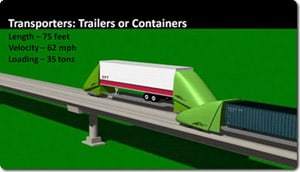
Roop’s freight shuttle would consists of a series of specially designed transport vehicles that carry freight containers and truck trailers. They would travel on an elevated guideway, propelled up to 60 miles per hour by electric powered linear induction motors. He envisions the use of a drive-through scanning station also developed by TTI enabling the freight to be checked without stopping. The Department of Homeland Security would operate the station.
The extensive study will examine important aspects of using the freight shuttle at border crossings including capital investment and operational costs, bi-national cooperation, commercial issues, and community and air quality benefits that reduced truck traffic could yield.
“If the study shows that the Freight Shuttle makes sense at the border, the ultimate jury on commercial viability is the private sector,” Roop said.
