




The study, presented to the port's governing board on Monday, also concluded that the commercialization case for LNG tractors in the port is 'extremely marginal' and would require sizable financial incentives to move forward.
Prepared by non-profit clean fuel advocacy group CALSTART — with testing conducted by a noted University of California, Riverside, fuel systems researcher — the study examined results of a port-initiated pilot program in 2004 to test the efficacy of LNG yard tractors.
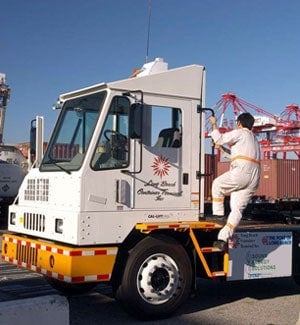
Yard tractors, referred to as hostlers, are heavy-duty off-road trucks used to ferry containers within a container terminal. Although similar to diesel tractors commonly seen on highways, yard tractors are regulated as off-road or non-road equipment and have a higher emission standards.
| LNG-powered yard tractor at the Port of Long Beach. |
Terminals at the neighboring ports of Long Beach and Los Angeles use about 1,300 diesel-powered yard tractors. The tractors remain a significant source of diesel emissions from the two port's operations despite a fleet-wide emissions-control retrofit program several years ago that considerably reduced overall tractor-generated emissions.
Widely considered a 'clean alternative' to the typical diesel-powered yard tractors, the three LNG tractors involved in the pilot program were operated in regular service for eight-months at Long Beach Container Terminal. During the program, the three LNG tractors were compared to a baseline group of eight diesel-powered tractors.
The CALSTART study found that dockworkers driving the LNG tractors had a strongly positive experience with the vehicles, most noting the ride comfort and reduced noise compared to diesel tractors.
Yard mechanics surveyed found the LNG tractors comparable in maintenance levels to their diesel counterparts. While the LNG tractors did suffer from fuel delivery and leakage problems early in the program — a problem subsequently fixed by the manufacturer — the tractors continued to suffer from inaccurate fuel gauges throughout the program. The study noted the gauge problem appears to be endemic to the LNG industry and no effective solution was available for heavy-duty LNG vehicles. During the program, fuel gauges were taped over to prevent 'drivers and mechanics from acting on unreliable data.'
Emissions testing for the pilot program was conducted on four of the program tractors — one LNG tractor and three diesel-powered tractors.
The testing found that while the diesel-powered vehicles were significantly higher in the generation of tailpipe carbon monoxide and particulate matter, the LNG tractor generated dramatically higher levels of hydrocarbons and nitrogen oxides than its diesel counterpart.
The most comparable diesel engine in the program produced 5.6 times more carbon monoxide and about 10 times more particulate matter than the LNG tractor, though the LNG tractor was not measured for particulate matter emissions and were assumed to generate none.
The LNG tractors in the program produced 21 percent more nitrogen oxides and 584 percent more total hydrocarbon emissions than the most comparable diesel tractor measured.
It should also be noted that each of the tested tractors met all the required state and federal emission standards for each individual tractor's model year.
Carbon monoxide, labeled a greenhouse gas, is a major contributor to the formation of smog. Particulate matter, most readily seen as smokestack soot, contributes to smog formation and can also lodge in the lungs exacerbating respiratory illnesses.
Nitrogen oxides combine in the atmosphere with emitted hydrocarbons to form ozone, the prime component of smog. Nitrogen oxides, in addition to being linked to respiratory illnesses, have also been identified as contributors to oxygen depletion and acidity in bodies of water as well as possible contributors to biological mutations.
The study also concluded that costs were an issue with the LNG tractors and that the 'business case for LNG yard hostlers is extremely marginal.'
The initial per unit cost of the LNG tractors were $120,000, a 50 percent increase over the $80,000 per unit cost of the diesel tractors.
Despite this, the study concluded that in the absence of vehicle purchase incentives — assumed to be between $30,000 and $40,000 — the total cost of operating LNG tractors over a 10-year lifespan was comparable to the life cycle cost of the diesel tractors. However, the cost analysis did not include a fueling infrastructure cost estimated at $700,000 per refueling station. Since tractors are generally confined to one terminal, this fueling infrastructure cost could amount to more than $10 million to provide fueling at the 14 Southern California container terminals. The ports of Long Beach and Los Angeles have no permanent LNG fueling stations on port terminals.
The study also found that current incentive programs and policies, including the port's own Clean Air Action Plan, are insufficient to stimulate significant near-term demand for LNG tractors.
'Given the current marginal business case and the cost of LNG refueling infrastructure,' said the study, 'it is unlikely that there will be a significant demand for LNG yard hostlers in the near-term without strong financial or regulatory incentives for yard hostler fleet operators to adopt LNG technology.'
The study also offered several recommendations to the port. These included: improving emission testing technology, evaluation of current LNG and diesel tractors, updating the business case model, streamlining the LNG fuel infrastructure permitting process, and considering port-based incentives to pay for LNG tractors and the needed fueling infrastructure.
Brokerage Compliance Symposium
The day before F3. Every compliance issue you face - fraud exposure, carrier liability, FMCSA rules, cargo theft, insurance gaps - navigated by attorneys and operators defining best practices in a changing industry.
F3 Awards Dinner
The night before F3. FreightTech100 companies honored. FreightTech 25 and Shipper of Choice winners revealed live. Cocktail reception into dinner and live music - 300 industry leaders in one purpose-built room.
F3: Future of Freight Festival
Industry-defining keynotes, rapid-fire technology demos, and industry leaders networking in experiences across Chattanooga - plus the inaugural F3 Awards Dinner featuring the FreightTech and Shipper of Choice reveals.
The day before F3. Every compliance issue you face - fraud exposure, carrier liability, FMCSA rules, cargo theft, insurance gaps - navigated by attorneys and operators defining best practices in a changing industry.
The Signal at Chattanooga Choo Choo • Chattanooga, TN Register NowThe night before F3. FreightTech100 companies honored. FreightTech 25 and Shipper of Choice winners revealed live. Cocktail reception into dinner and live music - 300 industry leaders in one purpose-built room.
The Signal at Chattanooga Choo Choo • Chattanooga, TN Register NowIndustry-defining keynotes, rapid-fire technology demos, and industry leaders networking in experiences across Chattanooga - plus the inaugural F3 Awards Dinner featuring the FreightTech and Shipper of Choice reveals.
The Signal at Chattanooga Choo Choo • Chattanooga, TN Register Now