




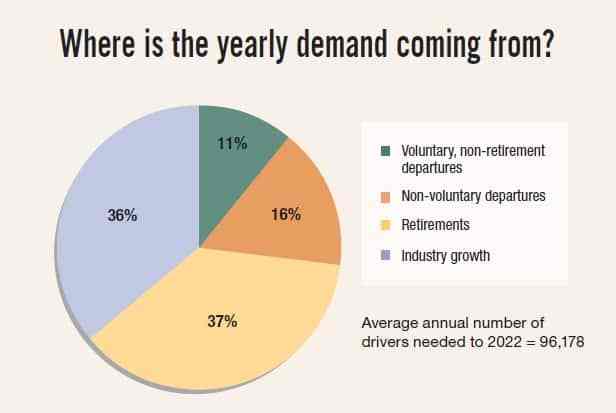
In its latest data on the perennial debate over the trucking industry’s driver shortage, the American Trucking Associations has predicted that by 2022 the industry will have an unmet demand for 239,000 drivers.
The Federal Motor Carrier Safety Administration’s new hours of service rules, which took effect July 1, and the Compliance Safety Accountability regulations will have a large impact on raising the number of drivers needed, the agency has said. The potential for more regulatory changes that will further impact the shortage appears almost certain.
Numerically speaking, 96,178 new drivers will be needed each year over the next decade, the agency said, or capacity in the domestic trucking market will tighten up; rates will increase. Shippers will see on-time deliveries plummet and their service levels decrease.
A central issue to the shortage debate, however, seems to be getting a new generation of drivers to buy into the trucking industry.
In the second half of 2011 and during the first few months of 2012, the driver turnover that had been fueling fears of a pending capacity crunch started deteriorating. For a while, it seemed like stability ruled the day, said Thom Albrecht, managing director at BB&T Capital Markets.
This year, however, the driver turnover trend started to change.
“The number of applicants has dropped pretty precipitously — whether it’s at truck driving schools or within a carrier’s own recruiting efforts,” Albrecht said. “It’s a pretty consistent 10-20 percent drop. Last year, the number of applicants was still fairly high.”
While Albrecht hasn’t seen rates go up or capacity decrease as a result of the lack of applications, he said it could turn into a problem. To try to keep the drivers around and possibly attract new recruits, he has observed carriers impose pay incentives for everything from excellent safety scores to on-time deliveries.
The recovery of the housing market could create an issue for generating needed drivers because being able to go home every night is more appealing than staying out on the road and living the life of a long-haul trucker, Albrecht said.
Stringent CSA regulations could also effectively eliminate some applicants before they even get into the driver’s seat.
“The cumulative impact of CSA has raised the standards of what constitutes either an acceptable driver or even an acceptable applicant,” he said. “Everyone’s standards have been raised over the last couple of years, and it’s probably gotten more pronounced now that CSA will be approaching its third birthday this December.”
The other main regulatory issue that has added fuel to the driver-shortage debate — the FMCSA’s new hours of service rule — has yet to be factored, Albrecht said. The HOS rules likely won’t have an impact on capacity until 2014, he added.
Albrecht reports that for now there is currently enough capacity in the domestic market and shippers have not had any problem finding space for their cargo. Sufficient trucking activity is also keeping the shortage at bay.
A shortage of qualified drivers would certainly be an issue in the current market, if dry van shipments weren’t shrinking, Albrecht said. In nine of the past 12 years, he explained dry van activity has dropped and it could have a larger impact on the driver shortage issue than all the other oft-cited determinants.
“If the van sector were growing, we’d be seeing the driver problem on the front page of the New York Times,” he said.
Not Convinced. Until there is more evidence that driver scarcity has become an issue, shippers won’t worry about it, Albrecht said. And any shortage, which will drive up rates, will likely not become a problem until 2015, he pointed out.
“The driver situation everyone is aware of, but until tender acceptance rates deteriorate, until on-time pickup or on-time delivery rates deteriorate, no one is going to pay up to solve what appears to be a fictional driver problem,” Albrecht said. “Nobody views it that way, but until it impacts your operation and your service, nobody’s going to just go out and voluntarily give out higher rates.”
“The shippers are skeptical enough that they’re not really paying much in the way of incremental rates,” said Stifel Nicolaus’ John Larkin. “On Wall Street, folks have been anticipating this shortage for four or five years, and it never really seems to materialize. Some of us are becoming a little more skeptical than others.”
Albrecht thought in 2009 there was a big capacity shortage just around the corner, and the impact would to start appearing within two years. However, when the market softened in the second half of 2011, he started to rethink his earlier opinions.
Albrecht said he realizes his earlier outlook of the impending doom coming to the truckload industry may have been premature. There are plenty of those in the industry who don’t share his new viewpoint.
“I still think there are guys clinging to the old thesis of, ‘Look out, it’s right around the corner,’” he said. “And there’s just no evidence of that.”
Shippers can take a few steps to prepare for any sudden lack of qualified drivers. Albrecht suggested looking at truck turnarounds — some shippers have told him they had been tying up trucks for seven hours at loading — can vastly improve productivity. Faster turnarounds also help keep drivers on the road. However, even shippers who get their goods on the road quickly have to make sure their receivers aren’t abusing the loading and unloading process, he said.
Foster Finley, a managing director in AlixPartners’ Performance Improvement practice, doesn’t see the driver shortage as an issue. While there’s no denying the driver pool is getting older and certain regulations may make it harder for carriers to find qualified drivers, he said the detrimental shortage that has been talked about for years hasn’t occurred.
“After 20 years of hearing that it’s a pending and dire issue looming on the horizon, our clients and I, personally, just have not seen that come to pass,” he said.
If issues exist in the current market, Finley said, it is not because drivers aren’t available. The rare instances drivers haven’t picked up goods for shippers can be chalked up to either ability — perhaps the driver couldn’t handle the specific item being shipped — or the free market. If shippers aren’t commercially competitive, drivers might look elsewhere, he said.
Finley acknowledged the aging driver pool has made it difficult for some carriers to hire new drivers than it has been in the past. But it’s not enough to cause a shortage that would impact capacity in any significant way, he said.
“If today we can’t get enough 25-year-olds to take an interest in over-the-road trucking, you pay more money, and they’ll take an interest. It’s a self-correcting phenomenon,” he said.
Finley also thinks recently imposed regulations haven’t impacted the industry’s ability to keep drivers in their vehicles. “Some pricing has changed, and routing and scheduling has changed, but it hasn’t stopped the flow of commerce,” he said.
More Money. Even if there was a more apparent shortage, some analysts aren’t convinced that higher wages are enough to get a new generation of drivers excited about a trucking career.
Larkin said carriers have been increasing their reliance on driver training schools and looking to mold new drivers instead of taking the traditional approach of hiring experienced drivers who have a tendency of cycling through the industry, jumping from carrier to carrier.
“The question is, where are the 20-something, 30-something drivers going to come from to replace those moss-back drivers who really have become the backbone of the industry,” Larkin said. “I don’t think anybody knows the answer to that.”
While bigger companies will still be able to find, and pay for, new drivers, smaller operators may have a harder time keeping their trucks on the road. “It’s easier for Swift to find drivers than it is for some small carrier operating 20 trucks in Kansas,” he said.
Brokerage Compliance Symposium
The day before F3. Every compliance issue you face - fraud exposure, carrier liability, FMCSA rules, cargo theft, insurance gaps - navigated by attorneys and operators defining best practices in a changing industry.
F3 Awards Dinner
The night before F3. FreightTech100 companies honored. FreightTech 25 and Shipper of Choice winners revealed live. Cocktail reception into dinner and live music - 300 industry leaders in one purpose-built room.
F3: Future of Freight Festival
Industry-defining keynotes, rapid-fire technology demos, and industry leaders networking in experiences across Chattanooga - plus the inaugural F3 Awards Dinner featuring the FreightTech and Shipper of Choice reveals.
The day before F3. Every compliance issue you face - fraud exposure, carrier liability, FMCSA rules, cargo theft, insurance gaps - navigated by attorneys and operators defining best practices in a changing industry.
The Signal at Chattanooga Choo Choo • Chattanooga, TN Register NowThe night before F3. FreightTech100 companies honored. FreightTech 25 and Shipper of Choice winners revealed live. Cocktail reception into dinner and live music - 300 industry leaders in one purpose-built room.
The Signal at Chattanooga Choo Choo • Chattanooga, TN Register NowIndustry-defining keynotes, rapid-fire technology demos, and industry leaders networking in experiences across Chattanooga - plus the inaugural F3 Awards Dinner featuring the FreightTech and Shipper of Choice reveals.
The Signal at Chattanooga Choo Choo • Chattanooga, TN Register Now