




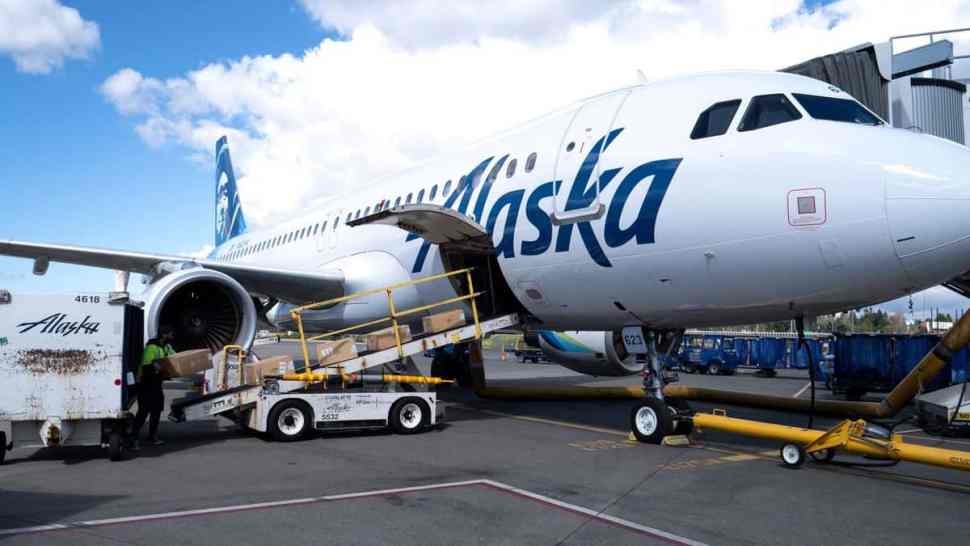
Alaska Airlines’ parent company on Monday dialed back its flight schedule even further and said it had applied for federal worker-protection grants, amid more signs that the airline industry is under extreme financial duress.
In a regulatory disclosure, Alaska Air Group (NYSE: ALK) said it will pull down 80% of its passenger capacity in April and May, less than two weeks after announcing plans for a 70% reduction in available seats. It said bookings had evaporated so much that keeping more planes in the air could not be justified, and that “sizable cuts” are likely in the coming months.
Reducing flight schedules to the bone is one of many drastic steps airlines are taking to maintain liquidity. Companies are asking employees to take unpaid leave, cutting purchases and capital expenditures, seeking to defer equipment leases and vendor payments, and borrowing money from lenders.
Alaska Air Group said subsidiaries Alaska Air, Horizon Air and McGee Air Services, a ground handling company, have also applied to the Treasury Department for payroll support under the Coronavirus Aid, Relief and Economic Security (CARES) Act, joining Delta Air Lines, Southwest Airlines and JetBlue, which are already seeking federal aid.
The program requires airlines to maintain employment rolls through Sept. 30 to be eligible for assistance. The CARES Act provides $25 billion in grants for passenger airlines plus $4 billion for cargo airlines. Each airline can apply for up to the amount paid in employee compensation for a six-month period last year, but the amount received could be prorated depending on the total compensation requested by the industry.
Delta (NYSE: DAL) and American Airlines (NASDAQ: AAL) stand to receive more than $7 billion each, followed by United Airlines at $6.5 billion, according to an estimate by Helane Becker, airline equity analyst at Cowen investment bank.
Alaska said it had $2 billion in liquid assets as of Monday. Those reserves could be quickly depleted, as domestic carriers have said they are bleeding tens of millions of dollars per day even after shrinking operations to a minimum.
The company also said it was indefinitely postponing the introduction of its “owner’s manual” as part of its May 7 shareholders meeting webcast. The owner’s manual is a document explaining a company’s broad principles of operation, financial targets and capital allocation goals.
Meanwhile, American and United Airlines said they will significantly reduce flying schedules via the three main airports in the New York City area to protect employees because the number of coronavirus cases in the area is so high. Nearly 69,000 people had tested positive for COVID-19 and 2,738 people had died in the city as of Monday evening.
Both carriers, like all airlines, are already flying very limited schedules because COVID-19 has led to extensive travel restrictions and a precipitous fall in travel demand. In United’s case, the new cutbacks eliminate almost 90% of its 157 daily flights to 66 destinations.
American said the limited number of flights will have capacity restrictions on board in order to maintain social distancing and will be crewed by people based outside of New York.
Continuing limited service is important to maintain some level of connectivity and transportation for essential personnel and goods, airlines say. Having scheduled passenger service in place, for example, enabled Alaska Air to carrying components to three cities last week for a manufacturer to make into face masks for hospital workers on the front lines of the coronavirus.
How much airlines need to fly to qualify for federal payroll assistance under the CARES Act is a bone of contention between the industry and regulators. Under the emergency relief law, airlines are supposed to maintain a “reasonable” level of services. The Department of Transportation indicated it plans to require scheduled passenger and cargo airlines to maintain minimum air services nationwide to communities served prior to March 1, with some exceptions. The proposed order does not cover charter operations.
In another decision that also ties the industry’s hands, the DOT informed U.S. and foreign airlines that they are obligated to provide cash refunds to passengers — not vouchers or credits for future travel — when a carrier cancels a scheduled flight or makes a significant schedule change and the passenger chooses not to accept the alternative offered.
Some governments are allowing carriers to issue travel vouchers. Requiring cash refunds will further drain airlines’ depleted cash balances.
Airlines are trying to retain loyal customers and spur future bookings by extending deadlines for maintaining status in mileage programs and waiving change fees for bookings made in the next few months.
Brokerage Compliance Symposium
The day before F3. Every compliance issue you face - fraud exposure, carrier liability, FMCSA rules, cargo theft, insurance gaps - navigated by attorneys and operators defining best practices in a changing industry.
F3 Awards Dinner
The night before F3. FreightTech100 companies honored. FreightTech 25 and Shipper of Choice winners revealed live. Cocktail reception into dinner and live music - 300 industry leaders in one purpose-built room.
F3: Future of Freight Festival
Industry-defining keynotes, rapid-fire technology demos, and industry leaders networking in experiences across Chattanooga - plus the inaugural F3 Awards Dinner featuring the FreightTech and Shipper of Choice reveals.
The day before F3. Every compliance issue you face - fraud exposure, carrier liability, FMCSA rules, cargo theft, insurance gaps - navigated by attorneys and operators defining best practices in a changing industry.
The Signal at Chattanooga Choo Choo • Chattanooga, TN Register NowThe night before F3. FreightTech100 companies honored. FreightTech 25 and Shipper of Choice winners revealed live. Cocktail reception into dinner and live music - 300 industry leaders in one purpose-built room.
The Signal at Chattanooga Choo Choo • Chattanooga, TN Register NowIndustry-defining keynotes, rapid-fire technology demos, and industry leaders networking in experiences across Chattanooga - plus the inaugural F3 Awards Dinner featuring the FreightTech and Shipper of Choice reveals.
The Signal at Chattanooga Choo Choo • Chattanooga, TN Register Now