




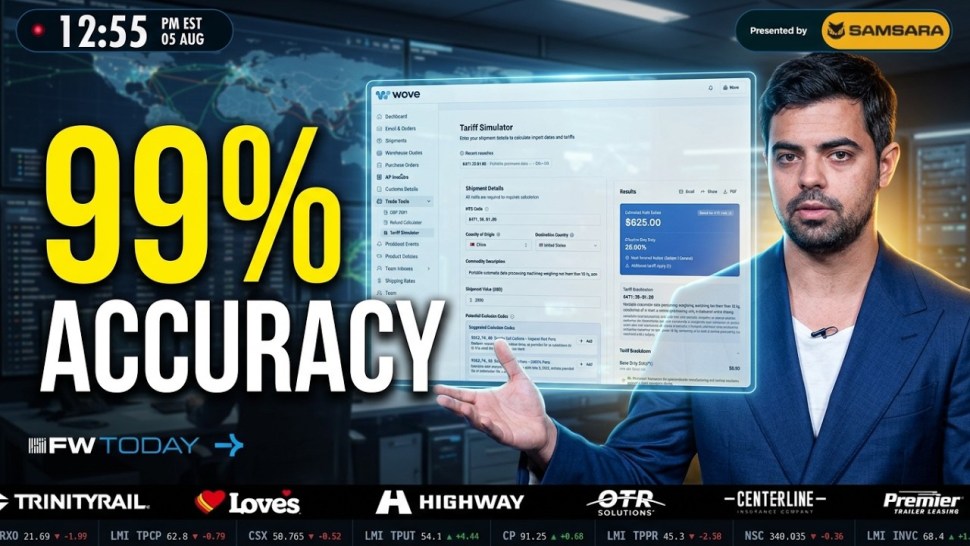
Keeping up with U.S. tariff changes and manual data entry has become a full-time job for freight forwarders and customs brokers, but it doesn’t have to be. Jay Edlin, Co-Founder & CEO of Wove, explains how their AI-powered orchestration platform is automating complex tasks, from ingesting 431-page federal notices in an hour to processing 2000-line commercial invoices in just 30 seconds. Learn how Wove’s solutions, including a free tariff calculator, are driving massive cost and time savings, helping logistics providers focus on strategy over tedious manual work. Discover the future of global trade compliance and why human expertise remains irreplaceable.
Wove, an agentic orchestration platform for global trade, can process a 2,000-line commercial invoice or packing list into CargoWise in roughly 30 seconds — work that freight forwarders previously handled entirely by hand, co-founder and CEO Jay Edlin told FreightWaves. The Chattanooga appearance marked Edlin’s return since the 2022 F3 conference, and he used the time to detail how the largely bootstrapped company has grown its annual recurring revenue sevenfold over the past year.
Wove serves two primary customer segments: logistics service providers — freight forwarders and customs brokers on the international side — and, more recently, shippers through a tariff intelligence product. Its core automation platform handles shipment registration, customs entry writing, and one-off quote creation inside CargoWise. Edlin argued that faster quoting translates directly to revenue: “In this business, if you quote faster, you’re probably going to win the business.”
The company’s free tariff calculator, available at tariffs.wove.com, grew out of a weekend side project late last year after a competitor — which Edlin identified as also being a customs broker — restricted access to its own free tool. Wove’s version drew thousands of users per week within a few months. The platform has since expanded into a premium tier and an API licensing business, all with what Edlin described as essentially zero customer acquisition cost.
“The Federal Register notice from last week for the new Section 301 tariffs, which came out about 12 hours before they went into effect, was 431 pages long. And with the technology that we have under the hood of our tariff engine, we were able to understand and ingest the 431-page notice in about an hour.”
The speed advantage matters because even a licensed customs broker can spend many hours parsing a document of that length. Wove’s ingestion engine — originally built to handle unstructured data like commercial invoices and packing lists — was repurposed for the U.S. Harmonized Tariff Schedule. The company says it has now ingested more than 45 HTS revisions since last year, building a database of roughly 3.2 million rules covering Chapter 99 exclusions, inclusions, and effective dates. Edlin called it a “tariff time machine” that importers are using to run historical audits via API.
Wove also white-labels its tariff data for customs brokers that want a branded calculator on their own websites, and offers a product catalog module allowing importers to bulk-upload SKU data and run real-time tariff exposure simulations. Fortune 500 companies and academic researchers are among current users, Edlin said. When a new Federal Register notice drops, an automated Slack alert triggers an AI agent to ingest the changes, with corrections from licensed customs broker partners turned around in minutes.
The company has raised less than $500,000 to date, and Edlin said it remains largely bootstrapped. He declined to disclose absolute ARR figures but confirmed the 7x growth over the past year. On the question of whether AI tools like Claude could replace customs brokers entirely, Edlin pushed back: the important work, he said, is helping customers interpret the latest tariff updates — not manually entering line items into a TMS. Wove’s long-term path, he added, could range from a sustainable independent business to an acquisition, with those decisions expected to come in time.
- Wove processes 2,000-line commercial invoices into CargoWise in about 30 seconds, replacing fully manual entry for freight forwarders and customs brokers.
- Its free tariff calculator at tariffs.wove.com ingested a 431-page Section 301 Federal Register notice in roughly one hour and has catalogued 3.2 million HTS rules across 45-plus revisions.
- The bootstrapped startup has raised less than $500,000 and grew ARR sevenfold over the past year, monetizing through automation SaaS, API licensing, and white-label tariff data.
Speaker 1 [0:00] In studio, we have Jay Edlin. He is the co-founder and CEO of Woe. Jay, welcome to Freightways Today.
Speaker 2 [0:08] Thank you. It’s so good to be here. It’s good to be back in Chattanooga.
Speaker 1 [0:11] Well, you were last time you were here was in 2022 at F3. I think that was our first year hosting F3.
Speaker 2 [0:18] Yeah. Thank you for the free tickets, by the way.
Speaker 1 [0:19] Yeah, it was a don’t tell anybody that. You’re not supposed to say that.
Speaker 2 [0:22] That was four years. That was four years ago. That was four years ago.
Speaker 1 [0:25] Nobody gets free tickets. But let’s talk a little bit about what Wove is. You’ve been doing this for a couple of years, focused on the international trade market. Tell us a little bit about Wove.
Speaker 2 [0:36] Yeah, so I would describe Wove as an agentic orchestration platform for global trade. And I know that’s very vague and high level. And the reason for that is because we have the pleasure of serving 2 distinct customer segments. We primarily serve the LSPs. freight forwarders and customs brokers, mostly on the international side. And then we’ve also quite recently started to work with shippers for our tariff intelligence product. And yeah, it’s all powered by this really powerful AI-powered ingestion engine that we’ve been building for the last couple of years.
Speaker 1 [1:15] Now, you are not a forwarder, so you’re not actually in the market. You sell the data to forwarders. What is it that they’re What is the value proposition to your customer base?
Speaker 2 [1:25] Yeah, we are not a forwarder, we are not a customs broker, we are purely a technology company. And I would say that our customers come to us because the work that we automate, they are largely relying on people, either in-house or outsourced right now. And so we have a unique value prop around cost savings and also time savings, which in this business also means revenue generating, because for example, if you’re using us to automate quote creation, for example, one-off quote creation into CargoWise is a big thing that we do for forwarders. That’s work that generally can take a long time, especially if you are having to request additional information from your customer or request a carrier rate. And we can do that completely autonomously, which allows you to actually quote much faster. And in this business, if you quote faster, you’re probably going to win the business.
Speaker 3 [2:15] So tell us like very specifically what your tariff engine does, what someone would use it for, a concrete use case.
Speaker 2 [2:22] Yeah, so earlier this year we launched our free tariff calculator, which is available at tariffs.wove.com for free. And so what we did was repurposed our ingestion engine that we were using to ingest commercial invoices, packing lists, all the crazy unstructured data that freight forwarders and customs brokers use on a daily basis. And we decided to repurpose that for the US Harmonized Tariff Schedule, which if you’ve ever looked at it is completely massive. For example, the Federal Register notice from last week for the new Section 301 tariffs, which came out about 12 hours before they went into effect, was 431 pages long. And that takes many, many hours for even a licensed customs broker to read through and start to interpret. And with the technology that we have under the hood of our tariff engine, We were able to understand and ingest the 431-page notice in about an hour. And we were the first ones in the world to actually have it ready to go and, and have customs brokers and importers start to know their new landed costs.
Speaker 3 [3:22] So what made you decide to build this free tariff tracker? You know, in addition to what you were already doing, what made you have that pivot and add this new offering?
Speaker 2 [3:31] Yeah. So we’re a small team. We’re largely bootstrapped. And so we have to be very creative in terms of our go-to-market. And this was late last year around the holiday season. Didn’t have too much going on. And one of our competitors who also had a free tariff calculator available, they removed access to a lot of their users because these guys themselves were a customs broker. And again, we are not. And so we just decided to spend the weekend building out kind of an MVP first iteration of our tariff calculator. And we had no idea what was going to happen, but within a few months we had thousands of people using it every single week, and that’s only grown from there. And now that’s also now evolved into a really nice API business and a sort of premium tariff calculator business as well that we’re seeing users sign up every day, and that’s with basically zero CAC. And we’re also seeing some really interesting use cases around historical tariff data as well, because what’s cool about ours is that because we’ve now ingested, I think, over 45 different HTS changes, Since last year. We act as a tariff time machine. So companies come to us and they can actually use our API to do historical audits for their own, either internal purposes, which is a very powerful use case and something that we didn’t even know about a few months ago.
Speaker 3 [4:47] So just true startup example. We decided, and we just built it over the weekend. We got together.
Speaker 2 [4:53] I love that.
Speaker 1 [4:54] You just had to grit and grind and hustle. In fact, interesting enough, Keep Trucking, which is now one of the most successful ELD companies out there, now called Motive, actually started by doing that. When the ELD mandate was a couple years out, they ended up doing electronic logs, giving it away for free, and that helped them attract hundreds of thousands of trucks into their ELD device. So there’s a great case for that. Now you’re referring to Flexport had a calculator when you say competitor, but you don’t view them as a competitor, right? Yeah.
Speaker 2 [5:28] Yeah, Flexport is not a competitor to us in the sense of we are not a forwarder or customs broker. I was really just referring to that they have a competing tariff calculator, but they, I believe, at least per my knowledge, they are not trying to monetize their tariff calculator at all.
Speaker 1 [5:43] It’s for their customer base.
Speaker 2 [5:46] Yeah, they do make it so that you have to be a Flexport customer to actually use it on a regular basis.
Speaker 1 [5:51] And your calculator is available for really anyone out there, including LSPs that may compete against Flexport. Should they be, in your view, should they be offering— if I was a forwarder, should I offer, should I send your calculator to my customers? What’s the downside to that?
Speaker 2 [6:08] Yeah, if you’re a forwarder, we are more than happy to either have your customers use our free tariff calculator. We do that for a lot of forwarders and customs brokers. We see them referring their customers to us. We’ve also seen a lot of interest though in white labeling the tariff data. such that if you’re a customs broker and you want to have your own white-labeled version of a tariff calculator on your website, then you can use our data for that. That’s part of the business that we’ve built.
Speaker 1 [6:34] So STEAM, that is a customs brokerage in Chattanooga, could certainly have the STEAM calculator if they decided to do.
Speaker 2 [6:41] Yeah, we’d be happy to power it.
Speaker 1 [6:42] And their customers would, I mean, ultimately their customers may not care what the data comes from. They just want to know, is it trustable? Can I trust it?
Speaker 2 [6:48] Yeah, and I believe our data is incredibly trustworthy, but we have Fortune 500 companies using it. We even have academic researchers using it. So we’ve been elated and surprised with all the excitement around what we’ve been building on the tariff side.
Speaker 1 [7:02] So you give away this for free, this calculator, but how do you make money? Like, there’s obviously a commercial angle here.
Speaker 2 [7:09] Yeah, so the tariff calculator has been primarily a lead gen tool for us. Again, it’s being used by thousands of users a week, and that’s naturally led to inbound for our other products as well. Most of what we sell is our core automation platform for whether it’s automating shipments, whether automating customs entry writing, automating quotes, really any of the core work that a freight forwarder or customs broker is doing on a day-to-day basis. But again, as I mentioned, we also do license the data via our API, and we’ve also built out what we describe as a product catalog module as well, where if you’re an importer and you have thousands of SKUs that you want to see in real time, the tariff exposure, and we allow you to bulk upload those spreadsheets with your SKU data and basically have a calculator with all of your SKUs where you can do simulations and Historical analysis.
Speaker 1 [8:10] I mean, the whole HTS, the whole codes, trying to get into that, navigate it, interpret what it means—is it is it just a disaster? I mean, government at its worst is all of this stuff. And look, a lot of this stuff didn’t change as dynamically, as fast. It’s constantly being disrupted, and maybe not as important. But when you have the administration doing executive orders and constantly sort of tariffs are on the move, it is hard to interpret what all these.
Speaker 2 [8:38] Yeah, no, absolutely. And we also have the benefit of working very closely with a lot of licensed customs brokers who are being very kind. And if they do find something that they think is interpreted incorrectly, they will communicate that to us. And that’s that feedback loop where we can turn around those corrections in a matter of minutes is, has worked really, really well for us.
Speaker 3 [8:58] I would imagine just the time in interpreting it and getting a solid answer immediately of the estimate of what it’s going to be. would be incredibly helpful.
Speaker 2 [9:06] Yeah, especially because I don’t know how much time you guys have spent actually looking through the HTS, but we, through our 45 revisions or so over the last year, I think we have something like 3.2 million different rules. And that’s all the different Chapter 99 exclusions, inclusions, effective dates, things like that.
Speaker 1 [9:24] I mean, the crazy part is that when you get these executive orders, first of all, you get the, like, the The classic Trump tweet that may or may not ever get into an executive order. Then you get the executive order. Then it’s got to get into the federal registry, and oftentimes they sort of the the the the different rules pivot, and it’s you know I always I get asked a lot about you know Trump tweeted this, and I’m like yeah we don’t know if that’s actually going to make it. Like he tweets a lot of stuff.
Speaker 2 [9:53] Yeah, news flash to everybody watching: just because Trump says something on live TV or tweets about it does not necessarily end up as law or as a Federal Register notice. So we’ve seen a lot of—
Speaker 1 [10:04] Even the executive orders is just an order to basically update the registry, but oftentimes those get changed by the time, you don’t really know what it is until the final rule comes into play.
Speaker 2 [10:14] Yeah, so we’ve automated the whole process of once a Federal Register notice is released, we get a Slack notification and then we have an AI agent basically go in and understand the changes and then make the Very cool.
Speaker 3 [10:27] So I want to talk a little bit about your core, your core business as well. Can you give us some examples of the problems that you are solving for some of your core customers and the value you’re bringing there?
Speaker 2 [10:38] Yeah, absolutely. So a great example of one is a freight forwarder that we’re working with right now that we’re onboarding for both shipment registration and customs entry registration. This is mostly into a system called CargoWise, which I’m sure a lot of your viewers are familiar with, but a great use case is when a packing list or a commercial invoice comes in and there’s, let’s say, 2,000 lines, which is not unheard of, and it’s something that our customers are dealing with on a day-to-day basis. Before they implemented Wove, they were actually doing this entirely manually. So looking through every single commercial invoice line and entering that into the TMS. And we can do that in about 30 seconds. So that’s a relative—
Speaker 3 [11:25] Massive process improvement.
Speaker 2 [11:26] Yeah, I would say. And yeah.
Speaker 1 [11:28] So, so, Jay, what about, you know, this conversation that’s been going around about Claude or AI disrupting the whole customs brokers? Like, you don’t need custom brokers. I’ve heard this from venture capitals. They’re like, you know, if so-and-so used AI, you may not— this, this thing is going to be blowing up. What are your thoughts on that?
Speaker 2 [11:45] Yeah, I don’t believe that just adopting Claude Code or Codex replaces a customs broker. Again, we’re not customs brokers ourselves, but from working with the people on the ground that do this important work day in and day out, they do really important work. And we believe as a business that that work should not be entering line items a packing list or an invoice into a TMS. It should be helping your customers interpret the latest Chapter 99 rules or the latest tariff update. And so that’s really, I think, the important work. And I know everybody talks about how this is a relationships business, and that’s exactly kind of what we—
Speaker 1 [12:29] Well, I think nobody wants to deal with it. Like, the whole idea, I mean, I understand that it’s complicated and it is complicated, tedious. Keeping track of it. But also the idea that businesses that are not— that a guy with a $100 million business is going to somehow use Claude to deal with is just nonsense. Real estate agents, you’ve had the ability to list your home for 20, for 50 years, whatever the number is, on the web. People aren’t doing that. They are somewhat, but it’s very marginal. You still pay real estate agents because you don’t want to deal with the problems. Right.
Speaker 2 [13:06] Yeah, there’s something to be said about comparative advantage and outsourcing laborious work to the experts.
Speaker 1 [13:12] Especially really boring, tedious legal nonsense.
Speaker 3 [13:16] That has to be right.
Speaker 1 [13:17] It has to be right, but it is all just jumbly-jook to somebody who doesn’t deal with this.
Speaker 2 [13:22] Yeah, we are seeing, I think, some importers come to us and ask if they do a lot of the work themselves, whether it’s auditing, using our tariff time machine, and real-time tariff data if that means that perhaps they can then pay less to their customs brokers, which is because they would, again, be doing most of the— a lot of the work themselves. So that’s an interesting one.
Speaker 1 [13:43] I understand what if scale— if I ran a billion-dollar importer, perhaps I could have the scale and take on some of that burden. But if I’m a mid-sized company, why would I even bother? Yeah, it just seems like a lot of work. Let’s talk about USMCA. We are super bullish on the commodity flow in the United States. We’re going to hear the AER reports Wednesday. So it’s my favorite day of the week, which is our AER weekly data. Commodities are doing well, but USMCA, Canada isn’t doing as well as the United States. What is your thoughts on USMCA?
Speaker 2 [14:14] Yeah, I mean, we look at USMCA through the lens of just our tariff data. And I mean, I’m not going to go out and say I’m a policy expert or I know what’s going to happen I just know that when there inevitably will be changes to the USMCA, we will be able to update our tracker and our tariff data in real time.
Speaker 1 [14:38] Well, the administration says they’re not renewing it. So any thoughts on Canada-US trade? Anything specific?
Speaker 2 [14:44] I would just say that, I mean, this administration did negotiate the USMCA during their first administration.
Speaker 1 [14:53] Version 1, it was the best trade policy ever.
Speaker 2 [14:55] Of course, that was 7 or 8 years ago at this point. even, even longer, but Canada and Mexico are like 2 of our biggest trade partners and that’s not going to change anytime soon, if, if ever. And just, just from a personal perspective, I believe in a rising tide lifts all boats. And I think that we are better off as a country when both Canada and Mexico are stronger. And we’ve had the benefit of working with lots of companies in both parts of, and in both countries.
Speaker 1 [15:24] Yeah.
Speaker 2 [15:25] We want to see them succeed because that means that we succeed as well.
Speaker 1 [15:28] Well, Mexico has certainly been more proactive. The administration, the president down there has been— she’s been very willing to negotiate. You could argue that Mexico is, I think, more— there’s a, I think, a sense in Canada that they’ve always been offended by America’s global presence and sort of being the little brother. Like, there’s this sort of like Whereas Mexico kind of accepts their position, and I think much more so than Canada does. And I think that’s one of the reasons that Canada hasn’t been as proactive, perhaps because politically that’s a challenge, whereas I think Mexico kind of understands their role.
Speaker 2 [16:05] Yeah, I think that’s right. So we’ll see.
Speaker 1 [16:08] It’s going to be interesting to watch. What is it? So you haven’t raised venture capital, a large amount of venture capital. What are you going to hope to do with the business?
Speaker 2 [16:19] Yeah. So we have raised to date less than half a million dollars, which I think is, yeah, which is very, very little. Exactly. And I did hear your conversation, I think right before this, about the SaaSpocalypse and companies that may have raised at the peak of the cycle. And I think what we want to do with the business is just continue to build a best-in-class product and serve this industry that we’ve come to really appreciate and love. And whether that means turning this into a quote unquote lifestyle business where we can do this for the next 20 years, or we ultimately find an acquirer or some sort of exit path, I think those conversations will come in time. But for now, we’re really just having fun finally building the business. We, it did take us a couple of years, I think, to go from 0 to 1, as I think is the case with many companies. But recently over the past year or so, I mean, we’ve 7x ARR.
Speaker 1 [17:12] What is your AR now?
Speaker 2 [17:13] Yeah, I can’t share our financial data.
Speaker 1 [17:16] You’ll share the growth rate, but you’re not gonna share the number.
Speaker 2 [17:18] Yeah.
Speaker 1 [17:19] It’s a very typical founder. Look, I get asked the same questions. I can do that. Well, look, a lifestyle business is great if you’re having fun. Yeah.
Speaker 2 [17:30] Are you having fun? I would say I have a lot of gray hairs over the last couple years. I would say I’m finally having fun. having fun because we’re finally focused on really building the business and not just thinking about survival.
Speaker 1 [17:45] Well, that’s always relief when you wake up and don’t have to worry about what is in my inbox that’s going to blow up today that I got to deal with, right?
Speaker 2 [17:54] Yeah, exactly.
Speaker 1 [17:54] Or my text messages are blowing up. I understand that painfully well. Really appreciate Jay coming in and telling us all about Wove. And, uh, where can folks find the calculator, uh, again?
Speaker 2 [18:05] Yeah, so they can find the calculator just at tariffs.wove.com, and they can learn more about us at wove.com.
Speaker 1 [18:13] And check that out. You’ve got a— by the way, you’re on X. You’re a great follow on X.
Speaker 2 [18:17] So I’m more of a lurker these days. You’re a great follow. Well, we— the X people stay together.
Speaker 1 [18:23] So it’s a club.
Brokerage Compliance Symposium
The day before F3. Every compliance issue you face - fraud exposure, carrier liability, FMCSA rules, cargo theft, insurance gaps - navigated by attorneys and operators defining best practices in a changing industry.
F3 Awards Dinner
The night before F3. FreightTech100 companies honored. FreightTech 25 and Shipper of Choice winners revealed live. Cocktail reception into dinner and live music - 300 industry leaders in one purpose-built room.
F3: Future of Freight Festival
Industry-defining keynotes, rapid-fire technology demos, and industry leaders networking in experiences across Chattanooga - plus the inaugural F3 Awards Dinner featuring the FreightTech and Shipper of Choice reveals.
The day before F3. Every compliance issue you face - fraud exposure, carrier liability, FMCSA rules, cargo theft, insurance gaps - navigated by attorneys and operators defining best practices in a changing industry.
The Signal at Chattanooga Choo Choo • Chattanooga, TN Register NowThe night before F3. FreightTech100 companies honored. FreightTech 25 and Shipper of Choice winners revealed live. Cocktail reception into dinner and live music - 300 industry leaders in one purpose-built room.
The Signal at Chattanooga Choo Choo • Chattanooga, TN Register NowIndustry-defining keynotes, rapid-fire technology demos, and industry leaders networking in experiences across Chattanooga - plus the inaugural F3 Awards Dinner featuring the FreightTech and Shipper of Choice reveals.
The Signal at Chattanooga Choo Choo • Chattanooga, TN Register Now