




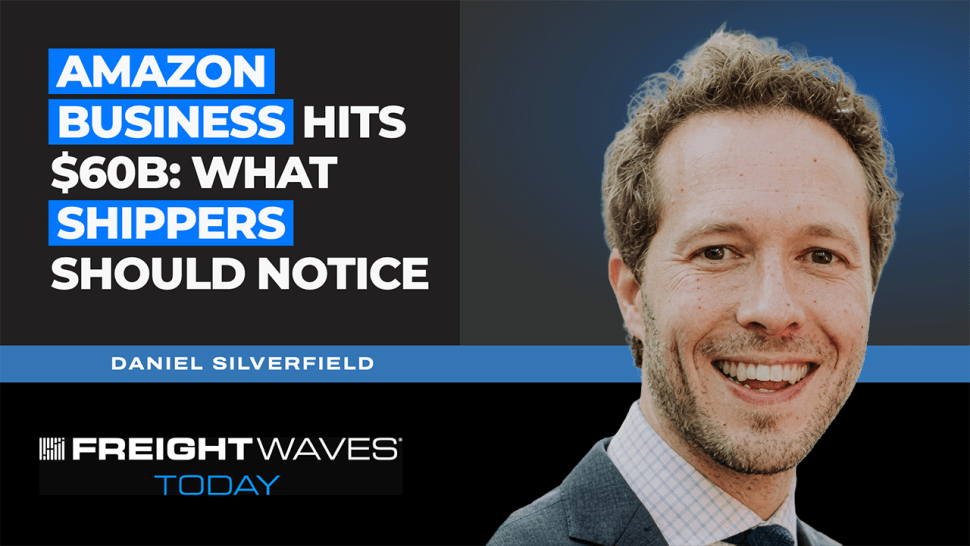
Amazon Business is now a $60B operation serving 11 million customers worldwide. In this FreightWaves Today interview, Amazon Business exec Daniel Silverfield breaks down what that scale means for procurement, supplier consolidation, same-day grocery delivery and AI-driven savings. The big takeaway: business buyers want fewer suppliers, better visibility and less waste in purchasing. Silverfield explains how Amazon Business is pitching exactly that to everyone from small companies to Fortune 100s.
Amazon Business has hit $60 billion in annualized gross sales and now serves 11 million customers worldwide, with 1.8 million organizations added this year alone — a growth rate that puts it on par with a Fortune 100 company if it were standalone. The platform, which launched roughly a decade ago after Amazon noticed businesses already shopping on amazon.com, is increasingly central to how companies across sectors manage procurement, from office supplies to same-day groceries.
The scale matters to shippers, carriers, and brokers because Amazon Business is driving a fundamental shift in B2B purchasing behavior — consolidating supplier pools, centralizing data, and moving procurement from quarterly reporting cycles to an always-on, AI-powered model. Every order that migrates to the platform is one fewer touchpoint for traditional distributors and one more shipment flowing through Amazon’s own logistics network.
Daniel Silverfield, head of value and selection for Amazon Business, said the platform saved customers $880 million on Prime free shipping last year and $1 billion through business-specific discounts. The company added 30% new items year over year and recently launched same-day grocery delivery across 2,300 U.S. cities in the first half of this year, a capability customers had been requesting for some time.
“The big shift that we’re seeing is that people are moving to a continuous, always-on, conversational-powered procurement journey where agents may be looking for the best price while they’re asleep, maybe negotiating on their behalf while they’re asleep, and then surfacing to them the best product to buy,” said Silverfield.
Two AI tools are at the center of that shift. Amazon Business Assistant is a conversational agent that helps buyers find the best product at the best price with the fastest delivery. A second tool, Savings Insights, analyzes purchasing data across an organization’s locations and proactively flags consolidation opportunities — for example, identifying five sites ordering different brands of paper towels weekly and recommending a centralized bulk order monthly instead.
On the logistics side, Silverfield was direct about the operational complexity of B2B delivery. “Delivering to a loading dock is very different than delivering to a porch,” he said. Amazon Business has built a dedicated delivery fleet — branded Amazon Business trucks launched last year — designed to handle consolidated pallet deliveries, scheduled arrival windows, and complex sites such as hospitals and universities. The goal is to reduce multi-day, multi-package deliveries to a single, pre-agreed shipment.
For businesses managing procurement compliance, the platform offers spending rules, category blocks, and visibility controls at the individual buyer level. Silverfield noted that generative AI tools like Savings Insights can surface unauthorized or redundant subscriptions automatically — a significant pain point for organizations with multiple procurement agents. “Whatever our customers tell us is a pain point for them, we’re going to go and add value there through Prime,” he said. Businesses can access the full suite of tools at amazonbusiness.com.
- Amazon Business reached $60 billion in annualized gross sales and added 1.8 million new customer organizations this year, now serving 11 million customers worldwide.
- The platform saved customers $880 million on Prime free shipping and $1 billion in business-specific discounts last year, while adding 30% more items year over year.
- Dedicated Amazon Business delivery trucks launched last year target B2B complexities like loading dock access, pallet consolidation, and scheduled delivery windows at hospitals and universities.
This Summary is generated thanks to a transcription of the interview, for the full interview please enjoy the video above.
Brokerage Compliance Symposium
The day before F3. Every compliance issue you face - fraud exposure, carrier liability, FMCSA rules, cargo theft, insurance gaps - navigated by attorneys and operators defining best practices in a changing industry.
F3 Awards Dinner
The night before F3. FreightTech100 companies honored. FreightTech 25 and Shipper of Choice winners revealed live. Cocktail reception into dinner and live music - 300 industry leaders in one purpose-built room.
F3: Future of Freight Festival
Industry-defining keynotes, rapid-fire technology demos, and industry leaders networking in experiences across Chattanooga - plus the inaugural F3 Awards Dinner featuring the FreightTech and Shipper of Choice reveals.
The day before F3. Every compliance issue you face - fraud exposure, carrier liability, FMCSA rules, cargo theft, insurance gaps - navigated by attorneys and operators defining best practices in a changing industry.
The Signal at Chattanooga Choo Choo • Chattanooga, TN Register NowThe night before F3. FreightTech100 companies honored. FreightTech 25 and Shipper of Choice winners revealed live. Cocktail reception into dinner and live music - 300 industry leaders in one purpose-built room.
The Signal at Chattanooga Choo Choo • Chattanooga, TN Register NowIndustry-defining keynotes, rapid-fire technology demos, and industry leaders networking in experiences across Chattanooga - plus the inaugural F3 Awards Dinner featuring the FreightTech and Shipper of Choice reveals.
The Signal at Chattanooga Choo Choo • Chattanooga, TN Register Now