




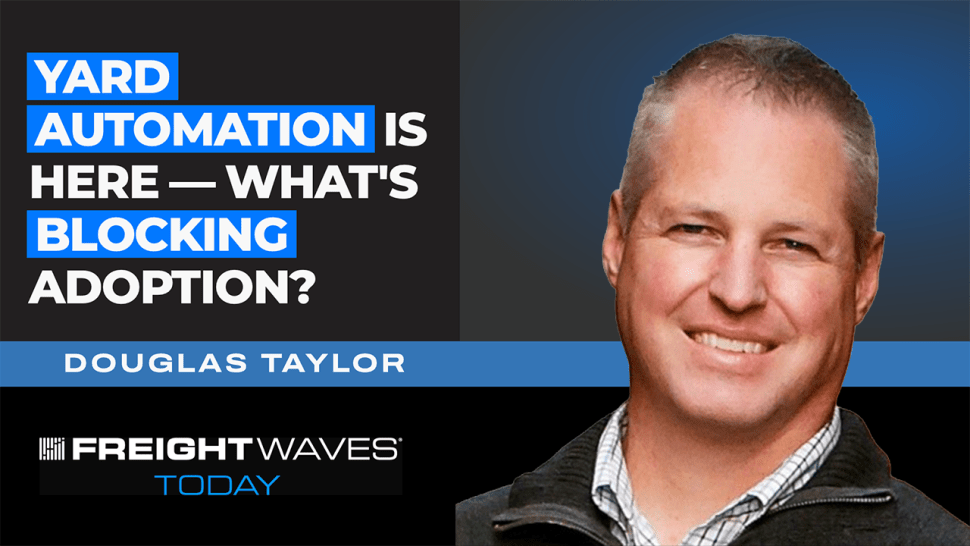
Autonomous yard trucks are moving from pilot to commercialization. Douglas Taylor of Autonomous Solutions explains why yard automation isn’t a tech problem anymore — it’s an adoption and yard-operations problem. He breaks down what’s slowing fleets and facilities down, how Mobius connects with the yard management system, and why consistency, visibility and remote supervision matter if you want autonomy to work in the yard. #AutonomousTrucking #YardAutomation #FreightTech
Autonomous yard truck technology is commercially viable today, but widespread deployment is stalling because operators haven’t restructured their yards to support it — not because the hardware or software isn’t ready. That’s the assessment of Douglas Taylor, general manager of the logistics division at Autonomous Solutions Incorporated (ASI), who spoke at a recent industry conference about where yard automation stands and what’s holding it back.
Taylor said the core obstacle is change management, not engineering. Yards were purpose-built for manual operation, with wide variation in yard management system (YMS) adoption, inconsistent processes, and physical layout challenges — including differences in gladhand connections and dock door types — that complicate autonomous deployment. “It’s not really a technology problem at this point,” Taylor said. “It’s more so maybe an adoption problem.”
To break through, ASI is moving away from narrow proof-of-concept trials and toward a pilot-to-commercialization model. Taylor said the company is launching several pilots designed to benchmark autonomous operations directly against manned operations across the full yard workflow, rather than testing individual problem areas in isolation. The pilots are expected to run 12 to 18 months, after which Taylor said the primary constraint shifts to truck availability and OEM lead times — currently 6 to 10 months — putting the realistic window from decision to live deployment at 6 to 12 months.
“Let’s look at what we’re solving. Let’s bet on the outcome of what we’re looking for as opposed to looking in each of these individual areas and kind of doing these trials in these individual areas. Let’s look at it as a holistic approach to what we’re trying to do.” — Douglas Taylor, ASI Logistics Division
Central to ASI’s offering is a command-and-control platform called Mobius, which integrates via API with a facility’s existing YMS. Mobius holds a geolocated map of the entire yard — dock doors, parking stalls, fixed obstacles — and orchestrates move commands received from the YMS, providing two-way status updates throughout each move. The system also continuously scans the yard to reconcile trailer locations and push corrections back to the YMS in real time.
The remote supervision capability enabled by Mobius is a key economic argument for the technology. Rather than stationing operators on-site at each yard, a single operator can oversee multiple trucks across multiple facilities from a centralized location. Taylor framed the workforce shift not as elimination of yard driver jobs but as an elevation of them: “Instead of a driver out, it’s a driver up,” he said, with workers moving into technical oversight roles that draw on their existing operational knowledge.
Looking further out, Taylor addressed speculation that fully autonomous over-the-road trucks — where the trailer and chassis form a single driverless unit — could eventually eliminate the need for yard trucks altogether by removing the drop-trailer model. One cost benchmark floated in the conversation: an autonomous electric chassis unit at roughly $100,000, compared to $240,000 for a conventional cab-and-trailer combination. Taylor acknowledged the possibility but said the transition is likely at least two decades away, and that enclosed yard environments will remain a distinct, high-value automation use case well before over-the-road autonomy matures. ASI is also positioning yard trucks for material delivery roles at large-scale data center construction sites, which Taylor described as potentially making ASI part of “one of the largest construction fleets in the world.”
- ASI’s Douglas Taylor says yard automation is an adoption and change-management problem, not a technology gap, with pilot-to-commercialization timelines of 12 to 18 months.
- ASI’s Mobius platform integrates with existing YMS systems to orchestrate autonomous yard moves and enable one operator to manage multiple yards remotely.
- Truck availability and OEM lead times of 6 to 10 months are the primary bottleneck once an operator decides to deploy, putting live deployment at 6 to 12 months post-decision.
This Summary is generated thanks to a transcription of the interview, for the full interview please enjoy the video above.
Brokerage Compliance Symposium
The day before F3. Every compliance issue you face - fraud exposure, carrier liability, FMCSA rules, cargo theft, insurance gaps - navigated by attorneys and operators defining best practices in a changing industry.
F3 Awards Dinner
The night before F3. FreightTech100 companies honored. FreightTech 25 and Shipper of Choice winners revealed live. Cocktail reception into dinner and live music - 300 industry leaders in one purpose-built room.
F3: Future of Freight Festival
Industry-defining keynotes, rapid-fire technology demos, and industry leaders networking in experiences across Chattanooga - plus the inaugural F3 Awards Dinner featuring the FreightTech and Shipper of Choice reveals.
The day before F3. Every compliance issue you face - fraud exposure, carrier liability, FMCSA rules, cargo theft, insurance gaps - navigated by attorneys and operators defining best practices in a changing industry.
The Signal at Chattanooga Choo Choo • Chattanooga, TN Register NowThe night before F3. FreightTech100 companies honored. FreightTech 25 and Shipper of Choice winners revealed live. Cocktail reception into dinner and live music - 300 industry leaders in one purpose-built room.
The Signal at Chattanooga Choo Choo • Chattanooga, TN Register NowIndustry-defining keynotes, rapid-fire technology demos, and industry leaders networking in experiences across Chattanooga - plus the inaugural F3 Awards Dinner featuring the FreightTech and Shipper of Choice reveals.
The Signal at Chattanooga Choo Choo • Chattanooga, TN Register Now