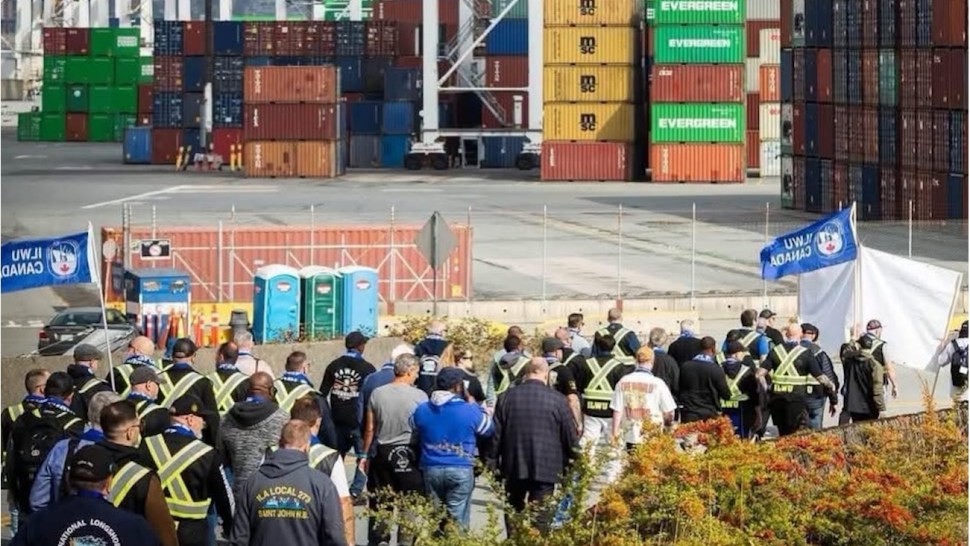
About 100 dockworker union delegates from Canada, the United States, Australia and New Zealand rallied outside DP World’s Centerm container terminal at the Port of Vancouver last week, launching an international campaign against what they describe as job-threatening automation and artificial intelligence at ports.
The protest followed the International Dockworkers Anti-Automation Summit, held at Vancouver’s Maritime Labour Centre in late September. Delegates marched to the DP World terminal Sept. 23 after adopting a shared position that accepts technology intended to improve safety and port communities but rejects its use to cut jobs, outsource work, expand surveillance, undermine unions or erode safety standards.
The current British Columbia longshore agreement is set to expire in March 2027, and the question of how automation affects jobs, work rules and bargaining rights is expected to be a prominent issue.
Tom Doran, president of International Longshore and Warehouse Union Canada, said the participating unions had organized around what he characterized as a common threat from employers introducing automation and AI. He singled out Dubai-based DP World, whose operations include the Centerm terminal in Vancouver, as a company at the center of longshore labor’s concerns.
“Dock workers are united and determined to hold the line on destructive automation in our ports, no matter where those ports are,” Doran said in the union’s announcement.
DP World is also backing a major container project at the Port of Montreal, as well as expansion at Port Saint John on Canada’s east coast.
A global labor campaign
The summit brought together representatives from ILWU Canada and the U.S.-based International Longshore and Warehouse Union; the International Longshoremen’s Association in Canada and the U.S.; the Maritime Union of Australia; the Maritime Union of New Zealand; New Zealand’s Rail and Maritime Transport Union; Montreal’s CUPE Local 375; the International Transport Workers’ Federation; and the International Dockworkers Council.
The group’s joint campaign calls for technological changes to be negotiated before implementation. Its principles oppose:
- Automation used as a union-busting tool
- New technology introduced without a “social dividend” for workers
- Technology-driven job cuts or reductions in wages and benefits
- Automation that reduces safety protections or replaces secure waterfront work without negotiated safeguards
Dennis Daggett, president of the ILA Atlantic Coast District and general coordinator of the International Dockworkers Council, said waterfront job losses extend beyond terminals, affecting businesses and communities supported by port workers’ incomes.
Vancouver’s Centerm dispute
The rally focused attention on DP World’s Centerm facility, one of the Port of Vancouver’s major container gateways and a critical link between Asian trade lanes and Canadian and U.S. inland markets.
In a major modernization program, DP World says the completed Centerm expansion lifted annual container-handling capacity from 900,000 to 1.5 million TEUs, while adding rail capacity, electrifying equipment and supporting larger vessel calls. The terminal includes two berths, 15,000 feet of on-dock rail, 19 rubber-tired gantry cranes and five electrically powered semi-autonomous rail-mounted gantry cranes.
The Trump administration’s tariff and trade policies have fueled a shift of containerized import traffic away from U.S. West Coast hubs and through Vancouver and the port of Prince Rupert, also in British Columbia, for entry into the American market via intermodal rail.
The modernization upgrades have made Centerm an important symbol in the automation debate.
In 2024, ILWU Local 514, representing ship and dock forepersons, accused DP World of planning to introduce automation at Centerm’s rail intermodal yard without first bargaining over the technological change. The dispute was among the factors behind a strike notice directed at DP World before the Canada Industrial Relations Board ruled that the union’s strike vote was unlawful and ordered the notice withdrawn.
The union’s broader concern is that terminal technology can alter staffing, dispatching and job classifications even where it raises capacity or improves equipment performance. Employers, meanwhile, have argued that investments in digital systems, automated gates, rail operations and remote equipment can increase throughput, improve safety and preserve the competitiveness of Canada’s Pacific gateway.
Competing views of modernization
DP World and the B.C. Maritime Employers Association have portrayed the Centerm upgrade as evidence that terminal modernization can grow both cargo capacity and waterfront employment. A KPMG report released Oct. 1 for the BCMEA said Centerm’s capacity increased 65%, to 1.5 million TEUs, from 900,000 TEUs, while waterfront payroll hours rose 59%, from 835,000 in 2019 to 1.328 million in 2025. The report attributed the gains to combined investment in terminal infrastructure, technology, process improvements and workforce skills.
The unions point out that their positions aren’t a wholesale rejection of technology. Delegates said the benefits of automation must be shared with workers and communities, and any operational changes must be subject to meaningful collective bargaining.
Read more articles by Stuart Chirls here.
Read more:
Savannah port project passes 60% complete mark
New California law clouds Trump-backed Oakland coal export terminal project
Port of Oakland August volumes fall year over year as exports edge up from July
Brokerage Compliance Symposium
The day before F3. Every compliance issue you face - fraud exposure, carrier liability, FMCSA rules, cargo theft, insurance gaps - navigated by attorneys and operators defining best practices in a changing industry.
F3 Awards Dinner
The night before F3. FreightTech100 companies honored. FreightTech 25 and Shipper of Choice winners revealed live. Cocktail reception into dinner and live music - 300 industry leaders in one purpose-built room.
F3: Future of Freight Festival
Industry-defining keynotes, rapid-fire technology demos, and industry leaders networking in experiences across Chattanooga - plus the inaugural F3 Awards Dinner featuring the FreightTech and Shipper of Choice reveals.
The day before F3. Every compliance issue you face - fraud exposure, carrier liability, FMCSA rules, cargo theft, insurance gaps - navigated by attorneys and operators defining best practices in a changing industry.
The Signal at Chattanooga Choo Choo • Chattanooga, TN Register NowThe night before F3. FreightTech100 companies honored. FreightTech 25 and Shipper of Choice winners revealed live. Cocktail reception into dinner and live music - 300 industry leaders in one purpose-built room.
The Signal at Chattanooga Choo Choo • Chattanooga, TN Register NowIndustry-defining keynotes, rapid-fire technology demos, and industry leaders networking in experiences across Chattanooga - plus the inaugural F3 Awards Dinner featuring the FreightTech and Shipper of Choice reveals.
The Signal at Chattanooga Choo Choo • Chattanooga, TN Register Now