




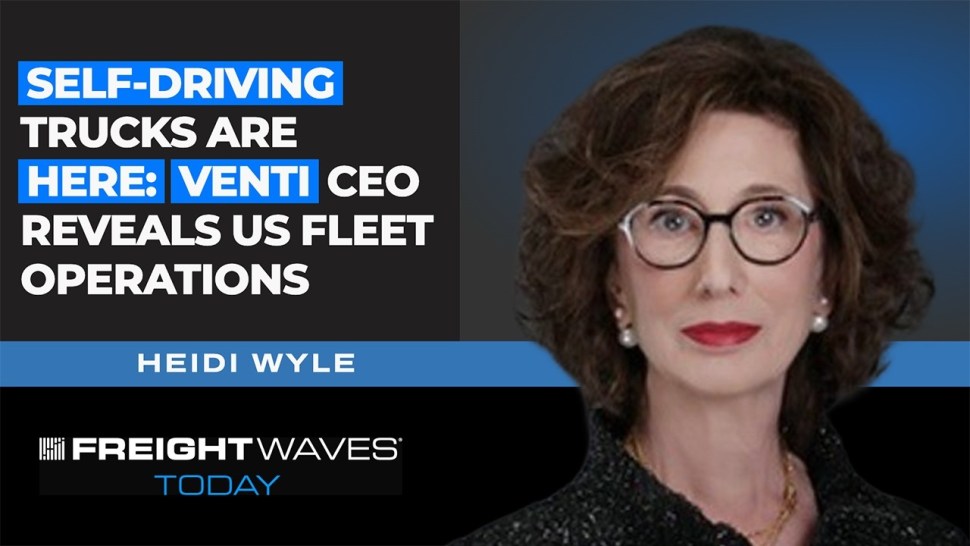
Venti’s CEO Heidi Wyle shares how their autonomous truck fleets are already running 24/7 in US intermodal yards. These self-driving solutions are recreating supply chain logistics, exceeding human productivity in controlled environments. Is this the future of freight movement?
Venti Technologies is not waiting for over-the-road autonomy to arrive. The MIT-founded software company told FreightWaves that approximately 60 large container trucks are running fully autonomous, 24/7 operations in intermodal yards across California and Texas — right now — with a clean safety record and productivity that exceeds human benchmarks.
The milestone matters to carriers, shippers, and rail operators because it represents one of the first documented, full-scale autonomous yard deployments in the United States, occurring in live production environments rather than controlled pilots. Venti founder and CEO Heidi Wyle said the company has existing agreements with several Class I railroads and is in discussions with the remainder of the industry.
“We are running, every day, 24/7, in full production operations, exceeding human productivity,” Wyle said. She added that significant rail-yard volume across the railroad sector is on track to materialize “in 2 years” as the technology scales.
“It’s anywhere from 40% to 70% of transportation costs — and we think that that’s a big win in the right environments.”
Venti describes itself primarily as a software platform, underpinned by what Wyle characterized as a roughly $70 million to $80 million software system deployed on customer-owned vehicles. The platform is sensor-agnostic, using LiDAR as a foundation but incorporating cameras and, in some cases, ultrasound depending on the application. Customers own the trucks; Venti delivers the end-to-end autonomy stack, including yard mapping and mission-specific functionality.
The company launched its first fleet in Singapore — home to the second-largest container port in the world, by Wyle’s account — and has operated there for nearly three years. A second Singapore fleet of 30 vehicles is set to launch this year. Weil said roughly 85% to 90% of the core software carries over across applications, meaning the transition from port operations to rail yards required only about two months of additional software development to handle train detection, signal recognition, and rail-specific functions.
On the broader question of when autonomous trucks will operate on public roads at scale, Weil drew a sharp distinction between enclosed logistics environments and urban last-mile delivery. Yard and port applications are financially straightforward — a direct cost calculation against mission-critical trucking needs in controlled spaces. Inner-city autonomous trucking, she said, is “probably 7 to 10 years out.” In the meantime, Venti is targeting the supply chain yard segment, which Wyle said moves $55 billion of goods every day.
- Venti is operating ~60 autonomous container trucks daily in California and Texas intermodal yards, with a clean safety profile and productivity exceeding human drivers.
- The company’s software platform requires only 2 months of adaptation to move between applications such as ports and rail yards, with 85–90% of code reused across environments.
- Venti projects cost savings of 40–70% on transportation costs for yard customers, with broad U.S. rail-yard deployment expected within two years.
This Summary is generated thanks to a transcription of the interview, for the full interview please enjoy the video above.
