




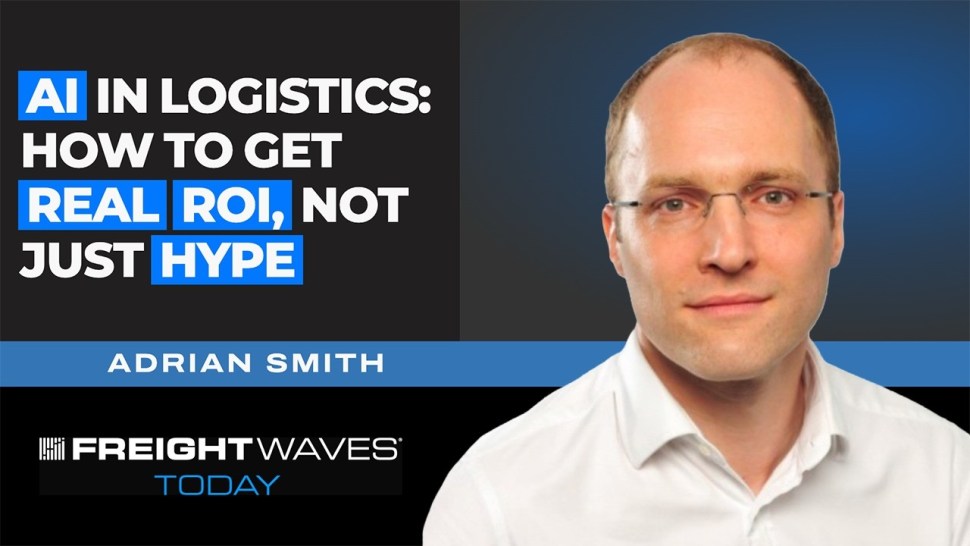
The world of global trade is in constant flux, from shifting political landscapes to unexpected disruptions like drone attacks. In this dynamic environment, how can logistics professionals leverage AI to not just survive, but thrive? Adrian Smith, Co-Founder & CEO of Ripple, shares insights on navigating these challenges. Learn why bespoke AI solutions, tailored to your specific value stream, are crucial for achieving real ROI in customs, inventory, and supply chain management. Don’t fall for the “helicopter pizza delivery” – discover how intelligent AI deployment can truly reduce costs and drive business outcomes.
Freight technology firm Ripple is expanding a partnership with Dubai-based freight forwarder Pentagon Freight, combining global customs AI intelligence with bespoke AI software development to manage imports and exports for oil and gas companies operating near the Strait of Hormuz. The deal, announced by Ripple co-founder and CEO Adrian Smith on FreightWaves Today, reflects how geopolitical disruption is accelerating demand for real-time inventory visibility in contested trade corridors.
The core of Smith’s pitch is that most companies deploying AI are spending too much and getting too little because they reach for the most powerful — and most expensive — models regardless of the task. “If you’re ordering a pizza from your favorite pizza store, and when it comes to the delivery option, they say, oh, we can deliver this by helicopter for you,” Smith said, drawing a parallel to indiscriminate use of frontier AI models. “Was it needed? Most probably not.”
“Sometimes it’s not necessary to use AI. People just rush to AI, but then their token cost goes through the roof. And if you’re using high-cost tokens and your token volume goes through the roof, but your return on using that AI process is minimal, then it’s not going to be a business case that’s going to stack up for those organizations.”
Smith advocates a Lean Six Sigma approach — mapping the full value stream of a business workflow, identifying manual steps and software inefficiencies, and then matching the intensity of the AI model to the criticality of each task. High-acuity frontier models are reserved for genuinely complex decision points; lighter, lower-cost models handle routine administrative processes. The cost differential between those tiers, he said, is significant.
Data security is an equally pressing concern. Smith warned that companies feeding sensitive business prompts directly into commercial platforms like OpenAI or Anthropic’s Claude risk eroding proprietary assets. His recommended alternative is open-weight models deployed on a company’s own infrastructure — what he called “building your own pizza oven” — so that unique business data never leaves a controlled environment.
On the ground in Dubai, Smith described a logistics environment shaped by drone attacks near the airport and uncertainty around Strait of Hormuz shipping lanes. Pentagon Freight and similar customers are rerouting shipments to alternative ports on the other side of the Arabian Peninsula to maintain continuity. “Business goes on as normal,” Smith said. “These guys are very resilient. The oil and gas industry is very resilient, but there is uncertainty and there are safety issues as well.”
Looking ahead, Smith said the maturity curve for AI adoption in logistics is accelerating. The next phase, he argued, hinges on companies treating their own data as a strategic asset — auditing incumbent SaaS providers, consolidating data into accessible repositories, and ensuring they retain control over that data as AI tooling continues to evolve. Without that foundation, he said, organizations will remain dependent on off-the-shelf solutions that are rarely the right fit for the specific workflows of individual freight and logistics operators.
- Ripple is extending its AI partnership with Pentagon Freight in Dubai to cover customs intelligence, inventory management, and import-export workflows for oil and gas customers near the Strait of Hormuz.
- CEO Adrian Smith warns that deploying high-cost frontier AI models on routine admin tasks destroys ROI, and advocates mapping the full business value stream before selecting a model tier.
- Smith urges logistics firms to use open-weight models on their own infrastructure to protect proprietary data, cautioning that feeding business prompts to commercial AI platforms risks eroding competitive assets.
This Summary is generated thanks to a transcription of the interview, for the full interview please enjoy the video above.
