




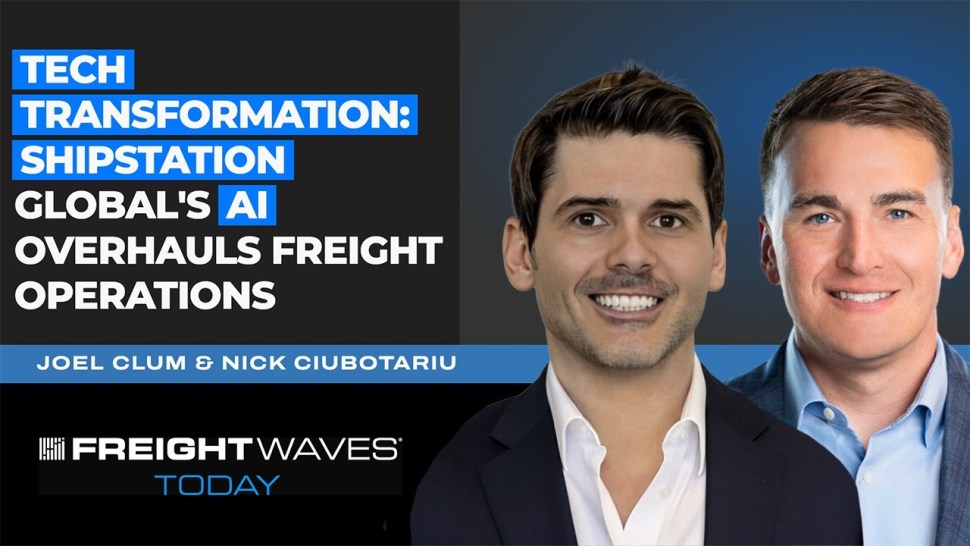
The freight industry faces unprecedented challenges, from complex peak season demands to surging cargo theft. In this exclusive interview, ShipStation Global’s Joel Clum and Nick Ciubotariu reveal how their innovative AI-powered platform is transforming logistics. Discover how specialized AI agents automate everything from quoting to booking, enhancing security, and empowering shippers to navigate an increasingly complex supply chain with Fortune 100 capabilities. Learn why staying hyper-vigilant against fraud is critical and how cutting-edge tech is delivering real, measurable impact.
ShipStation Global has deployed more than 250 purpose-built AI agents across its freight operations, with one agent handling the full cycle from an emailed quote request through carrier selection and shipment booking — all without a human dispatcher in the loop. The company, formed from the combination of legacy WEX Group and Octane, says the system is already in production and handling real customer requests, including a Sunday evening inquiry from a China-based shipper that was resolved end-to-end within minutes.
The scale of the deployment sets it apart from narrower AI pilots common elsewhere in the industry. Rather than a single bot, ShipStation’s CTO said the company built a dedicated AI platform for its engineers to develop custom skills that train specifically on freight data and retrain on subsequent actions. “Anybody can deploy an AI prototype, but getting as many AI features to production as we have with the consumption that we’re getting doesn’t happen overnight,” the CTO said.
“We actually have over 250 agents that take action on behalf of our customers. And one thing that we’ve deployed is an agent that essentially takes a quote from being mailed and executes it itself. And instead of a customer having to wait for somebody to respond through the weekend or whatever, it’s done in minutes.”
The agent-based architecture makes real-time routing decisions by reading internal systems and third-party platforms. Joel Clum, chief commercial officer of ShipStation Global, described a scenario in which an agent checks Salesforce, determines that a specific LTL carrier does not offer pickup at a given location on a given day, and automatically assigns an alternate carrier — all within the lifecycle of a single shipment transaction.
Beyond shipment execution, ShipStation has rolled out AI-assisted sales prospecting. Sales representatives now log into a single platform each morning and receive a prioritized list of 50 vetted, opportunity-scored prospects. The system also flags stalled deals and surfaces them to area sales managers. Clum framed the company’s overall approach as a business strategy enabled by AI rather than an AI strategy pursued for its own sake, with the goal of helping its more than one million annual customers “operate and act like they’re a Fortune 100 enterprise.”
SMB shippers are a particular focus. Clum noted that smaller shippers typically lack the staff and technology budgets to build such capabilities internally, making the platform a meaningful operational step up. The AI tooling also feeds into carrier vetting, an area of growing concern as cargo theft rises. Clum said ShipStation works with shippers on high-value loads — including electronics worth multiple millions of dollars and refrigerated freight valued at $250,000 to $500,000 — and that vetting rigor has “increased dramatically,” with security protocols for certain loads including escorts and checkpoint verification.
On the market, Clum said ShipStation is seeing strong volume growth heading into peak season across truckload, LTL, and parcel, with LTL benefiting from spillover out of a constrained truckload market. He added that larger enterprise shippers are deepening existing broker and carrier relationships rather than adding new counterparties, citing liability and cargo theft risk as primary drivers of that consolidation trend.
- ShipStation Global has more than 250 specialized AI agents in production, including one that books shipments autonomously from an emailed quote request in minutes.
- The company targets SMB shippers, aiming to give customers with limited logistics staff access to enterprise-grade automation across quoting, booking, carrier selection, and sales prospecting.
- Cargo theft concerns are driving enterprise shippers to deepen existing broker relationships rather than add new carriers, with vetting rigor rising sharply for high-value and refrigerated loads.
This Summary is generated thanks to a transcription of the interview, for the full interview please enjoy the video above.
