




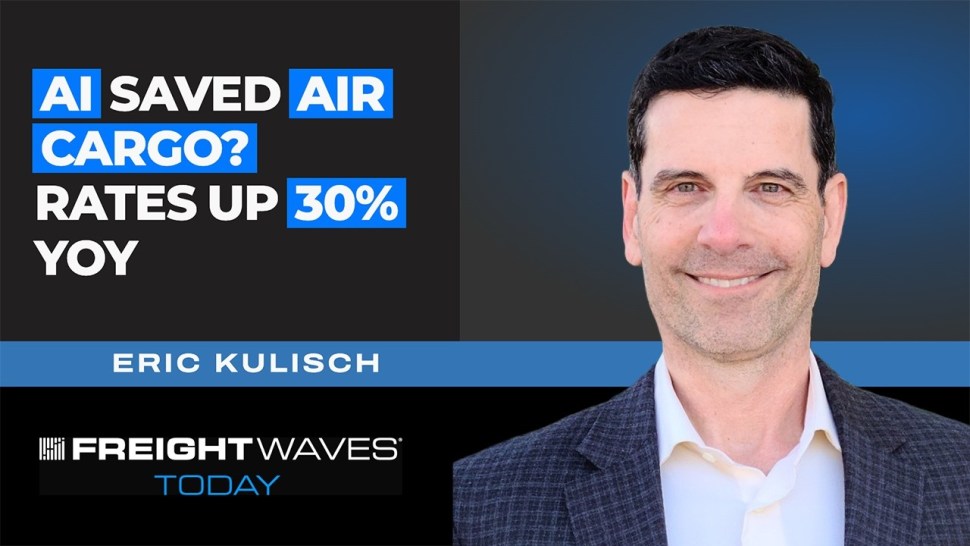
AI isn’t just for chatbots—it’s fueling a surprising boom in air cargo, preventing an anticipated recession. FreightWaves’ Eric Kulisch breaks down how global disruptions and AI equipment demand are driving rates up 30% year-over-year and volumes up 6%. Plus, find out how drone delivery leaders like Wing and Zipline are expanding partnerships with Walmart, racing to scale ultra-fast logistics ahead of new FAA regulations.
Air cargo rates are up 30% year over year and volumes have grown roughly 6%, driven by a combination of ocean disruptions, reduced Middle East carrier capacity, and surging demand for AI-related equipment, according to reporting from FreightWaves. The market’s strength has surprised analysts who expected a significant softening in 2025 following the post-COVID hangover of 2024.
The single biggest structural shift keeping air freight aloft is the rise of AI hardware shipments. As stricter customs and regulatory treatment of de minimis imports curtailed business-to-consumer parcel flows into the U.S. and Europe, AI equipment demand stepped in to fill the gap. Freight forwarder Kuehne+Nagel has also flagged slower automotive exports out of Europe as an additional headwind that AI cargo is helping to offset.
“We thought this year would be a lot softer, but it hasn’t — growth has been quite robust,” said Kulisch.
Two years ago, the de minimis crackdown was widely predicted to crater air freight and parcel volumes. That contraction never fully materialized. After a down year in 2024 as the COVID shipping boom faded, the market rebounded sharply at the end of that year and has continued through 2025, defying earlier bearish forecasts.
On the drone delivery front, Walmart is pursuing a hybrid strategy, deploying both Wing — an Alphabet subsidiary — and Zipline across nearly 300 stores nationally. Zipline last week announced a $1.5 billion funding raise, earmarked in part for manufacturing scale-up, while Wing said it will invest $125 million in a Texas factory to build delivery drones, with plans to eventually produce tens of thousands of aircraft.
All of this activity is building toward anticipated FAA rulemaking that would establish clearer operating standards for beyond-line-of-sight drone flights. Currently, operators must obtain individual waivers to fly drones outside a direct operator’s line of sight, limiting deployment scale and geography. New rules are expected to significantly accelerate commercial rollout.
The competitive landscape for last-mile drone delivery is sharpening around Walmart, Amazon, and DoorDash, each racing to operationalize so-called quick commerce — 30-minute or faster delivery — which carriers and retailers believe drives higher consumer engagement and loyalty. For heavier payloads between cities, autonomous aircraft capable of carrying several hundred pounds are seen as the more viable middle-mile solution, while lightweight drones carrying approximately 5 pounds remain the near-term tool for doorstep delivery in suburban markets.
- Air cargo rates are up 30% year over year and volumes have grown about 6%, with AI equipment demand offsetting slower e-commerce flows.
- Wing plans a $125 million Texas drone factory; Zipline raised $1.5 billion — both ramping manufacturing ahead of anticipated FAA beyond-line-of-sight rules.
- Walmart is deploying both Wing and Zipline across nearly 300 stores as retailers race to offer 30-minute drone delivery.
This Summary is generated thanks to a transcription of the interview, for the full interview please enjoy the video above.
